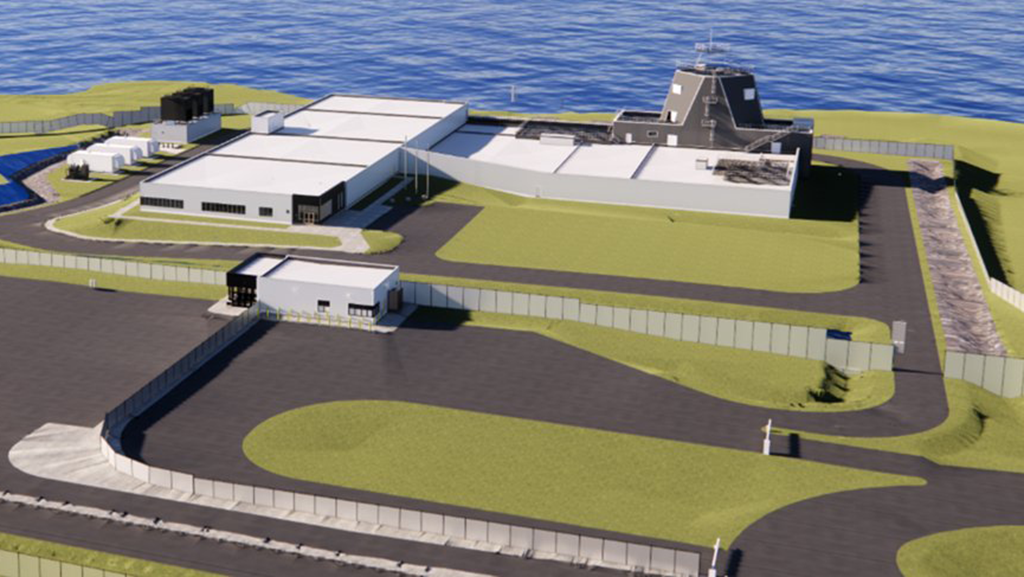
Construction is well underway on a major new military testing complex on Canada’s Atlantic coast, a project that blends complex building engineering with coastal environmental protection.
The highly specialized Land-Based Test Facility (LBTF) at Hartlen Point in Eastern Passage near Dartmouth, N.S., being built by the Department of National Defence (DND), will support the government’s new fleet of River-class destroyer vessels being made for the Royal Canadian Navy.
The project is one of the most technically focused defence infrastructure builds currently underway in Atlantic Canada. When completed in 2028, the site will serve as a full-scale testing environment where advanced shipboard combat systems can be integrated and validated before being installed on the new destroyers.
PCL Construction of Dartmouth was awarded the contract. Work began in November 2025 and is expected to sustain approximately 200 jobs over the duration of the build.
“Having the right infrastructure in place to support a modern naval fleet is mission critical,” National Defence Minister David McGuinty said in a statement. “This facility represents an important step in the River-class destroyer project. Once completed, it will play a vital role in bringing the new ships into service and preparing our personnel to work with the incoming ship systems.”
The main structure of the complex will encompass 12,567 square metres across two floors. In addition to the primary building, the 10-hectare site will include a 32-square-metre gatehouse, a 271-square-metre guardhouse, parking areas, access roads, security fencing and supporting utilities.
Because the building will house sophisticated testing equipment and electronic systems, its design had to advance in parallel with the destroyer program itself. Detailed ship specifications were required to ensure the facility could accurately simulate the vessels’ combat system architecture.
To keep the schedule moving while engineering designs were still evolving, DND adopted a phased construction approach. Site preparation began in 2023, two years before full construction started.
Those early works included brush clearing and tree removal, installation of access roads, grading operations and the extension of municipal services. Culverts were installed to manage drainage, while excavation and backfilling work prepared the ground for structural foundations.
Subsequently, concrete footings and foundation walls were installed, along with retaining walls and the structural cores for elevator and stair shafts.
Because of the coastal terrain and environmental considerations, engineering has been a major component of the project. A detailed soil characterization study was carried out before construction began. The analysis found no widespread contamination across the site, allowing most of the excavated soil to be reused locally during grading and backfilling.
A trench system was installed to collect runoff generated by heavy rainfall and construction activity. Instead of directing stormwater through extensive underground infrastructure, the trench releases water gradually toward the shoreline. This controlled-flow approach reduces erosion.
Shoreline stability has become a key consideration for the facility. The main building will sit more than 90 metres from the ordinary high-water mark, while the permanent security fence will be positioned approximately 52 metres from the shoreline. Even closer to the water is a stormwater outfall control trench located between 19 and 28 metres from the high-water line.
Before the final design for shoreline stabilization can be implemented, an additional environmental assessment process is underway. The goal is to ensure the new infrastructure can withstand decades of coastal change while protecting surrounding ecosystems.
Despite the active construction site, DND has maintained public access to surrounding areas at Hartlen Point, which are popular for outdoor recreation including fishing, hiking and birdwatching.
Temporary construction fencing, signage and concrete barriers mark the perimeter of the site. Security personnel and roving safety spotters monitor the area to ensure members of the public remain outside the construction zone. A commissionaire is stationed at the access road around the clock to manage vehicle movements and maintain site security.
To mitigate dust, noise and traffic caused by construction on nearby communities, project planners have introduced several mitigation measures. Heavy equipment traffic along the access road is carefully managed to minimize congestion and maintain safe vehicle movements.
Dust suppression measures are also being used. These include watering exposed soils and managing stockpiles to prevent wind-blown dust from spreading beyond the construction zone.
Contractors are also co-ordinating the timing of high-noise activities such as heavy excavation and concrete work to limit disruption whenever possible.
Canada has the longest coastline of any nation on earth. DND says the new River-class will allow the Canadian Armed Forces to continue protecting Canadian waters, contributing to international naval operations and addressing evolving maritime security challenges on behalf of Canadians.
The federal government plans to build 15 River-class destroyers to replace aging Halifax-class frigate vessels and the retired Iroquois-class destroyer fleet.
The complex electronic systems on these ships must be integrated, calibrated and tested before they are installed aboard the vessels themselves. The Hartlen Point facility will provide that capability.
The building will eventually be named HMCS Assiniboine, honouring one of Canada’s historic naval ships.