For all the progress made by factory-built modular housing over the past few years, systemic obstacles remain frustrating for both developers and manufacturers.
Federal and provincial governments are promoting, and even sponsoring, modular housing developments of various sizes. They also oversee the quality and manner in which prefabricated homes are built through their building codes.
However, municipalities hold “frontline power” in the form of local zoning bylaws and land-use planning. That means they can use these tools to effectively restrict or “ban” modular home developments in certain areas. Only if a municipality’s bylaw conflicts with provincial legislation or a provincial Minister’s Zoning Order, can it be overruled.
A case in point recently occurred in the City of Port Alberni on Vancouver Island. The Globe & Mail reported last month a modular housing development planned alongside a picturesque creek was turned down by the city. That’s because under the city’s current zoning regulations, modular homes are lumped in with trailers and similar types of temporary homes and therefore not permitted.

The site purchased by the developer was, in fact, a former trailer park. However, it had been rezoned for multi-family housing by the previous owners. The new plan was to erect 31 factory-built homes that would sell in the range of $700,000. Now, given the city’s refusal to approve the plan, the developer intends to walk away and sell the lots individually.
“Legally, municipal powers and responsibilities are set by provincial governments,” says the Institute of Municipal Finance and Governance. “Across Canada, each province and territory has its own set of legislative and regulatory frameworks that control municipal housing functions, often in highly restrictive ways.”
Although municipalities are usually focussed on foundation elements, utility connections, site drainage and the like, their rulings can go much further. These can permit local governments like Port Alberni to, amongst other things, control the mix of commercial, residential and agricultural uses within their boundaries.
They may also impose minimum dwelling size requirements, frontage rules, height limits and density caps, and whether a prefab home will be permitted as a primary dwelling, secondary suite, laneway home, garden suite or accessory dwelling unit.
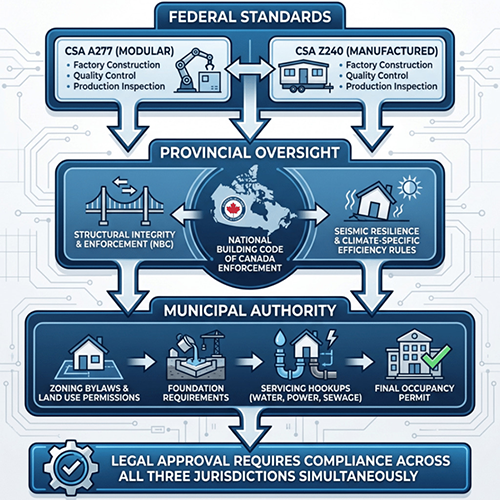
As the Port Alberni incident illustrates, municipal zoning bylaws and approvals can be a major barrier to modular home placement.
The motivation to restrict the construction of modular housing is often founded in old-school thinking. Despite the fact modular, factory-built homes can be attractive and extremely well-built permanent structures, some element of public opinion still maintains they are cheap and ugly, or unhelpful to the regional economy by reducing the content of local labour and trades.
These prejudices can be disproven with facts. They also fly in the face of Canada’s housing shortage, rising costs and the various efforts by higher levels of government to increase housing supply through modern production methods.
Off-site manufacturing also helps to reduce the carbon emissions associated with construction through the heightened efficiency of factory work and by significantly speeding up onsite work.
The maze through which even the modular manufacturer has to pass in order to have their structures approved is a concern to groups like the Canadian Chamber of Commerce.
“A builder operating a single facility but aspiring to serve customers nationwide is forced to untangle a mess of different provincial, territorial and municipal code interpretations,” writes policy adviser Olha Sotska. “This approach to regulation creates uncertainty, slows down operations, increases costs and limits product availability.
“Canada’s residential construction sector can’t solve the housing crisis with innovative new technologies like modular housing while operating in a fragmented, constantly shifting regulatory environment,” she continues. “It’s time to stop the rule‑changing roller-coaster and give builders the certainty they need. Consistent nationwide standards that follow a predictable, regular schedule for updates will allow the residential construction sector to innovate and scale with confidence, and finally build the affordable houses hopeful homebuyers are waiting for.”
It is estimated about five per cent of British Columbia’s housing today is modular. Nationally, that figure is estimated to be as high as seven per cent and growing. Although still a far cry from countries like Sweden where modular housing levels are over 80 per cent, the Real Estate Institute of Canada predicts a CAGR of 6.7 per cent in Canada.
Despite this growth prediction, some who have invested in modular manufacturing facilities have struggled. Bruce Bell, founder of London, Ont.-based Facit Homes announced in early March the company’s doors would close.
“The housing market has stalled. Rising build costs and higher interest rates mean fewer people are building homes.”
He added Facit had “pivoted toward multi-unit schemes and a scaled version of our manufacturing approach — but timing matters. VC (venture capital) appetite is at a long-term low and developer demand has slowed dramatically.”
Zoning incidents like those reported from Port Alberni and the plight of modular factories like Facit are unfortunate roadblocks to the further development of modular housing in Canada.
John Bleasby is a freelance writer. Send comments and Climate and Contsruction column ideas to [email protected].