A long-anticipated, $200-million event centre in downtown Sudbury is moving from concept to concrete.
Hoarding has been installed around the building site and several drill rigs have been brought in to begin the first major phase of work, installing hundreds of micropiles for the foundation of the new arena.
Over the next few months, as many as 500 steel pipes, each extending as deep as 57 metres below grade, will be installed to support the foundation of the three-level, 200,000-square-foot venue.
The micropiles will be drilled through layers of soil before reaching bedrock, where they will be secured and filled with high-strength grout and concrete to form the backbone of the structure.
The work is being carried out by Marathon Underground Constructors Corporation, whose crews are operating specialized mast articulation drill rigs.
Workers are welding together segments of steel casing as each pile advances deeper into the ground, a process that requires precision co-ordination between equipment operators, welders and labourers.
The complexity of the site has made the work particularly demanding. Subsurface conditions vary significantly, with soil depths ranging from 30 to more than 50 metres before bedrock is reached.
Variations in bedrock topography across the site necessitated detailed planning and exploratory drilling. Engineers chose to use micropiles instead of traditional driven piles, as the drilling method minimizes vibration and better suits the softer ground.
The piles will take five months to install. As sections of piles are completed, additional teams will move in to begin forming and pouring concrete.
Amy Tippin, communications and engagement adviser at the City of Sudbury, said in a statement prepared for the Daily Commercial News that the project is progressing well.
“Four mast articulation drill rigs, along with their crews, are currently onsite, accompanied by carpenters and general labourers,” she said.
Once the foundation work is sufficiently advanced, attention will shift upward. Structural steel installation is expected to begin in the fall. Wall and roof assembly is slated to follow by the end of the year.
The venue is expected to open in fall 2028.
The project site, bounded by Brady, Van Horne, Shaughnessy and Minto streets, sits directly across from the existing Sudbury Community Arena. Dignitaries attended a groundbreaking at the site recently and highlighted the importance of the centre to the city’s downtown master plan.
Mayor Paul Lefebvre described the event centre as a generational investment, emphasizing its role as both a gathering space and an economic driver and a venue that will shape Sudbury for generations.
“It’s about bringing our community together, in a space we can all be proud of,” he said.
The facility will serve as home to the Sudbury Wolves of the Ontario Hockey League. The arena is designed with flexibility in mind, offering seating configurations for a wide range of events, from hockey and basketball to concerts and theatre productions.
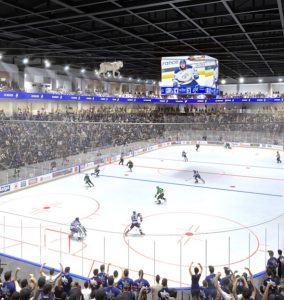
“Our local team here is rooted in Sudbury,” said PCL Construction area office manager John Schmalz. “Many of us are Wolves fans, lifelong residents and proud Northerners. We are building for our neighbours, our families and our shared future.”
Plans call for approximately 5,800 seats for hockey, expanding to 6,200 for basketball and up to 7,200 for centre-stage events. The building will also feature a two-level main concourse, seven dressing rooms, dedicated team facilities and extensive back-of-house infrastructure capable of supporting large touring productions.
Brisbin Brook Beynon (BBB) Architects in partnership with J.L. Richards & Associates Limited, an engineering, architectural and planning firm with a longstanding presence in Sudbury, has been retained as the architect for the venue.
Chris Riely, a partner at BBB, said the new venue will enable more people from diverse backgrounds “to come together and forge memories that they’ll keep for a lifetime.”
Sustainability and accessibility have been integrated into the design. The facility will include multiple elevators, accessible seating across all floors and carefully considered sightlines for mobility device users. Environmental features such as energy-efficient systems, electric ice resurfacers and net-zero-ready elements are also part of the plan, alongside Indigenous design influences reflected in the building’s form and ceremonial spaces.
The architectural team has drawn inspiration from northern materials such as copper and cedar while selecting durable, high-performance alternatives suited to the local climate.
Construction is being overseen by PCL Construction under a construction management delivery model, a decision city officials say is critical to keeping the project on schedule and within budget.
Unlike traditional design-bid-build approaches, the model allows construction to begin before all design details are finalized. The city says by bringing the construction manager into the process early it enables closer collaboration between the designers, engineers and builders. The overlap allows for early identification of risks, continuous cost estimating and more efficient sequencing of work, particularly when it comes to complex elements such as foundations.