Canadians’ growing passion for pickleball is breathing new life into everything from vacant big box stores to empty office spaces.
According to a January 2025 survey by Pickleball Canada, 1.54 million people are playing the sport. Ontario has the highest number, with an estimated 598,900, while Quebec is second with approximately 315,000 players.
Steven Fry used to work constructing hospitals, but is now founder and president of the Pickleplex Social Club. In early 2025, Pickleplex opened its first facility in Barrie, in a former Sears store that had been vacant for years. Barrie is Fry’s hometown.
Pickleplex Social Club now has 13 locations across Canada, with five more slated to open by mid-summer, representing a blend of corporately owned and franchised locations. Some are year-round indoor facilities; others are seasonal outdoor clubs that operate from spring to fall.
As word got out about Pickleplex revitalizing underused spaces, Fry says landlords began reaching out, eager to turn vacant or non-traditional retail areas into something vibrant and community-focused. One was a landlord who owned a 7,000-square-foot empty structure next to the York Mills subway station in Toronto. Now it houses three full-scale courts, after sitting unused for decades.
Pickleplex uses the same surface installer, Courtship Sports, for all its clubs, to have the same playability on their courts, then puts out RFPs for the renovation work. The makeovers cost anywhere from several hundred thousand to $1-million-plus.
“The first thing we ask is, does the space works in terms of location, then does it make sense. Can you fit courts in? Are columns too close together?” says Justin Farbstein, co-founder and chief development officer for Pickleplex Social Club. “In the suburbs, we are less likely to take on an interesting site and are more likely take on a big box retail site. If we are doing something in downtown Toronto, where there is not as much readily available, we have to think outside the box. Most stuff downtown is too expensive or the ceilings aren’t high enough.”
Among Pickleplex’s Toronto facilities is seasonal club, set to open in May on the fourth floor of a parking garage at the Shops of Don Mills. There’s another seasonal pop-up club in downtown Toronto at The Well. A year-round club is located in an old airplane hangar at the former Downsview air base.
Since the Pickleplex Social Club at the Shops of Pickering Centre opened in March 2025, more than 13,000 people have come through the door.
Dunpar Developments has owned the 500,000-square-foot Sheridan Mall in Mississauga since 2018. Built in 1969, it’s one of the oldest malls in the city. It’s been renamed Sherwood Village and will be the centrepiece of a master-planned community with a mix of housing styles.
In 2019, Dunpar lost a major office tenant that occupied 80,000 square feet, says Harpreet Bassi, vice-president of finance. A badminton club took over 30,000 square feet of that space. Dunpar considered a kids’ play area and rock-climbing zone for the remaining 50,000 square feet, before settling on pickleball and found an operating partner in Rally.
Transforming the space was difficult, as it had offices, boardrooms, carpeting and mechanicals designed for office purposes.
“The demolition was the big job, then laying out mechanicals and electrical system. It was a nine to 12-month process,” says Bassi. Cost of the renovation was about $2 million.
Transforming a space into a pickleball court is “a lot more art than science,” notes Farbstein.
“It’s a big undertaking. You have to build a proper floor, have pro lighting. Anyone can slap a crappy court in the ground. A lot of people try to do it, then can’t figure it out. It’s a lot more difficult than people realize.”
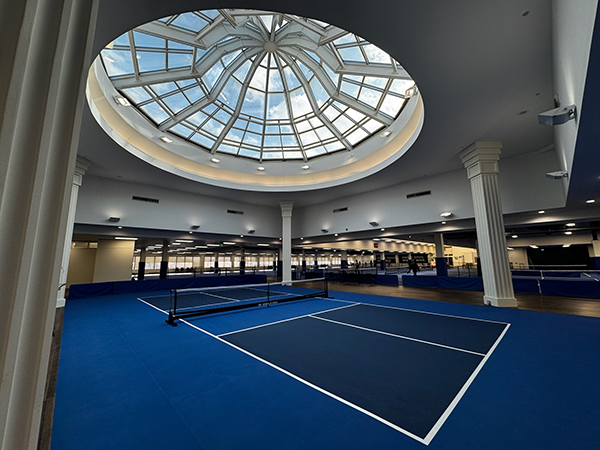
The goal for the Sherwood mall was to have as many courts as possible in the space (16), says Bassi. The half dozen pro courts have ceiling heights of 20 feet, while areas with lower ceilings are used for lessons and corporate events. Four pro courts are in a former corridor, with one of the mall’s domed skylights above.
“We thought the space might have to be torn down, but we’ve been able to repurpose it,” says Bassi. “The pickleball club is on the second floor, and below it at ground level is a space that may become a gym, adding more synergy.”
Fairgrounds is another Canadian company that has transformed multiple malls and other spaces into clubs for pickleball and padel (another up-and-coming racquet sport). Its permanent flagship facility opened in 2025 in a building that housed a Mercedes-Benz dealership in Toronto’s Leaside neighbourhood, and some of its other clubs are in malls, such as the Cataraqui Centre in Kingston, Cloverdale Mall in Toronto and the Capilano Mall in British Columbia.
“Pickleball is bringing new communities to what were dead spaces,” notes Fry.