A recent feasibility study comparing concrete to mass timber designs for a 12-storey residential rental building in Dartmouth, N.S., showed some surprising results for the development team.
Mass timber came in 8.39 per cent more expensive than concrete, but the study revealed the gap can be narrowed through several factors, including a much shorter construction schedule.
While a two-month savings on completion was found for mass timber, says Joe Nickerson, partner and vice-president, Sidewalk Real Estate Development, the project’s developer, says “there is a clear pathway” to delivering a mass timber structure even four to six months ahead of concrete.
Mass timber savings are also gained through a lighter foundation, the study revealed.

“This is not a theory-based, one-sided view, it is a real development that we’re looking to go forward with. We like that this study is putting the conversation out there of what the actual costs are of a real project.”
While Sidewalk may favour mass timber for the purpose-built rental, the developer faces a number of hurdles before it can make a final decision on the building type that could be in the ground within the year.
“The challenge in the project schedule is, ‘Can the other trade components catch up to a quicker- erected structure?’” Nickerson says. “We didn’t want to set a too aggressive schedule.”
They study found the window walls, mechanical and electrical to be equal for both designs, but builder’s risk insurance premiums for concrete were lower, ranging from $250,000 to $475,000 compared to $475,000 to $750,000 for mass timber.
BIM could be incorporated into a mass timber design to add efficiencies among the various disciplines, the study concluded.
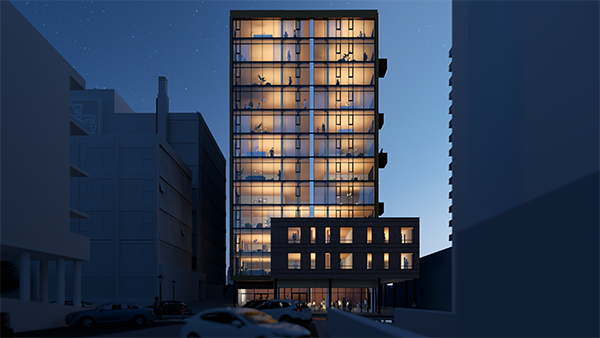
The Dartmouth mass timber tower would be the first of its kind above six storeys in Atlantic Canada.
Nickerson says Sidewalk will have to make a decision in the next few months on which medium to choose.
The post-and-beam timber building would be a composite of CLT and glulam, possibly with concrete cores/stairwells and a concrete foundation, he says.
“A really pleasant surprise for us is the ability to expose versus encapsulate the mass timber through a straightforward design path taking an alternative compliance approach.”
Nickerson says mass timber’s higher rents and earlier occupancy drop its costs to near par with concrete. The figures are based on Sidewalk’s “conservative calculations,” including keeping exposed‑timber suites priced at only about a $50‑per‑month premium over standard drywall units.
“With affordability at a stretch for a lot of people, we don’t think they have a lot of extra money to spend a month on rent,” he says.
While the study helped steer Sidewalk toward a preference for mass timber, the developer says the decision on which medium to choose could be determined by a zoning change to allow a 12-storey timber structure on a site that is currently capped at 10 storeys.
“It would be enough to push us to mass timber,” he adds.
Another potential tipping point, he says, would be obtaining federal grant funding to offset some of the early capital costs, such as for the prefabricated, spec-designed modular build.
“You’re paying for a lot of those costs early, whereas with concrete the formwork happens onsite and those expenses occur later in the project,” in keeping with traditional payment flows in construction, points out Nickerson.
The developer highlights mass timber’s lower embodied carbon compared with concrete as a key driver behind Sidewalk’s decarbonization strategy.
He says Sidewalk’s sister firm Pilot Build Co. worked on construction costing and scheduling details for the project and the developer teamed up with WoodWorks Atlantic, which funded the study.
ASPECT Structural Engineers was the engineer and Fathom Studio did the architectural design for both structures.
Nickerson says mass timber fits Sidewalk’s neighbourhood-style development image because it is largely built off-site, is erected quickly and with less noise and pollution than traditional construction.
“If it works on this site, we are really keen to roll out in other downtown (Halifax) infill areas where there are a lot of neighbours and tight sites.”