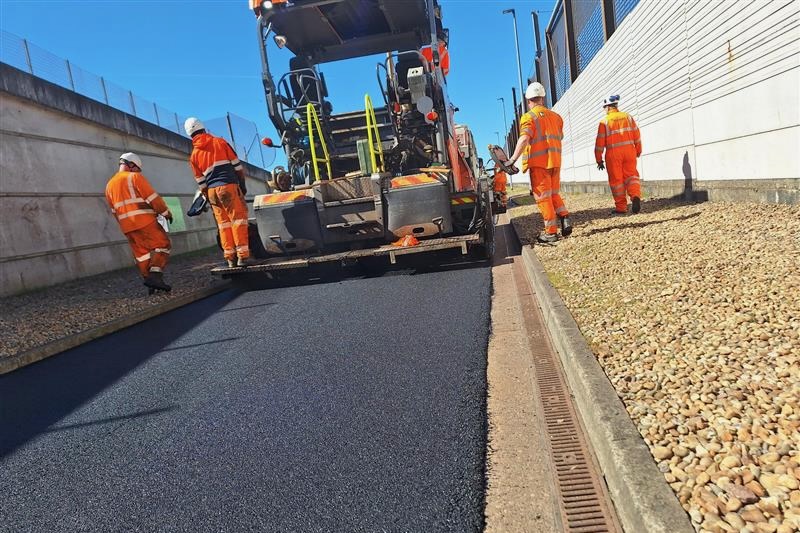
The company recommended the use of its Tufflex asphalt with CarbonLock bio-binder containing a CleanAir additive and produced using its Era 140 warm mix process to provide a complete sustainable solution. This cut carbon emissions by more than a quarter, compared to Eurotunnel Services Ltd’s original SMA specification.
Tufflex asphalt offers high resistance to deformation, improving durability, and provides good skid resistance. The CarbonLock binder contains biogenic materials that absorb and store CO₂ from the atmosphere during their life. This CO₂ is permanently ‘locked’ into the asphalt, even when it is recycled at the end of its life, reducing the carbon footprint of the asphalt.
In addition, the binder also contained CleanAir, an additive which reduces the release of specific gases and particulates into the air by up to 40 per cent. This minimises the impact of production and laying on local air quality and helps neutralise odour, which is particularly beneficial for use in tunnels and ultra-low emission zones.
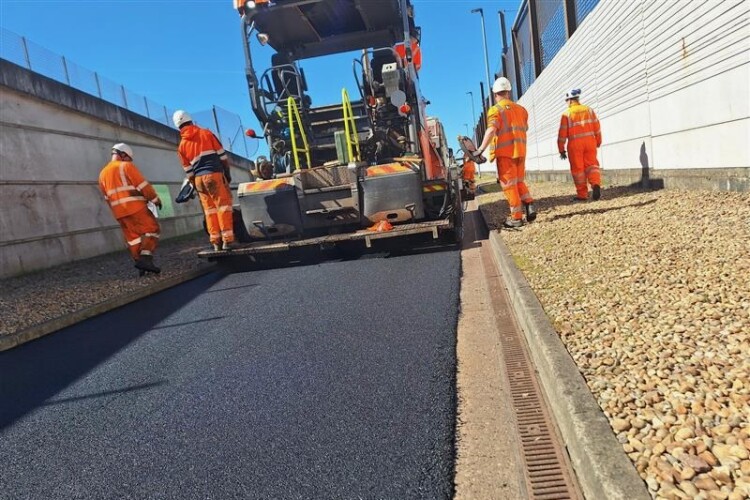
The asphalt was produced at the company’s nearby Allington plant using Heidelberg Materials’ Era 140 warm mix asphalt (WMA) process. This allows the material to be produced at up to 40ºC lower temperature than conventional hot mix asphalt, saving fuel and helping to cut the CO₂ emissions associated with production by up to 15 per cent. The lower production temperature also improves working conditions and allows faster completion of work, which was vital for this project.
In total 140 tonnes of asphalt was used to resurface around 1,600m2 at the entrance to the service tunnel and in front of the emergency response vehicle garages, with the worn out surface being removed and recovered for re-use.
The project also required the use of walking floor HGV, rather than tippers, due to the safe working height restrictions of the adjacent main tunnel high powered electricity cables.
Got a story? Email [email protected]