The State of Texas faces long-term water shortages resulting from recurrent droughts and continued residential and commercial development. In the immediate term, no city is threatened more by a water shortage than Corpus Christi on the Gulf Coast.
The severity of the problem is detailed on the city’s website. Even taking into account expected rainfall and the water available from reservoirs and reusable sources, a “Level 1 Emergency” is projected for September this year and possibly even sooner.
Under its provisions, water customers could be forced to reduce their overall use by 25 per cent or face extra fees. A Level 1 Emergency could even trigger an evacuation of residents and could also challenge major commercial operations like the Port of Corpus Christi, the nation’s top port for crude oil exports, causing shutdowns and layoffs.
The speed at which Corpus Christi’s water problem has developed coincides with the rapid development of shale oil extraction in Texas over the past 10 years, along with continued industrial expansion in the Corpus Christi area.
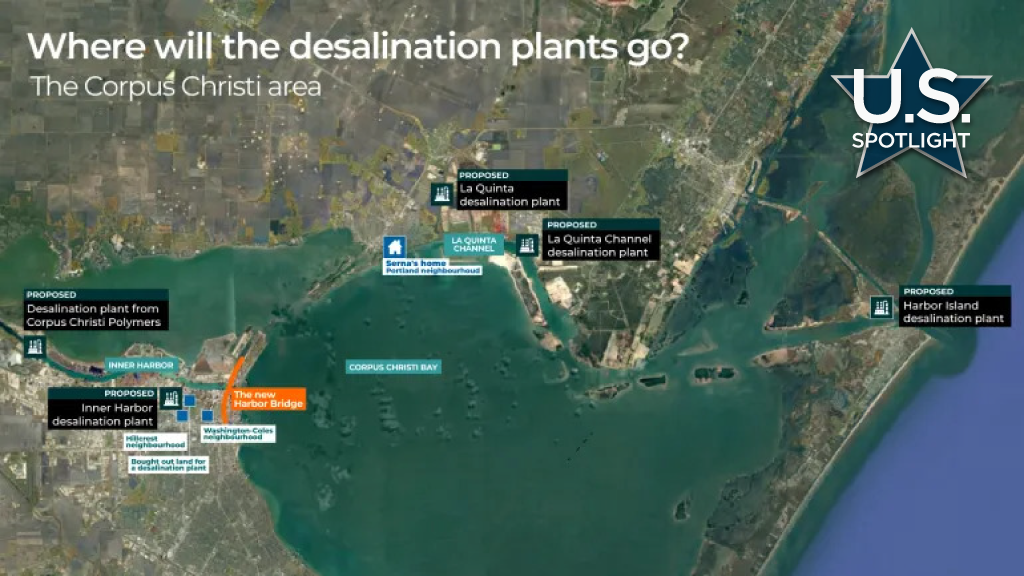
In 2017, desalination seemed to be a good solution to cope with increased water demands. Plans were presented to the city in 2019 to build the Inner Harbour desalination plant. While initially expecting to process 10 million gallons per day, it was soon recognized that more water would be required.
The planned capacity was expanded with estimated construction costs increasing alongside. Other questions were raised surrounding the potential ecological damage to Corpus Christi Bay caused by the desalination process.
By 2025, cost estimates for the Inner Harbour desalination plant had soared to $1.2 billion and its planned capacity growing to 30 million gallons per day. Council balked and shelved the project, despite plans already approved by council in October 2024 along with the securing of permits and state funding through the Texas Water Development Board.
Like many, Sean Strawbridge, former CEO of the Port of Corpus Christi Authority, was upset by the apparent lack of preparation taken by the city over the years, resulting from what he said was municipal inexperience and failure to recognize the risks.
“This should be no surprise to anybody,” Strawbridge told Inside Climate News. “We were talking about this over a decade ago. They’ve found themselves in quite a dire predicament as a result of those poor decisions. Time is up.”
There are not many options left to address the immediate crisis. However, the city says it has $1 billion funding available for water projects to address current needs.
Corpus Christi’s city manager Peter Zanoni told a March council meeting the city was refining its drought plan for reducing consumption. The “honor system” would be used to reduce water use, he said, and the city would not shut off people’s water supply. In the meantime, Zanoni was optimistic the city’s water supply was not near collapse and that several new water projects would be launched later in 2026.
“We’re not running out of water. This is no time to panic.”
Some of these new projects likely involve increased water drawn through the city’s main pipeline from Lake Texana and the Colorado River to about 24 million gallons per day.
New wells are being drilled, or are awaiting permits, which could double or even triple that volume if they come on-stream. Another 16 million gallons of drinking water per day could be freed if nearby industrial users switched to recycled wastewater. However, continued permit delays are causing concern.
Even the highest levels of the state have been frustrated by the city’s failure to move ahead with desalination.
Gov. Greg Abbott reportedly said the city has “squandered” more than $750 million in state money earmarked for the Inner Harbour desalination plant.
“Corpus Christi is a victim not because of lack of water,” Abbott said. “They’re a victim because of a lack of ability to make a decision.”
The Governor’s Office even reportedly threatened to cut all funding to Corpus Christi if it didn’t proceed with the plant.
This has put the Inner Harbour desalination plant back on the table. The project is now being led by Corpus Christi Desal Partners (CCDP), a joint venture composed of Acciona Agua Corporation and MasTec Industrial Corporation, along with local partners.
A contract finalizing 60 per cent of the project design, along with a guaranteed maximum price, is projected to be brought before council in early June.“This is a significant step forward in securing long-term, reliable water supply for our customers,” said Nicholas Winkelmann, chief operating officer of Corpus Christi Water. “We are pleased to move forward with a highly qualified team committed to delivering this critical infrastructure project.”
Other plants are also reportedly under consideration in the Corpus Christi area, including the Harbor Island Seawater Desalination Facility Project led by the U.S. Army Corps of Engineers, to be developed by The Nueces River Authority and a private entity. It could provide up to 100 million gallons of drinking water per day through reverse osmosis.
Council has also reportedly opened discussions with AXE H20, a new Houston-based start-up, about their proposal to build a desalination plant that could produce 150 million gallons of drinking water per day at a facility in the nearby Coastal Bend area.