When Hurricane Sandy struck New York City in 2012, it dealt a powerful blow to the city’s infrastructure. Experts estimate the economic losses to be approximately $19 billion. The storm flooded much of the subway system, and the city is still recovering from these losses.
Two of the four East River Tunnels are currently being rehabilitated from this damage through a joint venture with Skanska and E-J Electric Installation. Project leaders began the work in 2024 with the goal to rehabilitate and modernize the 2.5-mi.-long tunnels connecting New York Penn Station and Sunnyside Yard.
The tunnels opened in 1910. The tunnels’ age and the storm damage have shown the need for an overhaul. More than 300,000 passengers use the tunnel to commute into the city for work, business and pleasure.
The East River Tunnel system consists of four single-track tunnels. The Skanska-led team will be rehabilitating two of the tunnels. The project is expected to be completed by 2027.
Among the goals of the work is to rehabilitate tunnels that will last for a century and vastly reduce maintenance plus increase safety for passengers and workers.
Project manager Bridget Arnott explained the careful demolition process to Construction Equipment Guide.
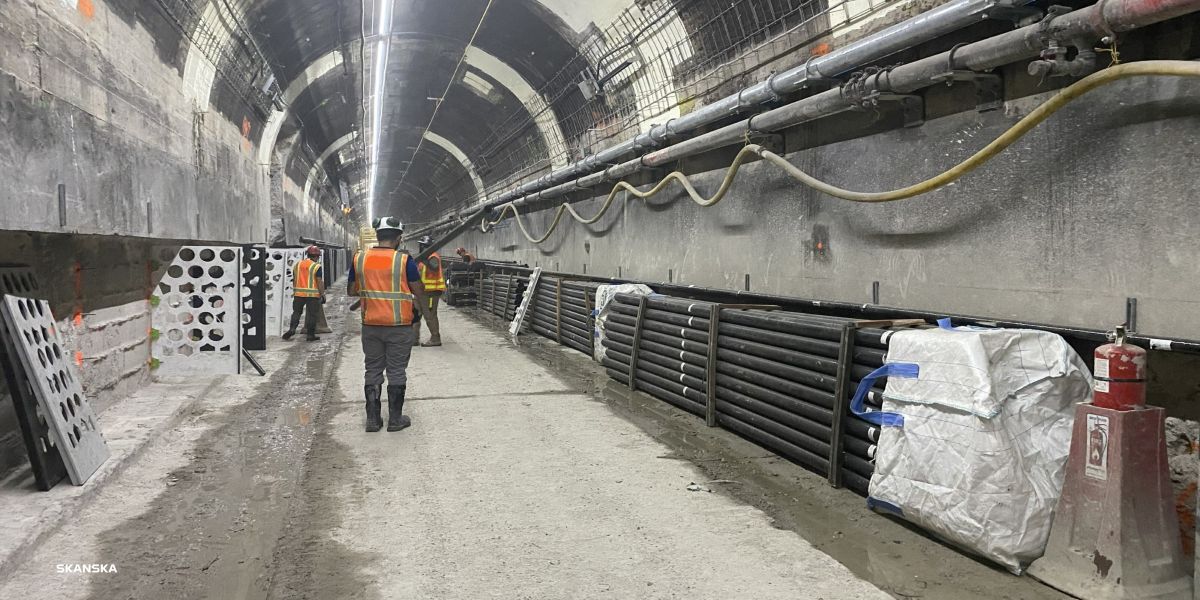
“The operation started with Amtrak decommissioning 100-year-old systems with our support before we began removing the concrete benches,” she said. “We set up devices to monitor the tunnel’s movement and vibration. Our plan was to remove the tunnel’s concrete benches and the electrical duct banks that carry power, signals and communications. The goal was to finish the demolition on time without harming the tunnel’s concrete lining or affecting the nearby live track.”
Workers had to demolish the concrete benches while leaving the tunnel’s concrete liner in place. The existing concrete did not contain rebar, but proved resistant to destruction, having been in place for more than 100 years. All this activity took place inside a single tunnel.
Skanska estimates that it will use 20,000 cu. yds. of concrete for the new bench walls for both tunnels.
Doing work reminiscent of a mining operation, workers used specialized equipment, including remote controlled Brokks in the narrow tunnel.
“As soon as the old concrete benches were removed, our team began installing the formwork for the new concrete benches,” said Arnott. “We also performed state of good repairs to the existing concrete liner of the tunnel. Because of our tight schedule, we had to run several operations simultaneously, which made logistics more challenging.”
The tunnel is as deep as 90 ft. below the East River. Scope includes addressing the existing clay pipes that serve as part of the tunnel drainage system and perform leaking crack repairs using injection. SEJV installed approximately 8,000 linear ft. of leaking crack injection.
A key aspect of tunnel construction is ventilation and fire protection.
“Because this was not a design-build project for us, we decided it would be prudent to build an additional access to the tunnel from 32nd Street for egress and ventilation,” said Arnott. “We determined that we could do that for safety and schedule certainty.”
The team adapted the existing standpipe for construction work. This allowed it to build new fire standpipes while keeping the construction fire standpipe in use. The new system uses mechanical air release valves connected to the Amtrak system. Electric equipment, such as electric buggies and Brokks, has been used to cut down exhaust and improve ventilation.
The new track and concrete track bed will be an upgrade of the old track, which sat on wood ties and ballast.
“The old tunnel ballast was cleared out early,” said Arnott. “We are installing a direct fixation rail system with low-vibration tie blocks.”
Arnott said that the first tunnel is 70 percent complete. She expects that what the team has learned so far will help reduce challenges for next phase, especially with logistics and preparing for the tunnel’s existing conditions. The first tunnel project is expected to take 13 months in total.
In addition to the underground tunnel work, the Skanska-led team will upgrade the tunnel approaches in Queens. Workers also will install signal, traction power and communication infrastructure.
Michael Viggiano, executive vice president of Skanska’s East Coast Civil operations, summarized the firm’s work on the East River Tunnel.
“In collaboration with E-J Electric Installation, Skanska will work to reconstruct and modernize the tunnel infrastructure to achieve the highest measure of quality and safety and improve the travel experience for the thousands of commuters who pass through the tunnel daily.”