
Bamford has been interested in the potential of hydrogen in construction equipment since joining family business JCB in 2003. The question facing the equipment sector, he says, is how to find a solution for site power that replicates current practices.
“Hydrogen you can fill up in a similar manner,” he says. “That does that sounds very simple and that sounds very easy, but it’s not. We don’t think about how we get diesel onto a construction site with a bowser. That’s the way it’s been done for the last 50 years.”
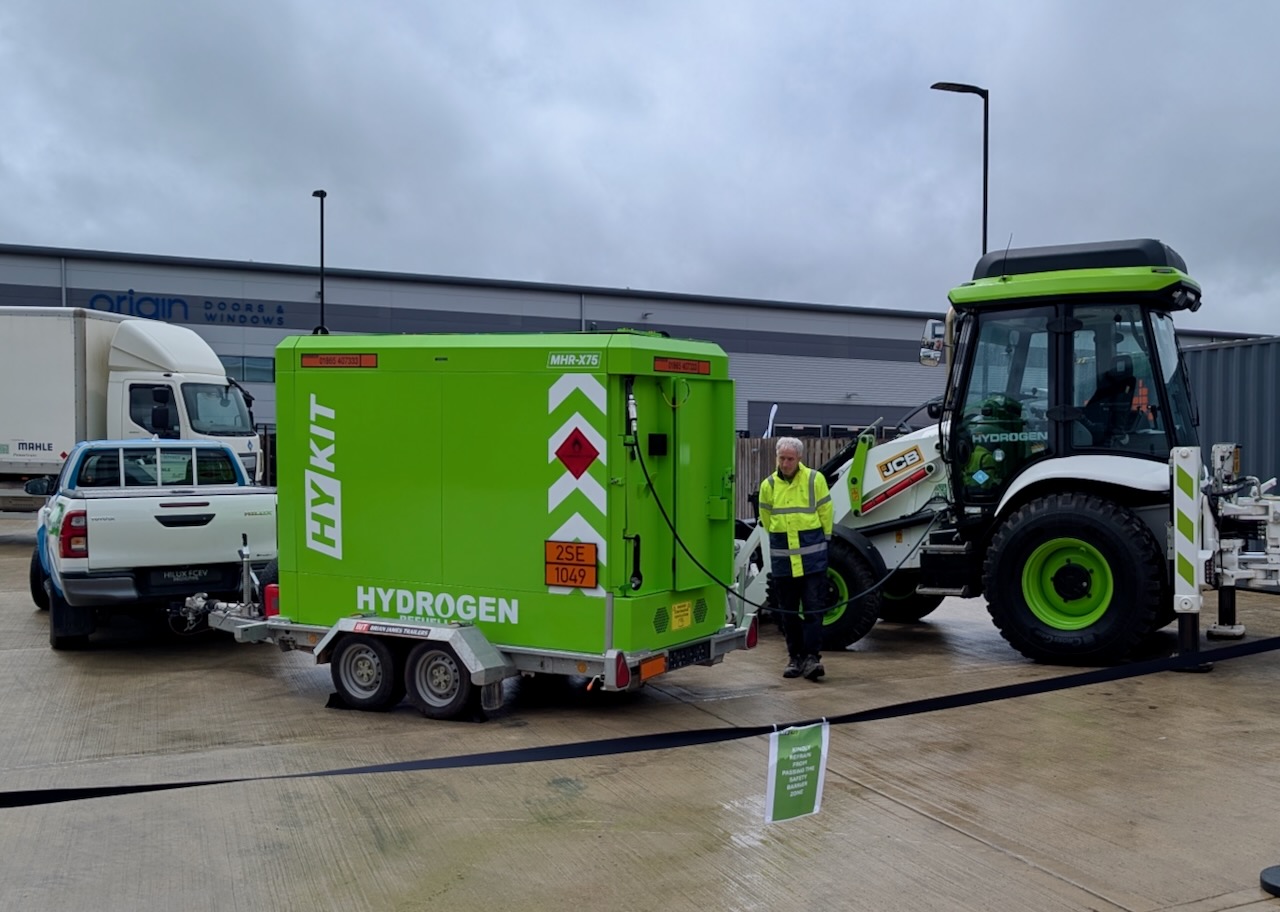
HyKit was launched with this problem in mind. The company’s first product is a mobile hydrogen refueller, the MHR-X75. This stores hydrogen in pressurised tanks, inside a unit small enough to be transported on a trailer, and moved around site using a backhoe or material handler. Brian James Trailers has developed a trailer suitable for the refueller, and Moffett has designed a tailored handler.
It can then be used to refuel site equipment or generators.

“It’s basically a bowser,” Bamford says. “It is a product that you can fill up with on a job site.”
The launch comes as the construction sector is experimenting with the adoption of hydrogen fuel, backed by clients like National Highways and HS2 who are supporting the use of zero emissions equipment on key sites.
The Bamford family business has been a key player in this move, with JCB developing its own hydrogen internal combustion engine, which burns fuel in the same way as a diesel engine, and allows for easier conversion of traditional equipment designs into emissions free use.
“At JCB for instance, they’ve got hydrogen combustion engines, they’re in backhoes and telehandlers and gensets, but you’re also seeing asphalt plants running on hydrogen, excavators running on hydrogen, all sorts of different use cases.”
At the launch of the MHR-X75, guests included Riversimple, who are building a hydrogen city car and planning delivery vehicles, and Swift Aircraft, who are developing hydrogen fuel cell planes.
“They all have one problem,” Bamford says. “How do you fill it up? Where does the gas come from?”
Bamford is working across his businesses to build the supply chain that will get green hydrogen from its source, to the nozzle. “One of my businesses makes hydrogen gas, one of my businesses moves it around, this business manufactures the mobile refueling solution.”
The HyKit factory has capacity to build around 500 units a year, with an initial target of 200. Hydrogen is notoriously leaky, with the small molecules able to pass through the smallest gap. Much of the work at the Bicester factory is conducted in a clean room, with each part inspected before installation to remove even micron-sized particles that could hold a valve open, allowing the gas to escape.

Bamford faces challenges like this across the hydrogen supply chain that he is helping build. “Every element has got to work. Every element has got to show up with the 99% uptime we are used to, and you’ve got to get it to cost the same.
“One of the ways of doing that is having one company like mine that has a business doing every element and then you put enough volume on it and repeatability in one or two areas.”
The refueller aims to prove that hydrogen can be supplied to equipment, with the reliability that the sector needs. But how will it get to site?
One challenge is how the gas will be moved around the country. Electrification has been seen by many as the key element of zero emissions energy sector. But Bamford calls this approach ‘myopic’, pointing out that the grid is just one of three energy networks in the UK, alongside gas pipelines and transport of diesel and petrol.
“The grid is highly congested, everyone wants to double the grid, but the lead times on one of the main components, a turbine, today it’s five years.” If the AI-optimists are right, a massive build-out of data centres looks likely to double demand for components like this, stretching lead times to as much as a decade.
Much of the current demand for energy, whether in domestic boilers or in fuel intensive processes like cement kilns, steel works and glass factories, is met by natural gas. Some have called for a complete switch over to heat pumps in homes, putting this pipeline network at risk of becoming unsustainable.
“You can’t get rid of two [of three energy networks] and make the most congested ten times more congested,” Bamford says. “You need all of them to work all at the same time and you need to drive that cost base down.”
Bamford is investing in ways to generate green hydrogen from sunlight, and ship it around the world and across countries. One way of shipping sunlight is in the form of green ammonia. Ammonia is made up of hydrogen, usable as a fuel, and nitrogen, a key component of fertiliser.
“We have four gigawatts of green ammonia under development in Oman,” Bamford explains. “The cost of solar is cheap there. The green ammonia now from that plant when it’s built will be about $650 a tonne. Grey ammonia is about $500 a tonne.
“So you’re not far [from that price]. And that’s with today’s technology. That’s using today’s electrolyser, which is 55% efficient. Tomorrow’s electrolyser, which is on the test plate, is 85% efficient. That efficiency will take the cost base down.”
There is a clear path to a viable hydrogen supply chain. But the initial work will be costly.
“In the short term, you do need government subsidies,” Bamford says. These will support UK jobs, and the UK’s building materials supply chain.
“There’s two and a half million jobs in heat and energy-intensive industries, that they need to subsidise.”
Another of Bamford’s business, Wrightbus is playing its own part in developing a robust demand base for hydrogen.
“The reason I started with buses is because they last fifteen years—and we can fill up the hydrogen for fifteen years.
“To make a hydrogen production facility work, like the one we’re building in Bradford, is going to cost £100 million. It’s 35MW, it can fill up seven hundred buses. You need 15 years of revenue to pay for that.”
This all round focus is key to Bamford’s approach. “My strategy to think about it is a full ecosystem.
“Energy, fuel, if you just do one element, you’re going to try and pay back 20 years of R&D on that one element, and you’re not going to get the cost base right.
“I am trying to drive a total cost of ownership that costs the same and try and drive an operational system where it fills up and you don’t have to think about it because you can get on with your day job.”
Got a story? Email [email protected]