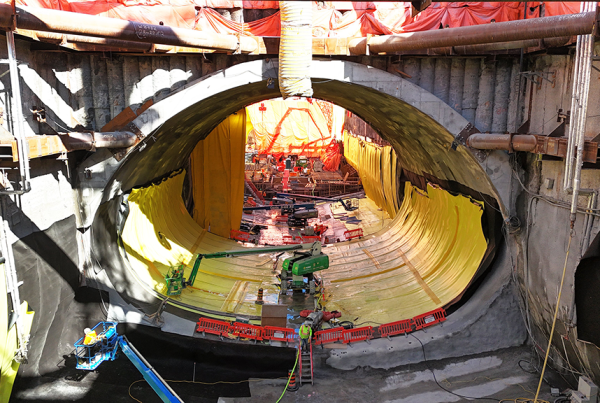
Children’s Museum of Manhattan takes over 123-year-old church in $300M project
Like many adaptive reuse projects, a 123-year-old church being converted into the Children’s Museum of Manhattan (CMOM) that provides early childhood development through research‑based play, learning and cultural experiences, is anything but straightforward.
Among the project’s complexities is how to “delicately thread seven floors within the cavernous building while preserving the overall architecture, structure and key spatial features,” says Mary Mahany, senior project executive, Shawmut Design and Construction, general contractor and construction manager for the project.
“We are essentially constructing a new building within a century-old church.”
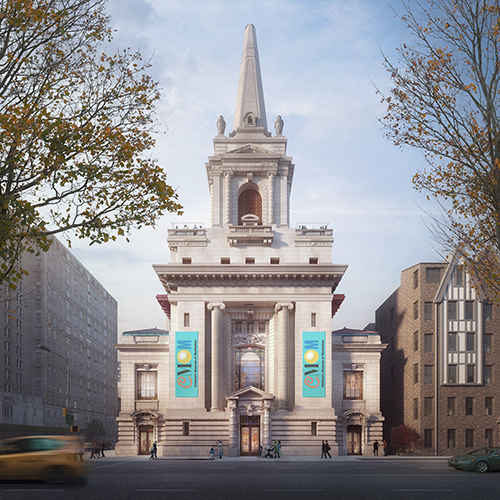
Overlooking Central Park from Manhattan’s Upper West Side, the renewed building will feature programmatic museum space, a café, museum store, performance space and a rooftop terrace.
To date, the project has undergone soft demolition and structural demolition is progressing according to a sequenced schedule.
Mahany says interior work is just underway with the construction of a seven-storey interior steel frame and slabs that is commencing in the cellar. The structure will rise through the church’s interior towards the barrel vault ceiling.
The church will be shored and stabilized with a new foundation to accommodate the new structure. All interior walls, floors and architectural details will have protective coverings.
DeSimone Consulting Engineers is the structural consultant.
Scaffolding has been erected around the church’s signature white granite façade for cleaning and restoration work that includes the preservation of the dominating steeple.
All of the work is being done in accordance with the church’s landmark designation by the NYC Landmarks Preservation Commission (LPC).
To minimize surprises often associated with adaptive reuse of historic buildings, the team conducted extensive onsite investigations and walkthroughs during the pre-construction phase, says Mahany.
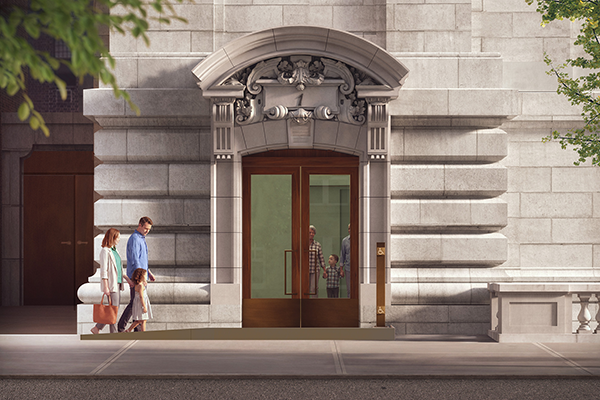
“We used digital modelling to develop the best logistics and construction plans and have implemented both Matterport (a 3D scanning platform creating photorealistic models) and OpenSpace (360-degree photo documentation of jobsites) for real-time digital documentation.”
The building’s distinctive barrel vault will be a key highlight of the completed space along with the tall, arched windows that let in an abundance of natural light to the interior, says Mahany.
No stranger to complex adaptive‑reuse work in New York and across the U.S., Shawmut had recently completed a project inside a 100‑year‑old LPC‑landmarked structure tucked beneath a 52‑storey tower on Fifth Avenue, tying it structurally to an adjacent building. Like the church, it demanded significant structural intervention and an organized sequencing effort, Mahany says.
This is the first expansion of the children’s museum in more than 40 years. When completed in 2028, it will double the CMOM’s capacity.
The project is a design by architect FXCollaborative and exhibit designers THG Creative. The church was originally designed in the Beaux Arts style by Carrère & Hastings, the firm that designed the iconic main branch of the New York Public Library.
Total cost for the project is $300 million.