A report on three conservation-focussed building retrofits in Halifax, Montreal and Vancouver concluded something the building industry may not expect: this type of adaptive reuse can cost less than new construction while delivering lower embodied carbon.
The findings are no surprise to the report’s organizers, the Canadian Association of Heritage Professionals (CAHP), but the extent to which the buildings outperformed demolition/new construction/demolition was “a bit surprising,” says Adam Hatch, president of the CAHP board of directors.
“It is really valuable to have the data finally measured in a whole live carbon lens as well as life cycle costing.”
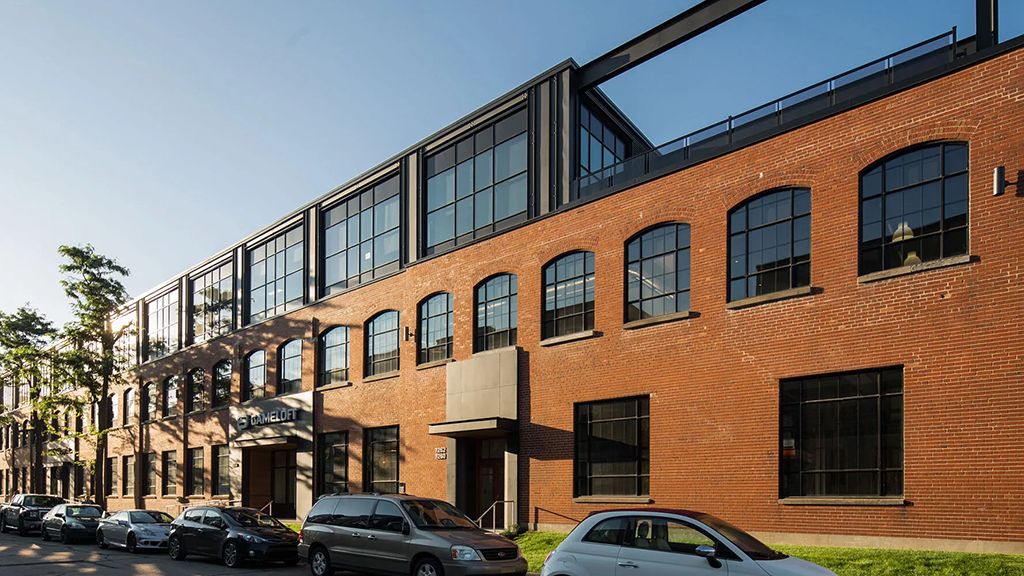
The buildings included a mid‑century modern office building in Halifax, a former textile factory in Montreal and a historic home in Vancouver. None of the three were designated historic buildings but all were seen to have intrinsic value in their communities.
Instead of a deep‑retrofit gutting strategy, the CAHP case studies adopted a conservation‑led approach, prioritizing reusing existing materials and structures to limit intervention.
He says conservation retrofits won’t advance without more flexible codes, and CAHP asserts current codes don’t clearly spell out how builders can meet performance standards.
It is rationale for why developers and contractors, who prioritize risk-avoidance, view retrofits as uncertain and therefore shy away from them. Demolition is treated as the controllable option.
With flexible code compliance pathways, builders would have options on how to deal with “unexpected” issues in retrofits.
“That all of a sudden derisks the project.”
Hatch says another impediment to conservation-focussed retrofits is an industry attitude that old buildings have little value.
“They have immense value. The industry has to start seeing them as opportunities, rather than burdens.”
For the mid-century government office-to-residential conversion in Halifax studied in the report, three scenarios were evaluated: a full-scale retrofit; a retrofit and addition; and a demolition and replacement with a new residential tower.
The retrofit had “dramatically lower embodied carbon” than new construction because of the concrete structure, foundations and envelope elements it retained. It also proved less costly than the demolition and new construction alternative.
The retrofit/conversion of the early 20th century textile factory in Montreal showed similar findings. All three of the projects studied found the retrofits less expensive than demolition and new construction.
Hatch adds retrofits can be done in a shorter period.
Halifax proves the point: the retrofit is renting units, while a similar government building across the street — purchased at the same time for demolition and a new tower — is still a hole in the ground.
Conservation-led adaptive reuse can also accelerate the permitting period because the form, scale and massing already exist, he says.
The response from all levels of governments to CAHP’s report has been notable and many municipalities are curious how to best apply building codes for retrofits so they can capitalize on the value of existing building stock, says Hatch.
CAHP’s next step is to pass its report’s findings to policy-makers for code standards and engage with government agencies, private owners, architects, designers, engineers and homeowners.
“We want to show everyone what their piece is in this puzzle.”
He says in preparation for the growing retrofit industry, builders and others should educate themselves and train their workers on what materials and structures can be reused.
“It will go a long ways to help them reach environmental targets of not spending carbon they don’t need to spend.”
The CAHP president says large firms are starting to shift away from new construction towards renovations.
“Five years from now I think that shift will be continuing and everyone is going to need to know how to do renovation.”
He says about 75 per cent of the buildings standing today will exist in 2050.
“Not only in terms of meeting climate targets do we need to improve and reuse these buildings but also from a practicality view. They are here to stay.”
Want to know how adaptive reuse is faring across the border? Read this U.S. story.