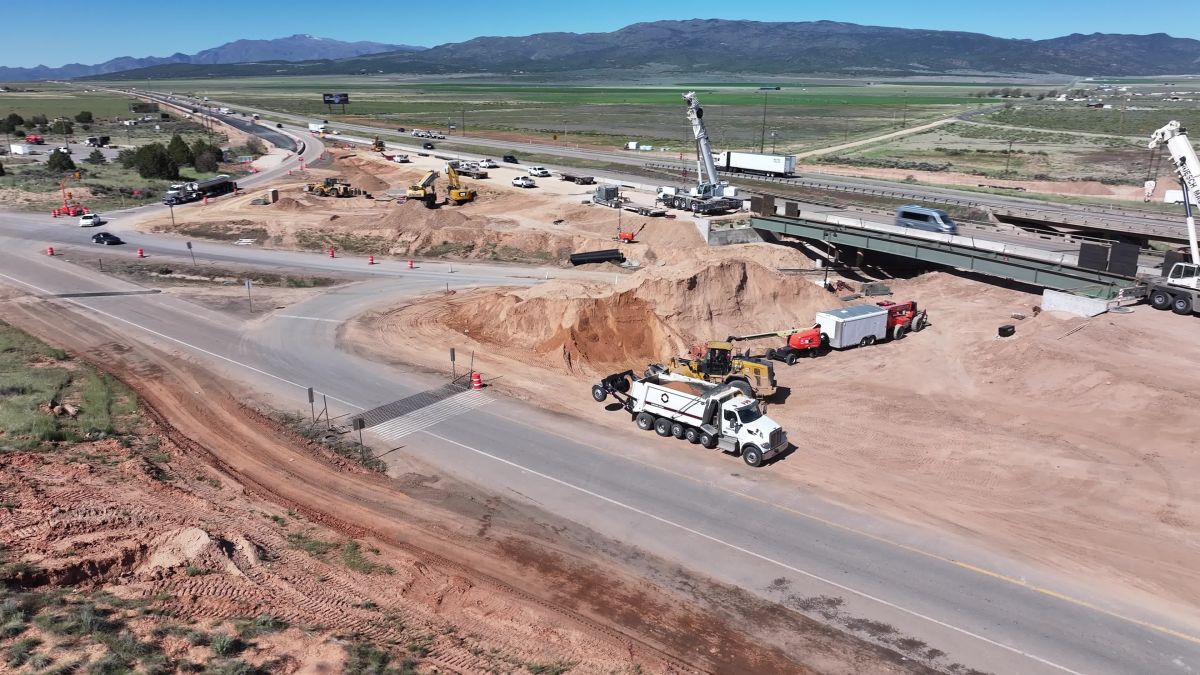
Suncore expects to deliver the Utah Department of Transportation’s (UDOT) $91.1 million Interstate 15 Hamilton Fort interchange and climbing lane project south of Cedar City in Iron County in late fall.
The design-bid-build project, financed by state funds, began in spring 2025.
Crews are adding a northbound climbing lane to an existing 13-m.-long two-lane road from the Kanarraville rest stop to the South Cedar Interchange (milepost 43 to 56) and reconstructing the northbound east side of the Hamilton Fort interchange (Exit 51) with a roundabout.
“The project was needed to improve safety and traffic operations on one of Utah’s most heavily traveled freight and tourism corridors,” Devin Squire, UDOT’s project manager, told Construction Equipment Guide. “Northbound I-15 climbs approximately 3,000 feet in elevation between St. George and Cedar City, where slow-moving trucks create bottlenecks and long vehicle platoons. The additional lane provides dedicated space for heavy vehicles while allowing passenger traffic to maintain more consistent speeds. The improvements to the interchange enhance access and reduce conflict points.”
Crews are rebuilding the northbound side of the interchange bridge, including constructing a new bridge deck and making structural improvements, Squire said. That work also improves the bridge clearance and extends the structure’s service life.
“This section of I-15 is one of the most critical transportation corridors in southern Utah, serving local, regional, interstate and international travel,” he said. “It is the primary north-south freeway connecting the rapidly growing communities of St. George, Cedar City and Iron County with the Wasatch Front, Nevada, Arizona and California. The corridor carries substantial freight traffic and provides access to major destinations.”
A multidisciplinary consultant team headed by Avenue Consultants Inc. completed the design in 2024, which required tweaking.
“A major high-pressure natural gas transmission line conflicted with the proposed improvements, requiring extensive coordination with the utility company to develop a relocation plan that aligned with the project’s schedule while minimizing delays,” Squire said. “In addition, an existing waterline had an uncertain location despite available records, requiring additional investigation, coordination and flexibility during design to reduce the risk of conflicts during construction.
“The project corridor is also known for areas of weak subgrade soils,” he added. “To address these geotechnical conditions, the design incorporated contingencies and pavement and structure design considerations to accommodate potential soft spots encountered during construction, helping reduce risk, maintain the project schedule and improve the long-term performance of the roadway.”
Squire noted that the pavement has a 20- to 30-year service life before major rehabilitation is required, while the roundabout lifespan is 50-plus years and the bridge is 75-plus years.
The interchange bridge was designed for staged, half-width construction.
“One half of the new bridge could be constructed while traffic continued to use the existing structure,” Squire said. “Once complete, traffic was shifted onto the newly constructed bridge half, allowing the remaining portion of the bridge to be reconstructed. This phased approach maintained traffic operations throughout construction while improving worker safety and reducing the need for extended lane closures or detours.”
The first construction season was anticipated to occur between June and October last year. However, Utah experienced an unusually warm and dry winter and, as a result, crews continued work through the winter season.
Suncore equipment operators and assorted personnel have ample space to work in many sites without being impeded by traffic. This provides opportunities to establish layout yards, store materials and set up field offices and areas to park equipment. It also allows for a fleet of pickup trucks to carry crews and smaller pieces of equipment and tools.
“Waste areas were planned during the design phase at locations through the project, and Suncore has been able to utilize those,” Squire said. “By minimizing haul distances, the project reduced trucking costs, fuel consumption, construction time and impacts to the surrounding roadway network, resulting in both cost savings and improved construction efficiency.”
Suncore has completed the following: all widening sections to the inside of the freeway, the rest area paving and the northern quarter of the outside widening. Half of the new bridge is complete.
“The project is experiencing steady progress, with only limited issues arising that require minor or routine attention,” Squire said. “No major concerns or delays are currently impacting the work. The Hamilton Fort interchange is a low point in the area and, with the project lowering it even further, it is prone to filling up with water until the storm drain work has been completed. To account for this, the construction documents required pumps of a certain capacity to be on site during any impacts to the pre-construction drainage so that they could be utilized if needed.
“Soft spots continue to be an issue on the project,” he added. “Pop-up springs and boggy areas have to be addressed by over-excavation and the utilization of additional material and geosynthetic material.”
The 180-ft.-wide single-lane roundabout is being built on a 2.25-acre site.
Before that work, the interchange contained I-15 on- and off-ramps that were connected to the two-lane frontage road (Old Highway 91) that heads under the twin 108-ft.-long, single-span concrete bridges.
The new roundabout, with a gravel-covered center section surrounded by a shoulder, is connected to the existing roads. The on- and off-ramps, 2,000 and 1,200 ft. long, are being rebuilt, with completion expected in late fall.
Crews are installing a new storm drain system with drop inlets through the roundabout and roadway.
“All lanes are asphalt,” Squire said. “The roundabout will have a concrete apron.”
The roundabout has an 18-ft. lane with a 15-ft. truck apron and a 55-ft. embankment. Other lane widths are 12 ft. Materials-wise, high-modulus hot mix asphalt (HMMA) is being used in the roadway sections. The pavement structure includes HMMA, a UDOT-specified untreated base course, granular borrow material and geosynthetics, including a separation geotextile.
“Concrete will be supplied from Suncore’s Cedar City batching plant and transported by truck to the project site,” Squire said. “Placement operations will be coordinated with field paving activities to ensure continuous delivery, proper consolidation and compliance with UDOT specifications for temperature, timing and finishing.”
The third-lane construction on northbound I-15 began in spring 2025
The excavation operation removing the earth and rock encountered a major outcropping of basalt that was pried and hammered out, broken into small chunks by excavators with attached hammers and then hauled away in dump trucks.
The new lane and shoulder are based on HMMA paving, UDOT spec base course and granular borrow, and UDOT spec geosynthetics and separation geotextile.
Once the excavation and site prep crews complete the long sections, paving crews are dispatched, while the excavation crews move to a new section.
For the excavation work, large excavators, including Cat models, removed earth and rock and placed the material into a variety of adjacent loaders. Also on hand are rock trucks, trackhoes, Grove cranes, graders, side dumps, dump trucks, skid steers, pavers, rollers, millers, water trucks, dozers, rubber wheel backhoes, shuttle buggies and tandem smooth drum compactors. Mack trucks have several types of loaders attached.
The northbound Hamilton Fort bridge reconstruction started with the demolition of the east side. The new structure will be 153 ft. long, with one span.
“The new bridge is significantly wider than the old one,” Squire said. “Abutments were placed on drilled shafts.”
The new bridge has seven steel girders. Four were placed on the east side by two large-wheeled cranes stationed on either end of the bridge. A Grove crane positioned on the road below placed the diaphragm steel gussets between the girders.
Ruesch Machine supplied the two non-Grove cranes for the girder lifts. Other equipment used there included drill rigs. ♣