In a first for Vancouver, the West Coast city has used a trenchless construction technique to renew aging infrastructure that lay beneath Memorial West Park, in the single-family residential neighbourhood of Dunbar on the west side.
The Vancouver office of GHD Limited did detailed design, tender development and support, contract administration and field support on the project.
During construction, GHD provided technical and construction-phase support to address the site-specific challenges of working in a constrained urban environment.
Starting in 2025, and finishing in spring 2026, the Memorial West Trenchless Sewer Upgrade replaced the old combined sewer pipes with separated sewer mains in the Dunbar West sewer catchment.
Separating combined sewer mains reduces the risk of combined sewer overflows, extends the separated sewer network and increases the system’s capacity to serve the city’s growing needs. It also advance the city’s Healthy Waters Plan.
Almost 90 per cent of the combined sewer infrastructure surrounding the park is at least 90 years old. The typical life expectancy of an underground sewer main is approximately 100 years, so it was time for a change.
A combined sewer is a pipe that carries both sanitary sewage from homes and businesses and rainwater runoff in the same pipe, says Mike Lam, the project director of GHD’s integrated water management team in Western Canada.
“A separated sewer system uses two different pipes,” says Lam. “One pipe carries sanitary sewage to treatment facilities, while a separate pipe carries rainwater runoff.”
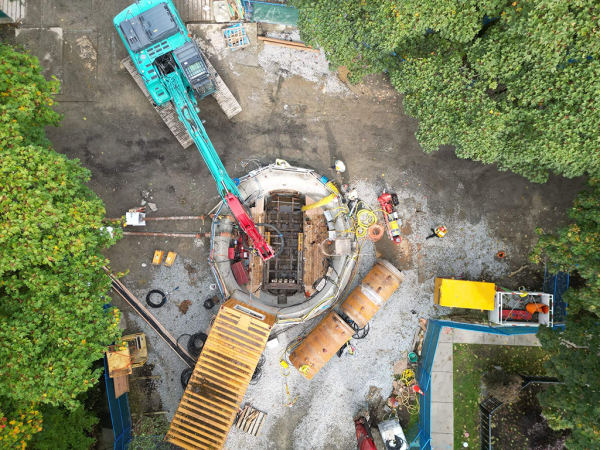
Instead of digging a conventional open-cut excavation to do the job, a remote-controlled micro-tunnel boring machine (MTBM) dug a long underground hole between W 31st Avenue and W 33rd Avenue directly underneath the park’s main footpath, which runs the full length of the park from north to south.
“In simple terms, micro-tunnelling is a smaller – less than three to 3.5 metres in diameter – tunnel that is installed using prefabricated pipe segments,” says Lam. “It’s typically done with an entry and exist shaft. The pipe is pushed through from the entry shaft, which forms the lining or wall of the tunnel, and the micro-tunnel will push forward against each installed pipe segment until it reaches the exist shaft.”
MTBMs have been used around the world for several decades, says Lam.
“While the technology continues to improve, micro-tunnelling is a well-established and proven construction method rather than a new or experimental one,” he says.
Lam says the main alternative to micro-tunnelling would have been open-cut construction.
“That would have required digging a long trench from one end of the project to the other,” says Lam. “It would have meant greater impacts to the park, trees, pathways and park users. Micro-tunnelling allowed us to install the pipe underground while minimizing surface disruption.”
Amy Sidwell, Vancouver’s director of sewers and drainage, says the city undertook an extensive evaluation of its construction options, including their respective costs and risks, because of the unique location of the project.
“Trenchless methods were ultimately determined to be the most suitable solution,” says Sidwell. “Micro-tunnelling was used for the new storm sewer…as it offered the most practical and lowest-risk means of completing the work.”
After they had completed the tunnel, crews used a second trenchless method, called slip-lining.
“Slip-lining is a rehabilitation method where a new, slightly smaller pipe is inserted inside the larger pipe,” says GHD’s Lam. “It extends the life of the sewer, reduces construction impacts and is typically faster and less disruptive than replacing the entire pipe.”
In spring 2026, crews completed the slip lining work, connecting the new pipes to water and sewer systems and installing new maintenance access holes.
The result? The old sewer system was replaced with a separated and larger-capacity system, with one pipe for rainwater runoff and another pipe for sewage.
Lam says one of the project’s biggest challenges was tunnelling through difficult ground conditions, including unexpected large boulders.
“The project team used specialized tunnelling equipment, careful planning and close co-ordination between the contractor, the city and engineers to safely complete the tunnel while staying on alignment,” says Lam. “I think, overall, this project proves that trenchless technologies are viable and can help deliver projects in areas that have challenging access/surface conditions.”
Sidwell says the city is pleased with the success of the project and the effectiveness of micro-tunnelling.
“We will consider it for sewer separation projects in the future,” says Sidwell.
The Memorial West Trenchless Sewer Upgrades project won a 2026 Award of Excellence from the Association of Consulting Engineering Companies British Columbia in the municipal and civil engineering category.