Greywater recycling involves the capture and treatment of wastewater from showers, sinks, laundry and other non-toilet sources, which is then reused in functions such as toilet flushing, cooling towers and irrigation.
Development of greywater use has moved well beyond small residential pilot projects, as seen in the City of Waterloo, Ont., to large-scale deployment. In North America, commercial greywater recycling is increasingly based on centralized, automated multi-stage process systems.
What is at stake is the respectful use of the world’s most valuable resource: water. An increasing number of experts question the logic of using fresh, filtered and treated drinking water for uses that do not require it. In addition, there is the cost of creating this level of water quality, particularly in urban centres, that is often passed on to the end user.
Of course, project developers and owners are concerned about costs, and the most effective greywater treatment systems are expensive. Payback periods for large commercial systems can run from five to 15 years, depending on local water supply and sewer rates.
The type of treatment technology selected can significantly impact cost. A simple filtration/disinfection system for a small building might cost between $5,000 and $20,000. Membrane bioreactor systems that combine biological activated sludge processes with membrane filtration, and sized to be suitable for larger commercial applications, run in the range of $50,000 to $500,000.
There is also the issue of dual plumbing installation costs. If an existing building is under consideration for one of these systems, costs can be several times more than when dealing with a new project. Storage tanks, pumps and distribution piping, monitoring and control systems using sensors and SCADA integration must also be included.
Ongoing costs include the energy required for pumping, UV disinfection, aeration for biological treatment, monitoring inspections and test, system maintenance, and possible insurance considerations regarding cross-contamination liability risks.
It’s a long list. However, there are many examples of successful projects that not only provide guidance and encouragement but also point to the development of advanced water treatment processes.
The 61-storey Salesforce Tower in San Francisco built in 2018 operates what the company describes as “the largest onsite water recycling system in a commercial highrise.”
The system collects wastewater from sources such as rooftop rainwater, cooling towers, showers, sinks, toilets and urinals. It then treats the water through a six-step process in a centralized treatment centre and recirculates it through a separate pipe system to serve non-potable uses in the building such as toilets and drip irrigation. An estimated 30,000 gallons are treated each day, saving an estimated 7.8 million gallons of potable water annually.
Today, such efforts are supported by the San Francisco Onsite Water Reuse Ordinance, a framework first pioneered by the city in 2012. Amended in 2021, it now requires new development projects 100,000 gross square feet or more to install and operate an onsite water reuse system.
In Seattle, Wash., the 50,000-square-foot Bullitt Center calls itself “the greenest commercial building in the world.”
Among its many eco-conscious features is a collection system that gathers water from sinks and showers, stores it in a 550-gallon greywater tank and then treats that water in a three-stage filtration process for reuse in the vacuum-flush toilet system.
The vacuum-flush toilet system was introduced in 2021 and now diverts that water into a constructed wetland on the building’s third level before being infiltrated into the ground to help recharge the aquifer.
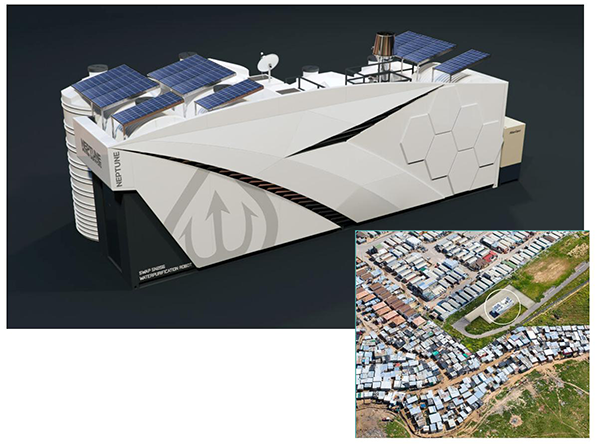
Pushing the wastewater recycling boundary even further is a private Canadian organization based in Sherbrooke, Qué., called Neptune8. It has developed the TRITON wastewater treatment robot that processes not only greywater from showers, sinks, washing machines and dishwashers, but also the “black water” from toilets that can be heavily contaminated by human waste and pathogens.
A 48-unit apartment complex in Sherbrooke is currently serving as a testing ground for Neptune8’s technology.
“At the heart of Neptune8’s mission is the development of decentralized and AI-powered direct potable reuse,” says the company’s Facebook page.
“Our approach merges cutting-edge water treatment technologies with the full integration of robotics and artificial intelligence,” the company says. “Designed for buildings and small communities, these robots will purify mixed wastewater and produce 10 M³ to 500 M³ per day of truly potable water, providing unprecedented safety and cost-effectiveness.”
Not only could the TRITON robot reduce drinking water use in the Sherbrooke building by nearly 40 per cent but it can also recover the heat generated during the treatment process to preheat domestic hot water, thereby cutting the energy required for heating by as much as 70 per cent.
If the system successfully completes its certification process, it could fundamentally reshape how residential buildings manage their water supply. To achieve this certification, regular water quality analyses will be conducted by independent laboratories over the next 12 months, including the deliberate introduction of bacteria, to confirm its reliability under various conditions.
Beyond commercial and multi-unit applications, the impact of successful greywater treatment processes needs to be understood at scale when considering its application to the homebuilding industry.
As reported in LaPresse, the Union of Québec Municipalities revealed over 36,000 residential units could not be built in Québec in 2025 due to a lack of municipal capacity to treat additional wastewater or supply more drinking water.
Companies like Neptune8 could offer solutions to developers and municipalities facing these constraints.
Mathieu Lapointe, an engineer and professor at the École de technologie supérieure, notes an added environmental benefit, saying, “Instead of releasing the water into nature, it is treated and reused in a closed loop.”
John Bleasby is a freelance writer. Send comments and Climate and Construction column ideas to [email protected].