Welcome to Ask a Design Obsessive, an advice column from the Real Estate desk at The New York Times. Each month, we’ll aim to solve a reader’s particular home design quandary. To submit your own question, email [email protected].
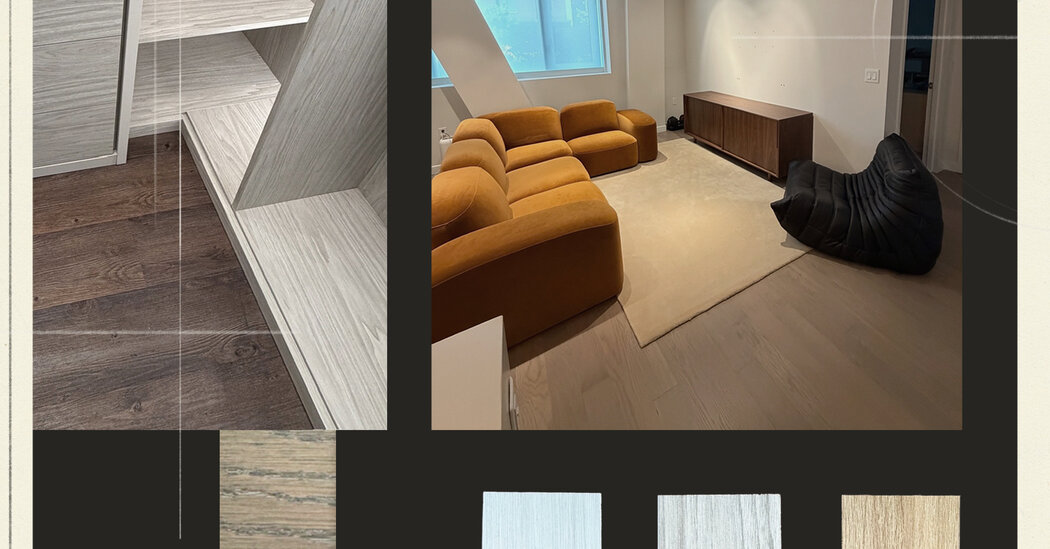
Q: I’m struggling with picking wood for the built-ins in my apartment closets. What goes best with my apartment and décor, including my existing hardwood floors?
A: Looking at your floors and samples, I invite you to join me at the drawing board where we can consider some options. I applaud your willingness to mix woods — many people think that all the wood in their home should have the exact same hue. I disagree. However, to avoid an unpleasant clash, there are a few factors to consider when mixing and matching wood.
I’d argue the most important consideration is the wood’s color temperature. (Others include contrast, wood grain and the surrounding aesthetic.) Generally speaking, warm woods play nice with other warm woods; cool woods play nice with other cool woods; and neutral woods work with all others. While cool woods and warm woods are leery of each other, with an adept design eye at the helm, there’s room for an enemies-to-lovers story line. But for now, let’s assume they don’t get along.
To know which color temperature your space favors, establish the dominant existing wood and its color temperature. Often, it’s the floors. Is the wood cool, warm or neutral? Warm woods contain red-orange-yellow undertones — think cherry, red oak or mahogany. Cool woods have green-blue-gray undertones — like beech, white ash or birch. Finally, there are neutral woods, which have undertones that are not discernibly cool or warm. Lighter maples, oaks and bamboo are often neutral.
Now, let’s take a look at your floors. Let me preface this by saying that the undertone can’t reliably be diagnosed by these phone photos, but from what I can tell, your floors are warm to neutral. I say warm because in the photo of the closet, I see a distinct red-yellow-orange undertone. However, in another photo, the undertone is more difficult to determine. Wood tones can belong to one color temperature camp but skew toward another: warm sun, neutral rising, to put it in astrological terms.
Knowing your floors are warm-neutral, the natural thought is to look at other warm woods like natural walnut. However, you’ve already established distinctly cool woods in other places. This is creating a clash. But not to worry. A neutral wood can act as a diplomat between the adversaries.