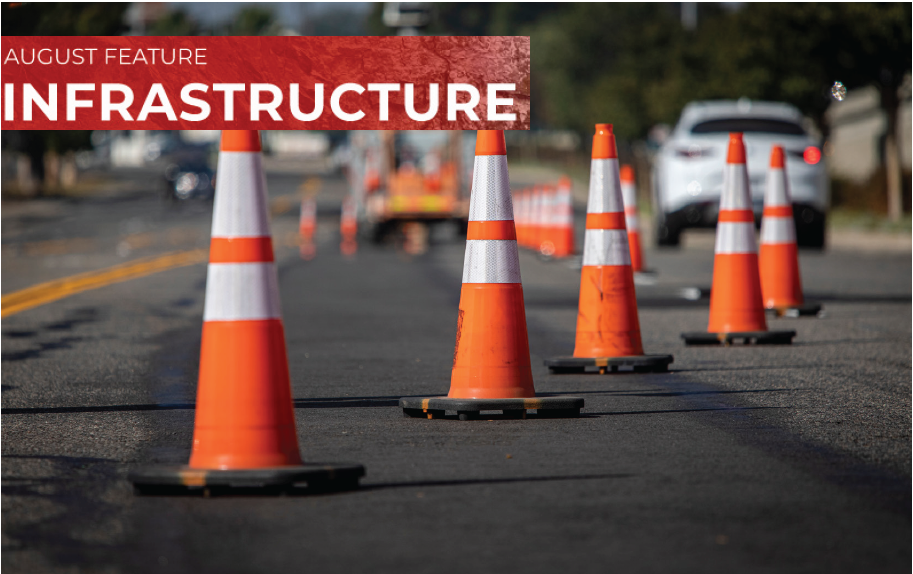
In Winnipeg, they’re not dancing in the streets, but summer’s here and the time is right for improving roads, bridges and active transportation infrastructure.
Because the Prairie city’s winters are long, its construction season is correspondingly short and condensed. In most years it runs from mid-May through October, a mere five-and-a-half months.
The City of Winnipeg says it undertakes four main types of renewal work on its infrastructure: reconstructions, rehabilitations, pavement preservation and right-of-way improvements.
In summer 2026, Winnipeg crews are at work constructing or renewing approximately175 lane kilometres of roads, 50 sidewalk locations and 15 kilometres of bike lanes and active transportation pathways.
The 2026 budget for local and regional street improvement is approximately $156.8 million.
Almost all scheduled projects have been tendered and have already started or will start shortly.
One of the road renewal projects in question is the Lagimodiere Twin Overpass Rehabilitation and Roadworks, a bridge rehabilitation project that includes the renewal of Lagimodiere Boulevard.
Lagimodière Boulevard (Winnipeg Route 20) is a major north-south arterial road on the east side of the Red River, and part of Manitoba Highway 59.
The city is fixing the overpass bridges where Lagimodiere Boulevard crosses Concordia Avenue and the Canadian Pacific Kansas City (CPKC) rail line.
Roadwork at the intersection of Lagimodiere and Grassie Boulevard began in July 2026.
The goal of the project is two-fold: to repair the road and ramps and enable the bridges to last another 50 years.
The project also includes building new multi-use paths along Concordia Avenue, which the city says will improve the walking and biking network in the area.
Construction is scheduled for 2026 and 2027.
A Winnipeg spokesperson says, “We expect to complete phase one, which includes work on the southbound bridge, by Oct. 31, 2026. We will fix the northbound structure in phase two, which we expect to work on from January to November 2027.”
The main contractor on the Lagimodiere project is PCL Constructors.
In addition to the work on Lagimodiere Boulevard, in the northeast part of Winnipeg, the city has a roadwork project in the southwest.
It is rehabilitating the Pembina Highway overpass at Abinojii Mikanah (formerly Bishop Grandin Boulevard), partially reconfiguring the interchange and making improvements to boost safety and optimize traffic flow.
Pembina Highway (Route 42) is a major arterial road that runs through the city.
A very long road, it connects the suburbs of North Kildonan, East Kildonan, Fort Rouge, Fort Garry and St. Norbert with downtown.
Specifically, the city is fixing the bridge, roads and ramps; moving the ramp that connects eastbound Abinojii Mikanah from Chancellor Drive to Pembina Highway; adjusting transit stops; and upgrading pedestrian and cycling infrastructure.
All of the work for the Pembina project has been tendered. The main contractor on the project is MD Steele. Construction is expected to be completed by October.
The count of roads repaired or potholes filled is an imperfect measure of whether the road network has been improved, or at least kept from deteriorating further, says Ahmed Shalaby, professor of civil engineering at the University of Manitoba and head of the department’s pavement research group.
“Some projects are small and others are very large,” Shalaby says.
To reduce the pressure to widen more roads or build more bridges, Winnipeg needs to reduce its dependence on roads.
“Winnipeg does not have as many transportation options as other Canadian cities of its size,” says Shalaby. “Investing in transit improvements and active transportation can save the city money on the long-term, but only if it attracts more transit ridership – currently it’s less than 10 per cent – and provide connected network routes for active transportation.”
Shalaby says Winnipeg has an extensive rail network, but at the moment there are no plans to use existing or abandoned rail lines for passenger transportation.
“This could be the game-changer, but it requires agreements with the rail owners and federal legislation that encourages the shared use of the rail lines, at least during peak commuting times.
“To use the existing rail lines for passenger rail is a much better outcome that to relocate them outside the city and turn the lands into green space.”