The failure of key structural columns inside the high-profile Pfizer building in New York’s Manhattan district in early June resulted in both the fire department and building departments being called, nearby buildings evacuated and streets closed off.
Although NYC Buildings Commissioner Ahmed Tigani declared the building stable the next day, the repercussions for the office-to-residential conversion industry are only just beginning.
Nathan Berman, chief executive of MetroLoft, one of the two principal firms behind the Pfizer conversion, suggested human error was to blame.
In fact, it was soon reported the private firm hired by Berman to inspect and certify crucial aspects of the project had a history of safety lapses. It was also revealed and alleged the founder of that company was a former buildings department employee forced to resign in the 1980s amid allegations concerning parties in the office and evidence tampering involving bribery in the permitting process.
Then reports arose concerning shortcomings in the installation of welded reinforcing plates for the two failed columns which did not appear to have been installed as specified.
While initial reactions appeared to suggest the Pfizer incident was an isolated event, two more conversion projects were also issued work stoppages.
Just a few blocks away, a 34-storey office tower built in the 1950s and undergoing a conversion into over 670 apartments, received a partial work stoppage from New York City’s Department of Buildings.
Inspectors had found unapproved modifications to several steel columns in the building. The order was later rescinded when it was determined there were no structural issues.
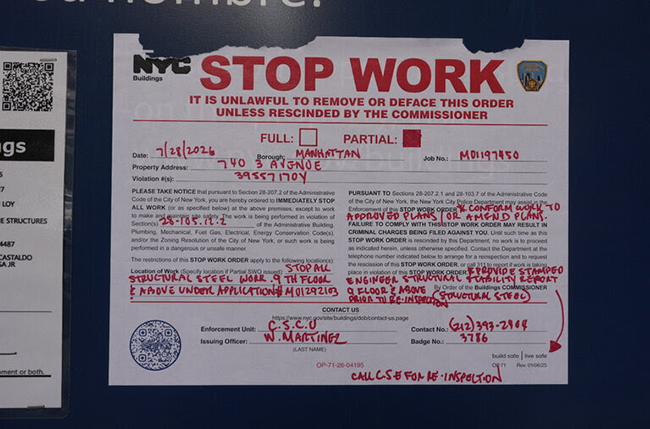
Next was news concrete beams in an office-to-residential conversion in south Manhattan had cracked and were then wrapped in steel as a makeshift fix.
CNN reports the beams had been repaired but without proper notification to the city. The Department of Buildings “escalated a partial work stoppage to a full stop-work order until engineers onsite provided a complete explanation of what caused the cracks and how they were repaired.”
Aside from the matter of structural integrity and regulatory processes, the Pfizer building project alone will certainly trigger a series of multi-party construction litigation actions, possible municipal penalties and extensive insurance subrogation claims.
It can be expected that finger pointing between designers, engineers and builders will emerge concerning whether the failures were caused by design flaws, sequencing errors or outright contractor omission.
The project developers and their backers will also likely face what could be major financial losses and cross-claims from investors, general contractors and subcontractors over the costs of removing and rebuilding the compromised upper floors.
Local shops, restaurants, and nearby property owners forced to close or scale down their operations during the city’s emergency “frozen zone” road closures can be expected to file negligence and economic loss lawsuits against the development team.
And of course, the project insurers along with those of affected adjacent properties and the city will likely sue responsible parties to recoup emergency response and temporary shoring costs.
The upshot is likely to be a continuation of the NYC Department of Building’s expanded citywide inspection sweeps of conversions. More stop-work orders are certainly possible and even mandatory peer reviews for related projects, which could translate to heavy administrative fines and stricter future code requirements for vertical expansions. Code changes governing conversions are also possible.
However, as Joe DiPompeo, president of New Jersey-based civil engineering firm Structural Workshop said recently, “It’s impossible to find a building in New York City that doesn’t have a violation on it. If you go out and scrutinize every major construction project in Manhattan, I expect you’ll find a violation on most or all of them.”
Conversions are, of course, recognized as complex projects.
An office building designed and built to support specific floor loads and layouts must be adapted to different loads, expanded MPE functions and new occupancy flow patterns.
Adjusting to these and many other factors can be complicated right from the start.
As legal services professional Denise Bashline writes, “conversions start with an existing object that has a history. Drawings may be incomplete. Prior alterations may not be fully documented.”
While New York City has been a national leader in promoting office-to-residential conversions with over 16,000 units currently under development, it is not the only city to host a large number of similar projects. For example, Washington and Chicago respectively have 8,500 and 4,300 conversion units underway.
In the City of Los Angeles, the Citywide Adaptive Reuse Ordinance took effect on Feb. 1 this year. This extends streamlined conversion rules to commercial buildings at least 15 years old and qualifying parking structures that are at least five years old.
Mayor Karen Bass says this could spur the creation of more than 43,000 units of housing.
“These projects represent the kind of innovation we are applying to break away from the status quo that has stunted L.A.’s housing production and driven up rents for decades.”
Despite the unsettling problems surrounding the projects in New York City, NYC comptroller Mark Levine said in a recent interview, “office-to-residential conversions have been one of the big bright spots, solving a problem for the city. We have tens of millions of square feet of vacant office space, especially in Midtown Manhattan, coming out of the pandemic. But also leading to something positive, which is adding to our supply of housing and supply of affordable housing.”
Tax incentives have and will continue to play a big role in incentivizing continued development in the city.
“These are big, complicated projects,” Levine said. “To make it work, they needed a tax incentive, and the proposition was, well, if these things just sit vacant as empty office buildings, it’s not good for our economy.”
John Bleasby is a freelance writer. Send comments and Climate and Construction column ideas to [email protected].