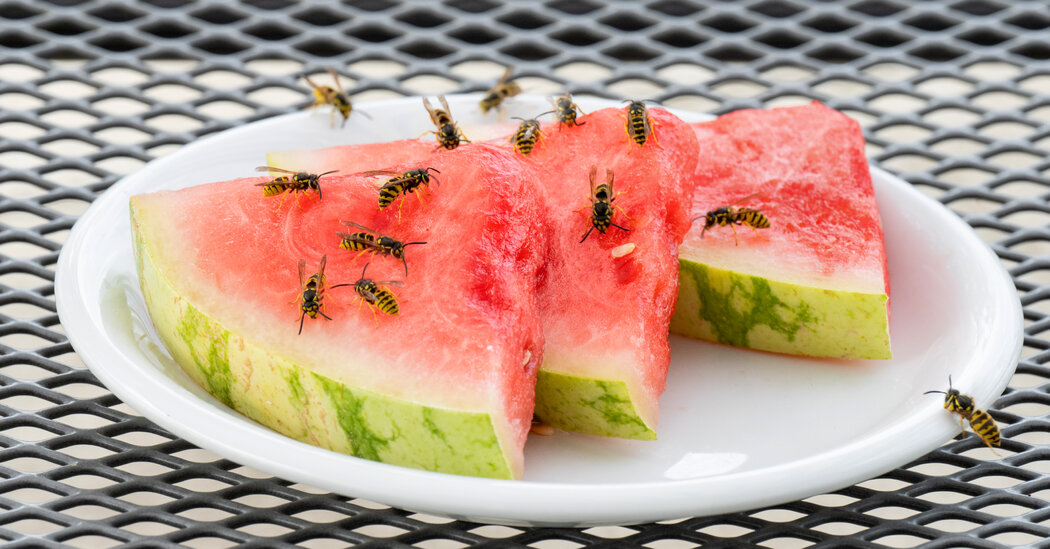
Few insects can ruin your backyard gathering faster than wasps: It takes only a handful of yellow jackets, paper wasps or hornets to turn a relaxed meal into a frenzy of swatting.
All three insects are social wasps, meaning that they live in colonies, and they will aggressively defend their nests if disturbed. Stings can prove fatal for those who are allergic, but attacks can also be serious for those who are not.
“We’re not talking about a local reaction, like swelling near the sting,” said Dr. Payel Gupta, an allergy, asthma and immunology specialist and assistant professor at Mount Sinai Medical Center and SUNY Downstate Medical Center. “But if you have any shortness of breath, coughing, wheezing, hives on other parts of the body besides where you were stung or lightheadedness, you should seek medical attention.”
Among the stingers, yellow jackets are particularly dangerous, said Michael F. Potter, a professor emeritus of entomology at the University of Kentucky, partly because of the size of their colonies, which grow much larger than other wasps’.
“They make their nests in the ground, a rock wall or some other unobtrusive area,” Dr. Potter said. “Then you’re out mowing the grass, or the kids are playing, and all of a sudden you disturb them and bam — they’re on you.”
Starting in spring, yellow jackets, wasps and hornets are drawn to protein, which they need to feed the larvae in their nests. The sugary foods and drinks found at backyard cookouts, park picnics and beach lunches become increasingly irresistible to wasps in late summer, when their diet shifts from protein to sugar, said Lynn S. Kimsey, a professor emeritus of entomology at the University of California, Davis.