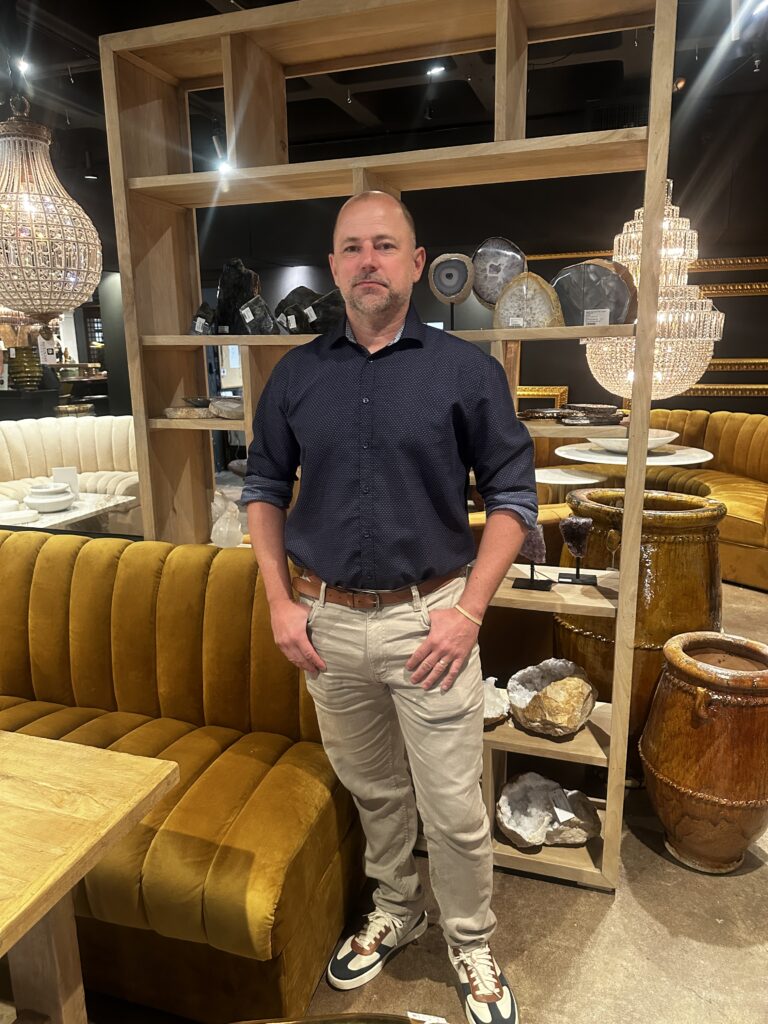
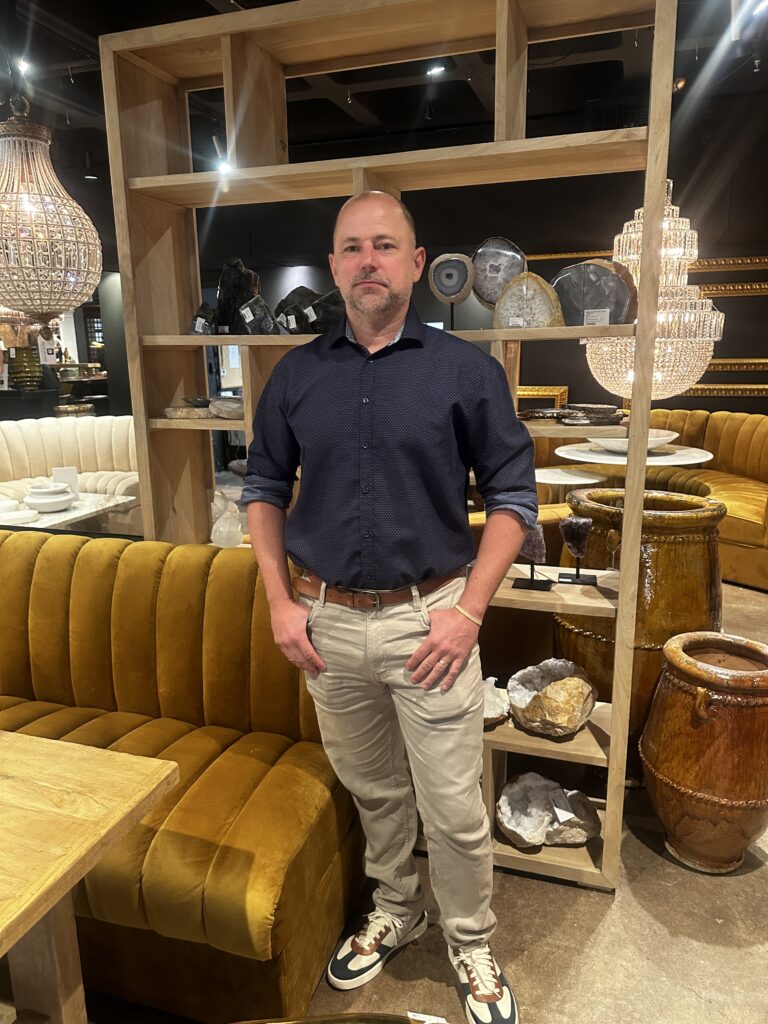
Blue Ocean Traders, which celebrates its 25th anniversary this year, got its start selling antiques at flea markets. Now headquartered in a 200,000-square-foot warehouse in Louisville, Ky., with showrooms in Atlanta, Dallas, High Point, Las Vegas and Round Top, Texas, Blue Ocean Traders employs 50 people, receives more than 300 shipping containers of goods each year from 25 countries, and supplies merchandise for small to national-sized businesses throughout the country. We caught up with founder Jason Mulvene during the recent Atlanta Market to discuss his many years in the antiques business and what he’s learned along the way.
How did you get started in this business?
I founded it almost by accident. I didn’t intend to do this. I thought I would have a corporate job in marketing. I grew up in Michigan, where my parents had a metal finishing business for auto parts. In the 80s, antique dealers wanted everything polished, and Dad traded in that stuff. I used to go to scrap yards as a kid, and my dad always taught me how to make a dollar. When I was 20, my dad sent me and a buddy to Holland with $10,000 to look for antiques. This was the early days of the Internet, so you had to rely on road signs to find antique sellers. I got to know an antiques dealer, who told me, ‘You need an export dealer.’ He helped me and he remains a friend.
I later went to the Canton Fair, and to Hungary, where I set up a network of pickers of vintage items in bulk. At the time, that was new. That became the core of Blue Ocean Traders. At home, I went to flea markets and sold to antique dealers, who mostly sold to retailers. I thought to myself, ‘I guess I am a wholesaler.’
How did you get set up in Atlanta?
In January 2001, friends who had a wholesale floral business and a huge showroom in Atlanta invited me to share some of their space to sell antiques. They didn’t charge me rent, so my first show was free. I had no employees, no business cards, no means of taking credit cards — I didn’t even have a credit card of my own. I never thought about merchandising and making the products look nice. My friends who leased the showroom told me, ‘Just take orders.’ They expected to make about $100,000 in orders themselves and thought I could make about half that. I sold $250,000 in orders at that show. Since I had no business cards, I wrote my name and phone number on slips of paper.
My friends’ company went out of business the year after that, and Kathy Bovey, the vice president of leasing at AmericasMart at the time, asked me if I was able to pay the rent and take over the lease. I’ve had a showroom ever since.
Tell me about your product mix.
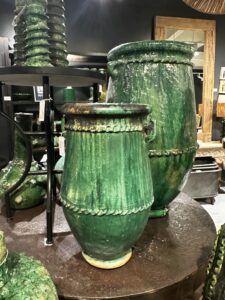
Being around metal finishing as a kid, I have an affinity for solid materials. Patina is one thing; hand-feel is another. So, I focus on materials. I also have a personal fascination with regional specialties, like blue and white ceramics from China, particularly Jingdezhen ginger jars. I also love Tamegroute from southern Morocco. They have been making the same, green-glazed pottery there for the past 400 years.
The second specialty of Blue Ocean is dealing with vendor issues, because our suppliers are not geared for export or the details of large-scale production. So, we help them through those problems.
What is your biggest selling category?
Upholstery is the highest in terms of dollar volume. Our most profitable, highest margin category is accessories that sell between $30 and $60 wholesale. We are especially geared to support brick and mortar retailers. It’s who I live to work with. We accept a lot of variation in product that’s not suitable for online selling.
Antiques are such a big and popular business right now. How do you remain competitive?
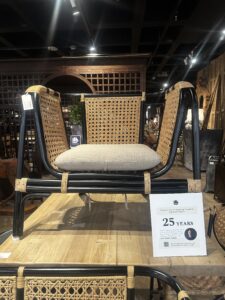
It’s twofold. One is streamlining the industry through volume, trying to find ways to make the supply chain as consistent as possible. The second is long-term supplier relationships, being the go-to person for our suppliers when they have something nice and always being there to buy it.
Now that you have business cards, how would you describe your management style?
I have never worked at a bigger company than here. I have definitely learned and reinvented the wheel a lot of times. That’s good when you come up with original solutions; it’s bad when it takes a while to figure out what other people [already know]. I try to identify the biggest problem in front of us and help people find solutions. I handle things on a day-to-day basis. In the last decade, I’ve tried to hire good managers and department heads and rely on their expertise. I am a buyer first and a manager second.
Are you a leaper or a planner?
I would say a planner. A planner for sure. I think I try to anticipate the bigger problem before it becomes an issue. Before I went to Round Top, for example, I ran the break-even numbers, traveled out there multiple times, considered all the downsides … I definitely think I’m a planner.
What’s the biggest business lesson your father taught you?
Two things come to mind. One is that ‘two fast nickels are better than a slow dime.’ Turn your inventory quickly [even if it’s] for a lower profit. It’s always better in the long term to turn over a lower profit quicker than wait for a bigger profit later. You’re not scared to leave money on the table. And you want to leave something for the retailer.
Two, you make your money when you buy it, not when you sell it. If you buy something right, you can always sell it for a profit. If you buy something right and the price is right, the hard part is already done.
Just for fun:
Pro tip for frequent fliers: I’m a big ‘fly coach’ guy. I use my miles to buy another ticket. But I am adept at finding an empty seat next to me, and I work quickly to get to the working man’s first class.
Favorite airport: The old airport in Jaipur, India. It was a military base and an airport — once they rolled a plane tire right through the airport. They just built a beautiful new airport, but it used to be just a funny place.
Favorite summertime activity: We bike to dinner with family a lot.
Favorite summer food: We just got back from a buying trip to Greece. It’s pretty hard to beat a mixed grill. Grilled lamb chops are my number one.