An electric-powered ship-loading system under construction in Bruce Mines in northern Ontario will reduce a major quarry’s greenhouse gas emissions, reduce heavy truck traffic, give a significant business boost and create more job opportunities.
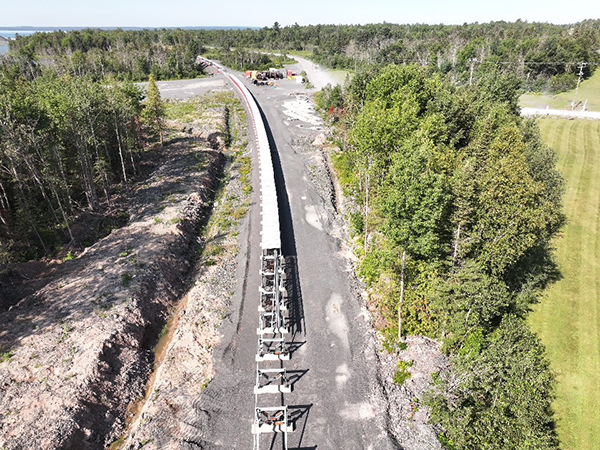
A two-kilometre-long conveyor system to move aggregate from Ontario Trap Rock’s 1,000-acre quarry, under Highway 17, and to its dock on Lake Huron’s North Channel, is expected to be completed this fall.
The investment in the electrified overland conveying system is approximately $12.8 million, with $6.4 million coming from the Government of Canada’s Green Shipping Corridor Program. Ontario Trap Rock’s owner, R.W. Tomlinson Ltd., is funding the other half.
Using low-carbon and net-zero emission technologies, the project will reduce emissions from the marine sector while making supply chains more efficient in moving construction materials through the Great Lakes.
“This project is about investing in the future of Ontario Trap Rock,” says Rob Pierce, senior vice-president of planning and development with R.W. Tomlinson Ltd., a Canadian-owned, family-run company that has operated for more than 70 years. “The Government of Canada contribution helps accelerate a major infrastructure upgrade that will improve how we move aggregate from the quarry to our marine terminal in a more environmentally responsible manner, while supporting the long-term competitiveness of the operation.”
Currently, aggregate is trucked from the quarry and across Highway 17. The new conveyor will significantly reduce the need for haul trucks, removing thousands of truck trips annually from the crossing and significantly reducing greenhouse gas emissions.
“Any time you can remove heavy truck traffic from a roadway crossing, that’s a positive outcome,” says Pierce.
The marine terminal will continue to be a critical part of the operation, with the conveyor enhancing the connection between the quarry and the dock. The conveyor will allow Tomlinson to live-load Great Lakes freighters as they come in as opposed to the current system of stockpiling material on the dock, then shipping it out.
The project has the ability to increase the company’s shipping volume by up to 25 per cent and create more employment opportunities at the facility in the future. Currently, Ontario Trap Rock is Bruce Mines’ largest employer, with about 50 fulltime employees.
“High-quality aggregate is an essential building material for infrastructure projects of all sizes. Our focus is on ensuring we have the facilities and logistics capabilities necessary to continue serving our customers well into the future,” says Pierce.
Ontario Trap Rock supplies high-quality aggregate used in a variety of construction and infrastructure applications. It’s desirable due to the hardness and density of the trap rock extracted from the quarry, mainly used for rail ballast and the top lift of asphalt on major highways (it lasts much longer than limestone or other rock-based materials).
It also is used in rock wool insulation, known for its superior and thermal properties and provides higher-than-average strength to specialty concrete applications.
Demand for aggregate is generally influenced by construction activity, public infrastructure investment and private-sector development.
Pierce says the aggregate is shipped through the Great Lakes to both Canadian and U.S. markets, with material moving through regional marine supply chains to support construction and infrastructure projects throughout the Great Lakes region. This is in addition to the northern Ontario market in and around the Bruce Mines area.
The quarry at Ontario Trap Rock has a reserve of millions of tons that will last decades, Pierce says. It’s the only large viable trap rock source on the Great Lakes, and it’s a material that’s highly sought after by those building key infrastructure.
When the announcement of the $6.4 million in government funding was made earlier this year, Terry Sheehan, MP for Sault Ste Marie-Algoma said the investment was great news for Bruce Mines and the North Shore region: “Projects like this show that small towns can lead the way in building a stronger economy while protecting the environment for future generations.”
“Ontario Trap Rock has been an important employer and economic contributor in the region for many years. This investment helps ensure the operation remains competitive and sustainable for decades to come while improving the efficiency of how material is moved from the quarry to our marine terminal,” Pierce says.
The Green Shipping Corridor Program provides funding for projects that contribute to the establishment of green shipping corridors and the decarbonization of the marine sector along the Great Lakes, the St. Lawrence Seaway, and Canada’s East and West Coasts.