The demolition and replacement of the 846-foot-long, 75-year-old concrete arch bridge in Pittsburgh, Pa., might have passed largely unnoticed had it not been for the speed of installation.
The new steel arched delta frame bridge took just 17 days to install due to the Accelerated Bridge Construction (ABC) technique called Slide-In Bridge Construction (SIBC). It was one of the heaviest slide-in structure projects ever undertaken in the United States.
ABC such as this is not new. A prefabricated “Bridge Slide” like the one in Pittsburgh is one of the techniques being used to speed up highway expansions in the United States.
The SIBC involves a new bridge superstructure built on temporary supports adjacent to an existing bridge which is then slid transversely into its permanent position once the old structure is removed. This significantly cuts down road closure times, sometimes compressing disruption into a single 48-to-72-hour window. This compares favourably with conventional cast-in-place techniques that can take over a year to complete.
However, SIBC is not the answer for every bridge project. There are distinct engineering, spatial and design challenges. The process requires a substantial amount of clear, stable land immediately adjacent to the existing bridge to assemble the temporary shoring towers and to construct the new deck. Therefore, it cannot be used in tightly constrained urban canyons or steep, unforgiving terrain.
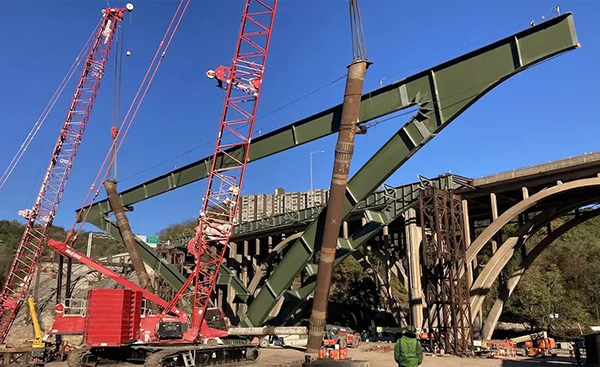
Since hydraulic pushing or pulling mechanisms used during the slide exert massive horizontal lateral forces, substructures must be specially designed to resist these temporary forces without tilting, sliding or tracking out of alignment.
And while single-span slides are relatively straightforward, multi-span slides require highly synchronized hydraulic systems across multiple piers and abutments. Any uneven movement can introduce severe torsional twisting, structural warping or localized uplift.
Mammoet, a Dutch-based company specializing in engineered heavy lifting and the transport of massive objects, worked with prime contractor Fay, S&B USA Construction on the Pittsburgh bridge project.
As Mammoet explains, it provided a specialized system consisting of 42 skid “shoes” spread out over four primary locations, two at the bridge piers and one at each of the abutments. The new 10,000-ton bridge was moved 102 feet in one continuous shift over a single day.
The SIBC technique has been used only selectively in Ontario. The more common ABC replacement technique is BEBO Bridge Concrete Arch System, developed in the 1960s in Switzerland.
BEBO is a combination of cast-in-place concrete footings, precast arch elements, headwalls and wingwalls that can be used for spans ranging from 12 to over 100 foot in length.
Because the BEBO system is comprised of modular precast concrete arch elements paired with cast-in-place or precast footings, it typically functions as underpasses for highways, grade separations or large-span arched culverts that support heavy highway traffic directly overfilled above them.
However, project time is not always compressed with BEBO.
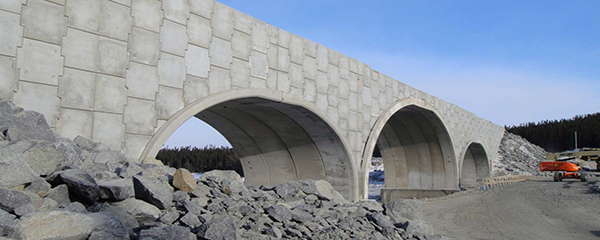
The total time from start to completion encompassing excavation, bedrock anchoring, earth overfilling and final paving varies based on the complexity of each site. For example, in Ontario, completion of the Highway 17 – Lauzon Creek Bridge and the Highway 630 – Amable du Fond River Bridge took months, not days.
The majority of Ontario’s approximately 2,900 provincial highway bridges were constructed during the post-war boom between 1950 and 1980 using traditional cast-in-place concrete forms. However, for modern replacements, the Ontario Ministry of Transportation (MTO) has heavily shifted towards a hybrid approach that relies on precast and prefabricated modular elements.
The MTO is promoting ABC frameworks through its “Get In–Get Out” (GiGo) initiative. This encourages crews to build an entire prefabricated bridge on the side of the highway and use Self-Propelled Modular Transporters to “move girder/deck segments into place during an overnight freeway closure and tying them together with rapid set concrete.”
The advantages of the slide-in and BEBO techniques are many, says the Transportation Association of Canada (TAC). Yet despite reduced traffic disruption, improved work zone safety, lower environmental impacts, improved constructability and lower life cycle costs, these benefits are rarely the driving factors on typical projects.
“The construction cost is approximately double the cost of other prefabricated bridges,” the TAC says, “and is therefore justifiable only when the bridge carries very high traffic volumes which cannot be detoured, typically an average annual daily traffic in excess of 100,000 vehicles.”
ABC in Ontario lags that of the United States. One reason could be institutional. The procurement model in Ontario is said to lean heavily towards a traditional bespoke design-bid-build approach with low-bid award, which can be hostile to the use of ABC techniques. It also calls into question how the economic costs of time delays are considered in relation to capital cost.
It can also be argued a U.S. federal policy push has made ABC more of a standard practice south of the border is the largest reason for the difference.
In the United States, there is a large, standards-laden federal aid program administered by a dedicated federal agency. Federal money and technical deployment come in many forms, such as the Highways for LIFE grants, SHRP2 R04 implementation assistance and the Every Day Counts program. These programs pay states to try slide-in and other ABC techniques and document the results.
That contrasts with Canada, where highways are primarily a provincial responsibility, with municipalities owning most road kilometres under provincial delegation. Ottawa’s main lever is fiscal transfers, which carry administrative and environmental conditions but no federal engineering or design standards.
It might be time for a review.
As Mathew Raso, vice-president of Powell Foundations notes, “Ontario is gearing up for some of its largest highway projects in decades, from the new Bradford Bypass to the sprawling Highway 413 and the twinning of the Garden City Skyway…The status quo won’t cut it; we need more collaborative and flexible models to get shovels in the ground sooner.”
John Bleasby is a freelance writer. Send comments and Inside Innovation column ideas to [email protected].