Innovation has been the hallmark of a $63.7 million project to rehabilitate four aging bridges with a combined length of approximately 1.5 kilometres in a rather congested section of east-end Toronto.
Underway since 2024 and scheduled for completion in early 2027, the project consists of the rehabilitation of the Eastern Avenue Bridge, the Richmond Street East Bridge, which spans over King Street East, the Adelaide Street East Bridge, which also crosses that street, and the Don Valley Parkway off ramp over the Don River — and connecting with Richmond Street.
Soncin Construction is the general contractor overseeing a long inventory of deck top and underside rehabilitation tasks. Just a few include expansion joint replacement and reconstruction of deck overhangs and parapet walls.
Stantec is the consultant for the project which is now in its final stages.
Constructed in 1963, the bridges were last rehabilitated in 1992, says Toronto chief engineer Jennifer Graham Harkness, pointing out the project is an integral component of the city’s State of Good Repair initiative.
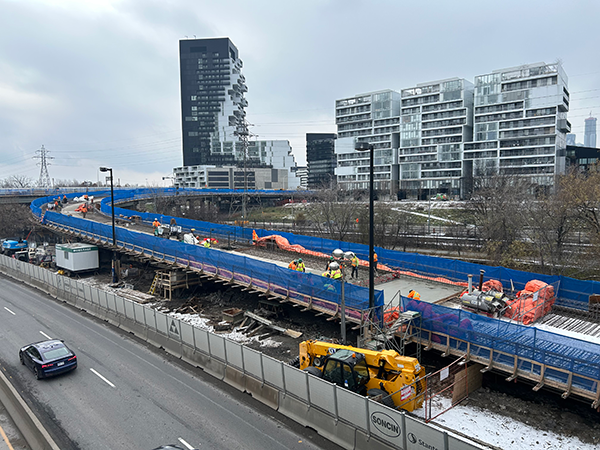
Considering the proximity of the four bridges, other unrelated construction nearby and the fact thousands of cars pass through that area daily, the city conducted intensive long-range planning in the lead up to the project and has continued to employ inventive procedures throughout the construction, she says.
“We’re trying to balance our goals in terms of getting work done and easing congestion along with making sure that we get very high-quality work and working with the contractor in order to accomplish both.”
Just one example was the use by Harrison Muir Inc. of a specialized Rapid Deployment Unit system to coat the structural steel on the undersides of the bridges without having to close lanes on the Don Valley Parkway, the major north-south highway in the area and one of the city’s busiest corridors. Enclosed access allowed its crews to safely perform sandblasting coating over live traffic on the parkway.
There was also a high degree of co-ordination with Metrolinx, Waterfront Toronto and private developers to minimize the impact on their projects.
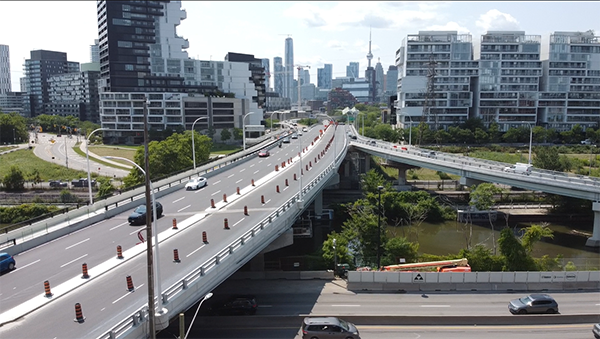
As an example, Graham Harkness cites the scheduling of rehabilitation work on the Don Valley Parkway off ramp so it wouldn’t interfere with regular maintenance on the parkway by city crews.
Given the scale and complexity of the work, multiple specialized crews operated throughout the project. Depending on construction needs, there could be three to five crews onsite at any given time, she says.
“These included dedicated teams for structural jacking and bearing replacement, steel coating, electrical work, paving, waterproofing and concrete demolition and forming, rebar installation, traffic control and finishing elements such as railings.”
To meet accelerated timelines, the contractor implemented extended working hours and flexible scheduling. Crews worked in two extended shifts covering approximately 20 hours within a 24-hour cycle. The most intensive periods occurred during the full closure of the Don Valley Parkway off ramp from fall 2025 to its reopening this past spring.
Eighty overnight shifts were used to expedite the critical rehabilitation work. Weekend work was also strategically scheduled, with frequent Saturday daytime work and selective Friday night and Sunday night operations, depending on construction requirements, she says.
While emphasizing the project is part and parcel of the good repair policy, Graham Harkness acknowledges the accelerated work on the Don Valley Parkway off ramp was influenced by the recent FIFA games.
“We didn’t know the full details of the FIFA games when planning started and the original plan was to work through the games.”
But shortly after the project started in 2024 the city made the fateful decision to accelerate the project to complete it before the games got underway.
Although the bridge construction site is several kilometres from Toronto Stadium (the corporate FIFA name used for BMO Field), traffic does tend to be interconnected and has ripple effects, say Harkness.
And certainly the 15-kilometre-long Don Valley Parkway which connects the Toronto’s northern suburbs with the downtown area is a major artery into the city, she points out.
Of course, the overriding objective was to keep traffic moving and minimizing the disruption to the community. That was the rationale for closing the off ramp to Richmond Street rather than sporadic work.
“We wanted to get in there, get it done (the repairs) and then get out.”
Most of the very complex rehabilitation on the four bridges has now been completed. But undercoating and some other work will take the project into early next year, says Graham Harkness.