Major marine construction projects are in the works at the Port of Brunswick in Georgia that will increase capacity and improve vessel access at one of the fastest-growing vehicle ports in the United States.
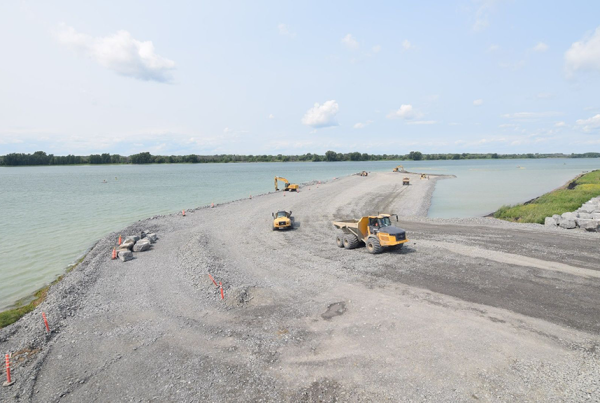
Crews are currently dredging both the inner and outer harbour channels to restore the waterway to its authorized depth of approximately 36 feet, while a construction project is underway to build a fourth Roll-on/Roll-off (RoRo) berth at the nearby Colonels Island Terminal.
At the same time, another harbour improvement will widen a bend in the channel and expand the port’s turning basin where tugboats maneuver ships for docking.
Together, the dredging and berth construction projects represent roughly $126 million in harbour work, all aimed at improving ship navigation and increasing the port’s ability to handle growing cargo volumes.
“This is terrific news for our customers, who rely on the Port of Brunswick to serve the fast-growing Southeast market,” Georgia Ports president and CEO Griff Lynch said in a statement. “Deeper water will mean increased vessel transit efficiency at America’s premier auto port.”
The improvements come as Brunswick cements its role as the nation’s busiest gateway for automobiles and heavy equipment. The port handled more than 900,000 units of RoRo cargo in 2024, including vehicles and machinery driven directly on and off ships.
The dredging work now underway is a routine but essential part of maintaining navigable waterways. Natural processes constantly deposit sediment into harbour channels, gradually reducing water depth and restricting the size or loading capacity of vessels.
Specialized dredging equipment is working in both the inner harbour near the docks and the outer harbour approaching the port entrance.
Mechanical dredges and hydraulic cutter-suction dredges are typically used in such projects. Mechanical dredges lower large buckets to scoop sediment from the seabed, while hydraulic dredges use rotating cutter heads to loosen material that is then pumped through pipelines to designated disposal areas.
The dredged sediment is transported to approved offshore placement sites or containment areas.
Bruce Fendig, president of the Brunswick Bar Pilots Association, said maintaining the channel depth allows RoRo vessels to transit the channel with increased safety and efficiency.
“Greater depth also allows vessels loaded with more cargo to transit the channel without having to wait for high tide.”
Ships carrying between 4,000 and 8,000 car equivalent units are now common in international fleets, and vessels capable of transporting up to 10,000 vehicles are expected to serve U.S. East Coast ports in the coming years.
By accommodating larger ships with greater cargo loads, ports can reduce the number of voyages required to move goods. This lowers shipping costs for manufacturers and ultimately consumers.
While dredging improves access to the harbour, a major landside project is expanding capacity at Colonels Island itself.
Construction crews have begun work on the RoRo berth. When complete, the berth will provide an additional docking position where ships can load and unload vehicles, trucks and heavy machinery.
Building the berth involves a number of steps. First, contractors install deep steel sheet-pile walls driven into the seabed to form the structure of the dock. These interlocking steel panels create a retaining wall that stabilizes the shoreline and supports the dock platform.
Behind the wall, large volumes of fill material are placed and compacted to create a stable backland area for cargo operations. Reinforced concrete deck sections are then constructed along the waterfront to provide a durable working surface capable of supporting heavy vehicles and port equipment.
Because RoRo cargo includes large construction machines weighing up to 100 tons, the pavement systems behind the berth are typically designed with extremely thick concrete slabs – sometimes more than a foot thick – to withstand the loads. The berth is scheduled for completion in fall 2027.
Later this year, engineers plan to widen a bend in the shipping channel and expand the turning basin, an area of deeper water where tugboats help ships rotate before docking or heading back out to sea.
Survey teams will first map the harbour floor using sonar and GPS equipment to determine where excavation is required. Dredges will then remove material from the designated areas. In some sections, protective rock or sediment stabilization measures may be installed along the channel edges to prevent erosion.
Congress has already approved $11.35 million for the federal share of the project, with the state of Georgia contributing just over $6 million.
The construction projects are part of a broader expansion of the Colonels Island Terminal, which is undergoing more than $262 million in upgrades. Recent improvements include expanded paved vehicle storage areas, near-dock warehousing and rail infrastructure designed to move vehicles directly from ships to trains.
Meanwhile, the Corps of Engineers is expected to begin a feasibility study to examine whether Savannah Harbour should be deepened and widened to accommodate even larger vessels.
Congress recently allocated $500,000 to start the study. The review will begin after the Corps receives the federal funding and a cost-sharing agreement is reached with the state of Georgia. Total cost of the three-year study is expected to be $3 million.