Many in the construction industry foresee the continued expansion of data centres as a key part of their growth projections for 2026 and beyond. However, could hyper-scale data centres be too much of a big thing?
Factors are emerging that could force builders to dial back expectations.
On one hand, Bob Pragada, CEO of engineering and construction solutions provider Jacobs, told a recent earnings call that Jacob’s sees “a very strong runway to build on that success in the second half of the year. The investment cycle is still in the early stages.”
Even so, not all construction players are in a position to take advantage of the current boom.
Aarni Heiskanen of Finish-based AE Partners references remarks made at the Datacenter Forum 2026 in Helsinki by Ciarán Forde, senior vice-president at CTS Nordics.
“The industry must rethink everything. Data centres are no longer just construction projects with a tight schedule, but rather technology production systems with a construction component.
“The machine sets the terms,” explains Heiskanen. “In a data centre, the IT load defines everything else. Design starts with power distribution, cooling topology and redundancy strategy.
Architecture and structure follow. MEP systems can represent 70 per cent or more of construction costs in demanding facilities.”
Construction industry players must adapt their methods and delivery platforms.
“If they (builders) continue to approach data centres as construction projects with unusual specifications, they will be treated as execution vendors, brought in for the concrete and steel, and then left behind while the real integration work happens elsewhere,” says Heiskanen. “The contractors who will matter in data centre construction are those who are ready to rethink their role from site executor to system integrator.”
Speed of completion is the objective. As a result, prefabrication is impacting the data centre building process through repeatable systems, integrated supply chains and digital workflows that carry across projects rather than being rebuilt each time.
Paola Manteca, general manager for modular data centers Europe at Schneider Electric, describes the new data centres as a series of “factory-preassemble pods and skids, integrated power, cooling, cabling and containment, to cut onsite work and reduce errors. The construction timeline is being compressed from the outside by companies whose primary business is not construction at all.”
Another factor to consider is the intimidating scale of the newest data centres. Resistance has grown beyond the local level to higher jurisdictions. Major concerns include the volume of power and water required.
A recently approved data centre campus in Utah called Stratos, backed by Kevin O’Leary, could, upon completion, use natural gas to self-generate and consume more than twice the entire state’s current average electricity usage.
Developments of this scale are leading to further questions such as noise levels and environmental pollution, resulting in many municipalities, and even entire U.S. states, declaring moratoria on future developments.
The need for land is another issue beginning to confront facility developers.
As reported by Cushman & Wakefield, the average data centre covered about 224 acres in 2024, a 144 per cent increase since 2022. Another study suggests the latest hyper-scale facilities will require as much as 1,000 acres. In fact, O’Leary’s Stratos facility has been approved to occupy 40,000 acres of private land plus 1,200 acres of military and state-owned property.
This demand for land is forcing new data centres into rural areas, often replacing valuable agricultural land, and resulting in growing tensions.
“Some local governments are exploring policies to treat data centres as a distinct land use, steer development away from prime farmland and apply additional reviews to large-scale projects,” says the World Resource Institute. “These approaches can include strengthened agricultural zoning and implementing performance standards to address buffering, traffic, noise and long-term site management.”
Given the near-boundless growth of AI and its required computing power, one might ask if hyper-scale data centre development at this scale is too big to fail.
Not necessarily. owever, However, some observers suggest it could be too much of a big thing. Looking ahead in time, they believe that small might be the new big. As witnessed with computer systems, technological power can develop enormously while actual size decreases. Why not data centres?
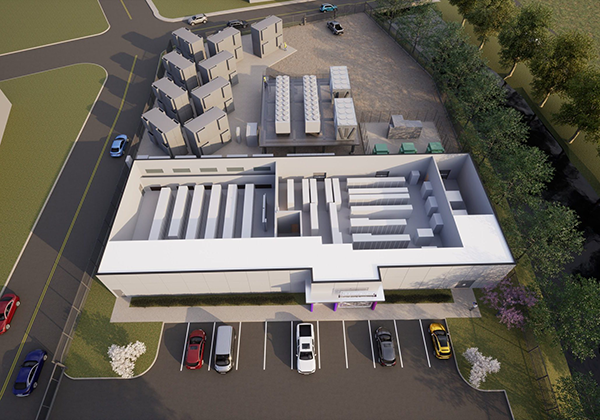
Pete Sacco, founder and CEO of PTS Data Center Solutions, told a recent Data Center World conference in Washington, D.C. that clusters of small data centres requiring only five to 20 MW of power are the future.
Sacco noted many large projects are now being cancelled due to interconnection delays and local pushback. At the same time, he said inference work — answering prompts — as opposed to training, is growing rapidly and will account for 55 per cent of AI computing demand in 2027.
He explained inferencing requires a response time of about one millisecond, one-tenth of that required by training. This means new facilities will need to be located closer to users and not on remote rural flatlands.
“Instead of having a 1,200-MW data centre — which there are no more places for — I can build 120 10-MW data centres in a region (and) glue them all together,” he said. “The idea is to be the Starbucks of the data centre industry. Some of them will be company-owned. The majority will be franchised-owned. Some will be independent, but they will all operate as a (distributed autonomous organization) and they’ll all operate using that same cloud approach.”
If Sacco’s predictions come to realization, the implications for the construction industry are enormous. Small, repeatable facilities built quickly across many more sites also reinforce the points made by Forde, Heiskanen and Manteca concerning building delivery platforms.
Whichever path future data centre development takes, either continued super-sized singular facilities or smaller interconnected networks, the construction industry needs to prepare and adapt as never before.
John Bleasby is a freelance writer. Send comments and Inside Innovation column ideas to [email protected].