Office-to-residential conversions continue to move forward rapidly, particularly in the United States.
According to one analysis, over 90 conversions across the U.S. are scheduled to be completed by the end of 2027.
This wave of conversions is the result of pandemic-era decision-making, writes Travis Barrington, co-founder and CEO of media and research platform Propmodo. Conversion projects typically run three to five years from announcement to occupancy when conditions co-operate, he explains.
Many of the buildings looking at completion in 2027 were actually rezoned, financed or purchased in 2023 and 2024. During this period of historically high office vacancies, developers began to see the financial opportunities surrounding commercial assets that had collapsed in value.
Even more impressive is the number of housing units actually being created.
A March 2026 report from RentCafe says the number of office-to-apartment conversions in the U.S. reached 90,300 units at the start of 2026, up 28 per cent year-over-year and nearly four times larger than in 2022.
“Office conversions now account for almost half (47 per cent) of all future adaptive reuse projects nationwide.”
Commercial office vacancy rates vary across cities in the U.S., with higher conversion rates going hand-in-hand with higher vacancy rates.
“In early 2025, national office vacancy was close to 20 per cent, while physical occupancy in many buildings hovered around just 50 per cent – 55 per cent,” says RentCafe. “That gap has left millions of square feet underused, opening the door for large-scale residential conversions.”
Although high vacancy rates persist in Canadian cities as well, the situation appears to be improving in some markets.
A CBRE report released this past April speaks of a shift towards reduced vacancies across the country overall.
“Net absorption was positive for a third consecutive quarter and led by Toronto once again. Overall, six of 11 markets reported positive net absorption at the start of 2026.”
The report also says the national sublease space declined for the 11th consecutive quarter and is well down from its previous peak.
“Given current trajectory, sublet space could soon fall to a level on par with averages leading into the pandemic.”
However, what might concern the building industry is that new supply coming on market in Q1 of 2026, alongside record low starts, has resulted in total new construction dropping to a 22-year low. However, in the absence of new commercial office projects, the CBRE report provides a bright spot for construction players concerning conversion opportunities.
Over 1.5 million square feet of office space was removed from inventory for conversion into residential in Q1 of 2026, a record quarterly high. In fact, since 2021, CBRE says conversions and demolitions have helped reduce office inventory space by 2.5 per cent and could outpace new supply in the year ahead.
As promising as this might sound for those interested in office-to-residential conversions, the number actually underway varies enormously across Canadian markets.
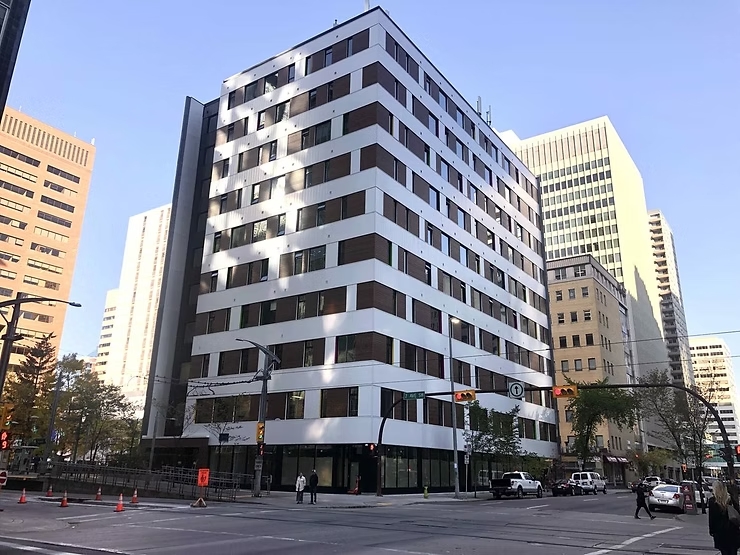
Recent CMHC figures show non-residential to residential conversions underway in Calgary are on track to provide almost 1,400 new units, nearly 40 times the number in Toronto’s pipeline. One explanation is Calgary’s Q1 office vacancy rate of nearly 28 per cent versus Toronto at 17.6 per cent.
The City of Calgary has responded to this high vacancy rate with supportive financing and zoning policies that set a high standard for others to follow.
For example, in February, Calgary announced 128 new homes aimed at low and moderate-income groups will be delivered through the city’s inaugural Downtown Non-Market Office Conversion Grant. This new initiative is aimed at transforming underused downtown office space into much-needed non-market housing. Project costs of $55 million for the two developments are assisted by $10.3 million in funding through the federal Housing Accelerator Fund.
Calgary’s continuing Downtown Development Incentive Program has already supported 21 office conversion projects, six of which are already completed, representing $805 million in private investment. This has created 490 new homes in the city core, including 170 below-market and affordable units.
Office-to-residential conversions require serious ROI analysis, and when undertaken can span several years, and are often held back by structural constraints, high construction costs, financing hurdles and local regulatory requirements.
These factors are identified by The Atmospheric Fund (TAF) as often standing in the way of conversion projects. However, TAF points out there are several financing programs available across Canada through governments and other sources that support conversions, particularly those aimed at carbon reduction in the final result.
“The capital is ready, but we need policy certainty and market activation to really scale retrofits and reap the benefits as a society,” says TAF.
With the outlook for new commercial office projects appearing to be weak, exploring office-to residential conversions would seem an opportunity to be explored by developers and the construction industry.
John Bleasby is a freelance writer. Send comments and Climate and Construction column ideas to [email protected].