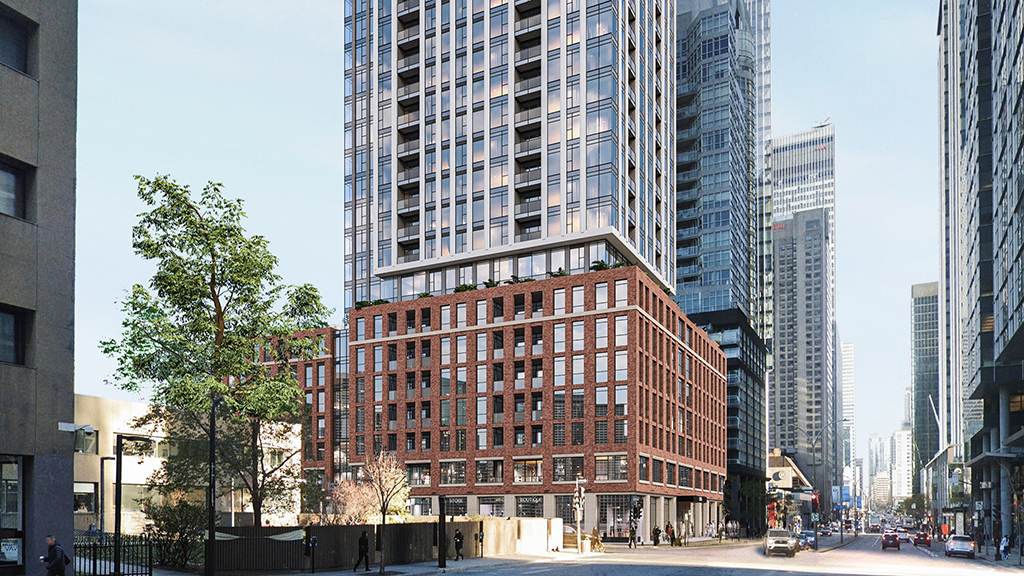
At a time when many developers are looking beyond Montreal’s downtown core for new opportunities, a Quebec-based real estate group is moving in the opposite direction by betting on a $200-million, 30-storey rental tower with 400 new housing units at 1355 René-Lévesque Blvd. W.1355, Boulevard René-Lévesque Ouest Rental Residential Building ConstructionStatusPre-Construction/NegotiatedValue$200MLocation1355 Boul. René-Lévesque Ouest, Montreal QC H3G 1T3SectorPrivateTypeMulti-Residential · Demolition · New ConstructionData as of June 9, 2026View Project Page →
The project, unveiled recently by Groupe HD, will transform the former YWCA site into a mixed-use, transit-oriented development in the heart of the city.
The complex will include street-level commercial space beneath a residential tower designed by NEUF Architectes. Construction Praxis will serve as general contractor.
The former YWCA building has reached the end of its useful life, according to the developer, and the new tower will make way for a more contemporary redevelopment aligned with urban needs.
The structure is one of the largest residential projects announced for downtown Montreal this year and reflects a growing confidence among some developers in the long-term future of the city’s core, despite a broader trend toward residential construction in suburban and emerging neighbourhoods.
“Downtown remains a key hub of Montreal,” explained Thomas Dufour, co-president of Groupe HD. “We believe in its capacity to evolve and in the importance of maintaining a high-quality residential offering. This project is part of a long-term vision aimed at actively contributing to its vitality.”
New housing projects have been sprouting up in neighbourhoods outside the traditional downtown core as builders seek larger development sites and respond to changing residential preferences following the pandemic. For Groupe HD, however, the former YWCA site presented an opportunity to secure a strategically located site in an established district.
Located in the Golden Square Mile area of Ville-Marie, a defining attribute of the development is its proximity to the Lucien‑L’Allier metro and commuter rail station, positioning it as a transit-oriented development (TOD). The site is also within walking distance of major employment hubs that includes banks, hotels and academic buildings operated by Concordia University.
The combination of transit access, employment density and amenities continues to make downtown an attractive location for renters, developers say, particularly young professionals and students seeking car-free lifestyles.
Dufour said those characteristics make the project particularly attractive.
The development follows the TOD model, emphasizing higher-density housing near major transportation infrastructure.
The project also arrives at a time when land values in some downtown sectors have stabilized, creating opportunities for developers willing to take a long-term view.
According to Groupe HD, stable land pricing in the Golden Square Mile helped make the economics of the project feasible while allowing the company and its partners to diversify their real estate holdings.
Capital Property Developments, a Montreal-based real estate investor and development partner on the project, views the location as one of the development’s greatest strengths.
The tower will feature a stepped design, with a commercial podium integrated into the surrounding streetscape and the residential component set back above street level. This approach is intended to maintain a pedestrian-friendly environment at the street level while increasing residential density on a site already serviced by infrastructure.
Developers say the inclusion of retail and commercial space at ground level will help animate the streetscape and contribute to the area’s economic activity.
The project will also mark the end of the former YWCA building, which has occupied the site for decades. Following the relocation of YWCA activities to eastern Montreal in April 2025, Groupe HD determined the existing structure had become obsolete and no longer suited contemporary residential or commercial needs.
Rather than redeveloping a greenfield site on the urban fringe, the company is choosing to intensify an already serviced property in the city’s centre – a strategy that aligns with broader municipal objectives aimed at increasing housing supply within existing urban areas.
Construction is expected to begin this fall. Demolition approvals have already been secured.
The project also underscores a broader shift taking place in some major North American cities, where developers are increasingly viewing downtown districts not solely as employment centres but as complete residential communities.
Groupe HD, which is involved in more than 20 projects representing more than 10,000 residential units across Quebec, says the investment signals confidence that downtown Montreal will continue to attract residents seeking an urban lifestyle connected to transit, employment and amenities.