THUNDER BAY, ONT. — Construction has begun on one Ontario First Nation’s road to the Ring of Fire mining region.
Premier Doug Ford is visiting Webequie First Nation today to mark the milestone, his first visit to a region he has spoken about often since taking power in 2018.
Webequie is one of two remote fly-in First Nations that have signed partnership deals with the province in order to connect them to both the proposed mining area and to the provincial highway system.
The proposed road and mine has angered a number of other First Nations in the area that are opposed to development in a largely untouched part of the province.
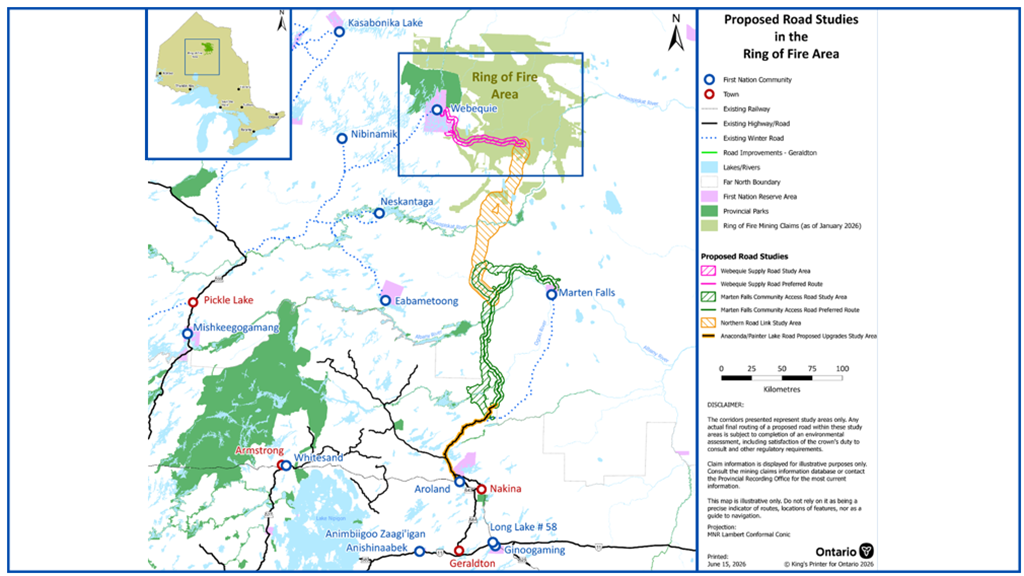
Webequie has already cleared part of the road that sits on its reserve, which is on an island about 500 kilometres north of Thunder Bay, Ont.
The community’s leadership has said it wants the road in order to help lift itself out of poverty and to connect to the provincial highway system.
Climate change is fuelling the desire for an all-season road as the winter road season continues to shrink. That road is the community’s lifeline as it trucks in diesel to power the reserve as well as materials for any type of construction, including new homes.
The province says construction is underway on the Webequie Supply Road, which will run 107 kilometres east through wildly varied terrain, from esker rock to peatland and be completed by 2030.
Ford says the Ring of Fire is a “once-in-a-generation opportunity.”
“We’re delivering on our promise to protect Ontario and we are doing so in partnership with First Nations, to support true economic reconciliation,” the premier said in a statement.
“We appreciate the partnership of First Nations leaders and communities, including Chief Lorraine Whitehead and Webequie First Nation, as we can continue our work to create opportunity and prosperity across the north.”
The province inked a deal with Webequie for nearly $40 million to build a community centre with an arena, rebuild an airport terminal that recently burned down and provide equipment to build the road.
There is also money to help Webequie with badly needed mental health resources.
“Today is about Webequie First Nation and their leadership, together with partnering First Nations in the Ring of Fire region, who remain committed to protecting traditions and their way of life in the Far North, while moving forward on the modern legacy infrastructure needed to access the kinds of economic activities that create lasting prosperity,” said Indigenous Affairs Minister Greg Rickford.
Australian mining giant Wyloo is looking to build a big nickel mine in the region and has its eyes on several other potential spots to mine in the mineral-rich area.
Wyloo along with Juno Corp., a Canadian junior mining company, own the vast majority of the 40,000 claims staked in the Ring of Fire.
A series of proposed roads make up the larger road to the Ring of Fire.
Several hundred kilometres south of Webequie is Marten Falls First Nation, which is set to begin construction on its road in August. In between Marten Falls and Webequie will be the Northern Road Link, which the province said will begin construction in 2028.
Ford has long held a vision of mining and refining critical minerals in the province’s north and connecting it to the once-burgeoning electric vehicle battery industry in the south.
But the EV market in Canada is collapsing, in part due to decreased electric vehicle demand as well as the ongoing trade war started by U.S. President Donald Trump, who has said his country does not need or want Canadian-made cars.
©2026 The Canadian Press