Interstate 15 (I-15) is a north-south highway that runs between San Diego and Sweet Grass, Mont., on the Canadian border.
The 1,400-mi.-long I-15 passes through San Bernardino County, which is 50 mi. due east of Los Angeles, and the San Bernardino County Transportation Authority (SBCTA), along with the joint venture Skanska and Coffman Specialties, is working on a long stretch of it to enhance area traffic flow.
Significant Congestion
The average daily traffic in the project area tops 220,000 vehicles. The project area is near three major highways: State Route 60, Interstate 10, and State Route 210.
At each crossing of the major highways and I-15, there is significant congestion. It’s particularly slow going at the I-15 / I-10 interchange. That’s no surprise since half of the interstate truck traffic traveling in and out of Southern California passes through the interchange. The route serves as a connector between Las Vegas and Southern California.
The SBCTA said, “Interstate 15 (I-15) is an economic lifeline connecting San Bernardino County and the nation.”
Additional Express Lanes
The project area runs for just under 11 mi. The team is adding two express lanes in both directions for a total of 8 mi. At the southern end of the project, the new express lanes tie into others in Riverside County.
Upon completion, the corridor will include four regular lanes and two express lanes. The lanes will end at Route 66 (Foothill Boulevard0.
Due to the heavy truck volumes in the area, the team of the SBCTA and Skanska is adding a third lane for freight traffic along a 2-mi. segment north of I-10.
Other project elements include:
• 33 bridge widenings
• Installation of 12,000 ft. of retaining walls and 10,000 ft. of sound walls
• Improvements to drainage and electrical systems
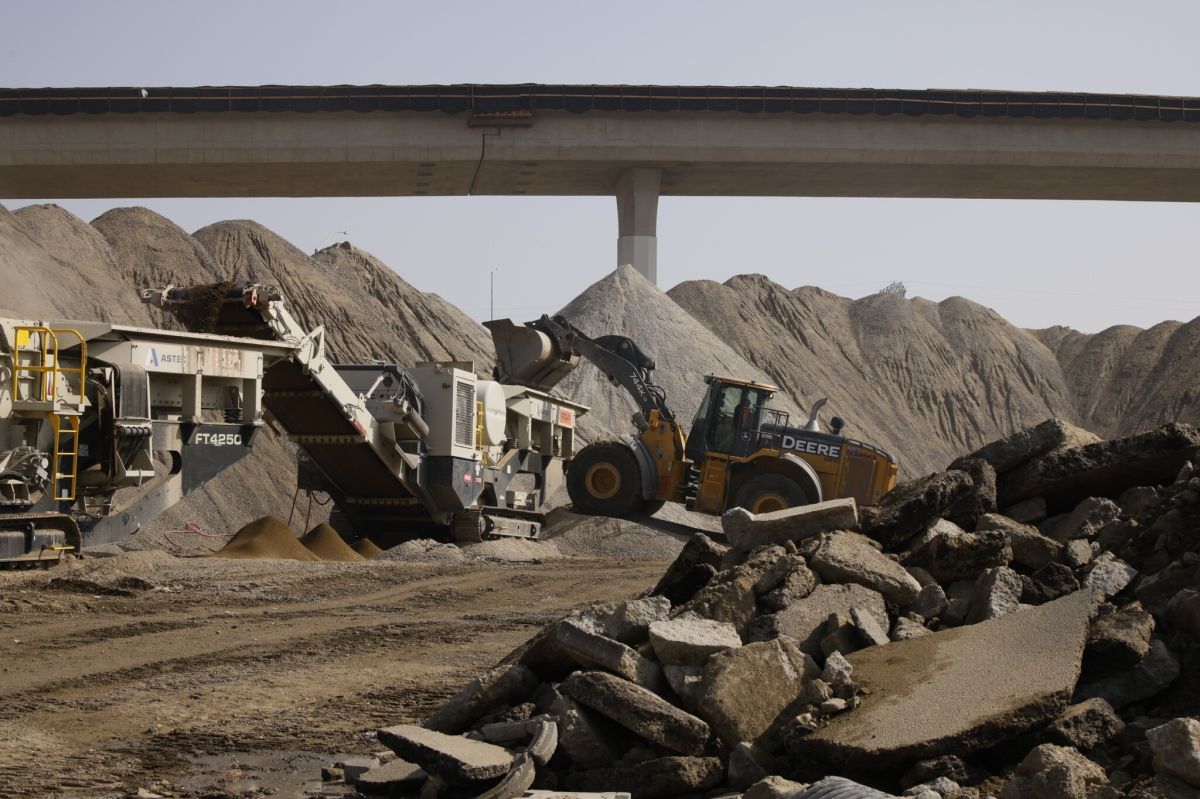
• Concrete and asphalt paving
Why build the sound walls?
“At the northern end of the project, past where the express lanes end, there’s a major mall and shopping as well as some communities,” said Skanska Project Executive Rafael Gutierrez, who is overseeing the project.
And the retaining walls, most of which are on the northbound side of the I-15?
“We’re building the retaining walls along the east side of the freeway, which is mostly a commercial area, so SBCTA couldn’t really acquire more land, which means they’re limited on the area that they can do the widening on,” Gutierrez said. “Because they can’t just have embankments in there, they have to do retaining walls to widen the freeway.”
Straightforward But Big
Gutierrez describes the project as standard, just big.
“The staging on the project is pretty simple,” he said. “We push traffic to the inside. We widen the outside in both directions. Then, once the outside is complete, we push traffic to the outside and build the inside.”
What isn’t simple is the amount of structural work, along with all the roadway work needed to complete the outside widenings.
Another challenge: maintaining the pace of construction to meet the schedule.
“We basically had to open up the whole job and work everywhere at once,” Gutierrez said.
Maintaining the pace is complicated by the fact that one of the bridges is over an existing flood-control channel. The scope calls for widening the two outer sides and one inner side.
Due to fish and wildlife protection mandates, the team is only allowed to work from April 15 through Oct. 15.
Gutierrez explains what the team did to ensure the bridgework would fit into the schedule.
“When we started the project, we did all the substructure for that bridge, including for stage two, so that we wouldn’t have to go back in the channel because we don’t want to wait till next season to go back in and tear out throughout the channel and build the next substructure for the bridge,” he said. “During our first season, when we could work in the channel, we worked overtime and double shifts to complete all the work.”
Another scheduling issue: three of the bridges the team is widening are over railroads. Two belong to Union Pacific, and one belongs to Metrolink.
“Working with the railroads requires coordinating with them to ensure we get the work done in the windows of time they allow,” Gutierrez said.
Finally, there’s a Kinder Morgan (energy infrastructure company) line that runs adjacent to the tracks of one of the Union Pacific crossings. The team has to drill piles between the tracks, and Kinder Morgan has a fuel line running through the job site.
“Kinder Morgan recently relocated the line, and it runs from one side of the freeway to the other,” Gutierrez said. “We’ve been potholing up to 90 feet deep to locate and positively identify the line prior to proceeding with the bridge construction in the area.”
The area poses a safety challenge for the team. The team is performing significant night work to avoid interfering with the shopping areas at the north end of the project. The area also includes multiple restaurants and bars.
“On the weekends and Fridays, there’s lots of drunk drivers through the areas,” Gutierrez said. “Our guys noticed that on Friday nights, there was more drunk driving and people running through our lane closures.”
The team switched the schedule to avoid Friday nights and instead works from Sunday night to Thursday night. While they still see some drunk drivers, there are fewer.
Good Partnership
The project’s construction budget is $390 million. So far, the project is on budget within the contingency.
Work on the project began in February 2025, and the lanes are expected to open to traffic in August 2028. The team must complete the work four months prior and turn it over to the Tolling Service Provider, so they can input what they need to get the road ready. The project is on schedule.
Gutierrez attributes the team’s on-time, on-schedule performance to the preplanning it did and the constant communication between the teams.
Another key to the partnership between the joint venture and SBCTA: “We’re really partnering with each other to keep the project moving, not pointing fingers, and treating the problems as our own,” Gutierrez said.