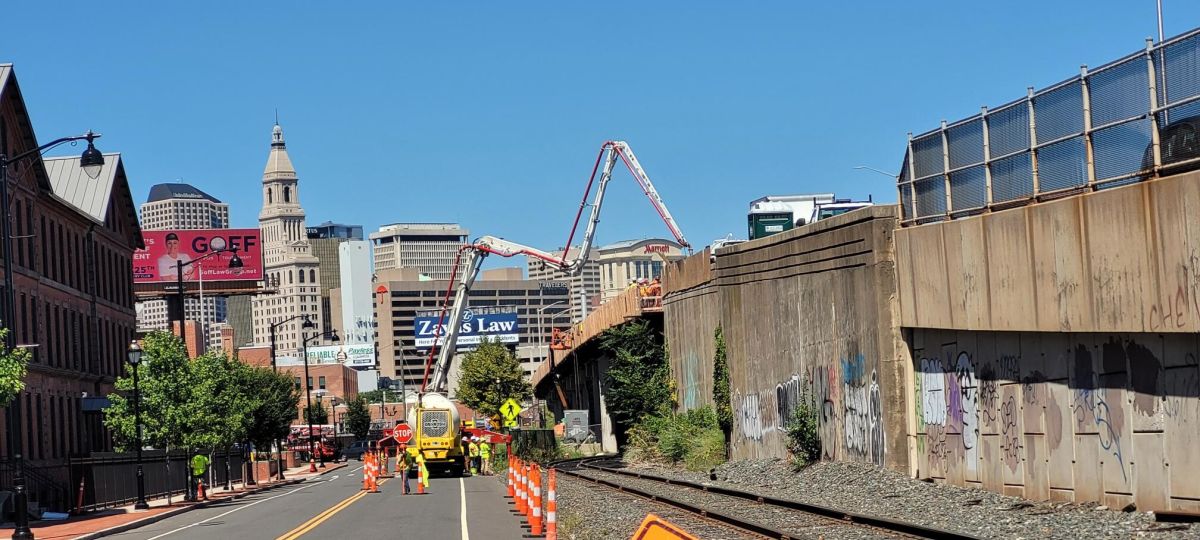
The Connecticut Department of Transportation’s (CTDOT) $91 million design-build rehabilitation of the Dutch Point Viaduct project, which started in February 2025, is expected to be delivered in summer 2027. J.F. White Contracting Company is the lead contractor on the project.
At 1,800 ft. long, the three lane, concrete viaduct on I-91 southbound spans the Connecticut Southern Railroad and the I-91 northbound ramps to and from Whitehead Highway in Hartford. The construction zone covers I-91 southbound between the Connecticut Convention Center and the Colt Armory.
“The project is upgrading the bridge’s structural elements to current design standards, which will improve its load carrying capacity and extend its service life,” said Eva Zymaris, spokesperson of CTDOT. “Design began shortly after the project was awarded in December 2023, and construction began in early 2025. The Dutch Point Viaduct was built in 1964, making the structure 62-years-old.
“The bridge is deficient by today’s standards,” Zymaris added. “The rehabilitation will increase the viaduct’s lifespan by at least 25 years, allowing it to function efficiently for many more years, reducing frequent repairs and ensuring a reliable transportation route. The Dutch Point Viaduct serves as a critical connection to downtown Hartford — with thousands of people relying on this stretch of I-91 daily.”
The work includes the pouring of a new bridge deck with an upgraded drainage system, the installation of new parapets that meet the latest federal standards and new standard highway lights, the metallizing of bridge girder beam ends and steel strengthening repairs to bridge girders to increase load carrying capacity. The replacement and repairing of bridge bearings and placing of new micropiles and concrete encasement of steel pier bents will strengthen the substructure of the bridge and increase load carrying capacity.
The replacement of the bridge deck began in Spring 2025, shortly after the completion of the superstructure design phase in early 2025.
The bridge deck reconstruction required the closure of the State Street on-ramp to I-91 southbound for approximately 18 months. The closure, initiated on March11, 2025, coincided with the start of the detour route.
“The project includes a comprehensive traffic management plan,” said Zymaris. “Our design-build team is constantly coordinating with nearby projects during construction.”
J.F. White hired Hardesty & Hanover to design the rehabilitation project.
“Designing a new deck that is being placed on an existing structure while trying to improve existing conditions to meet current standards was a challenge, as you are limited to the existing space and geometry,” said Jessica Carvajal, CTDOT project engineer. “Staging and maintenance and protection of traffic has been challenging for both design and construction; the bridge carries I-91 Southbound in Hartford and carries significant traffic. With the structure located near a levee and over the Park River Conduit, we had to do extensive coordination with regulatory agencies to ensure impacts were minimized.
“With the repairs and strengthening being done as part of the project, the bridge is anticipated to have an additional 25-year service life until a major rehabilitation is needed,” she added.
The design plan maximized the construction process.
“Having a cast-in-place concrete deck with a full lane closure allows the contractor more time to perform work and allows flexibility in the field when dealing with unforeseen issues due to the existing superstructure condition and geometry,” said Carvajal. “Use of precast deck panels was originally considered; however, the panels would need to be installed during nightly lane closures to minimize impacts to traffic and deck panel fit up issues were a concern. A cast-in-place concrete deck was proposed by the design-build team due to these concerns.”
Dealing with live traffic in a tight work zone is a constant challenge.
“We’re maintaining traffic flow at all times while keeping the public and the workers safe,” said Juan Ruiz, project engineer of CTDOT. “Workers access the construction zone through temporary lane closures during off-peak hours or at nighttime. Work is progressing as this project continues to move forward.”
Mostly, work is happening during the daytime with nighttime work, as needed.
“The next construction phase will split the highway in half by creating a work zone in the center lane of the highway,” said Ruiz, “That will necessitate nightly lane closures for the removal and installation of the bridge deck. The work zone is tight. We’re going one lane at a time for the removal and rebuilding of the concrete deck. There are no utility issues other than a portion of the bridge that is directly over the railroad. Coordination with the railroad is a daily occurrence.”
The project has been divided into four stages.
An early May construction update noted that day shift crews were engaged in track monitoring, forming joints and parapets, installing rebar and falsework, replacing bearings and bearing pedestals, strengthening steel, pouring pedestals, metallizing and installing conduit.
Pre-construction work in October 2024 saw J.F. White taking soil boring samples to gather data for designing micro piles. The demolition operations began in February with crews installing lagging under the bridge in advance of demolition.
Lagging installation continued into March, which also saw temporary barrier installed for Stage 1 construction on I-91 southbound and the removal of sections of concrete parapet on the bridge. The removal of the southbound deck took place between late March and early- to mid-May.
The operation to install a new deck for the southbound bridge began in May. Site prep crews cleared the exposed deck of rubble and other debris and then installed the rebar in May and June. Most of the concrete pours took place in August — early morning and during the day. The parapet also was replaced. After the rebar was placed, the parapets were cast-in-place.
The deck for the Whitehead Highway on-ramp to I-91 SB was removed in June and the new deck was poured in October, following a similar process for the bridge deck.
Major deck operations resumed last April on the northbound bridge. With the rebar already in place, the concrete pouring operations proceeded rapidly. Pouring operations will be completed in spring 2027.
Crews were on site during the winter months. In early, day work saw the setting and forming of scuppers; removal and installation of shielding bridge edge formwork on I-91 southbound; install stay-in-place deck and foam and rebar on I-91 SB, as well as falsework; steel strengthening; and bearing replacements. These operations continued into February, along with installing scupper forms, overhead brackets, and studs; replacing bearing pedestals; and barrier relocation and approach slab prep.
Late March operations saw a ramping up of preparations for concrete deck pours and early deck pours. Late April had crews engaged in major pouring operations for the deck and pedestals.
Removing and installing a new bridge deck is no easy task.
“For the deck removal to occur, a work zone area was established behind a temporary barrier on the bridge,” Ruiz told Construction Equipment Guide. “A debris shield was then installed between the bridge girders to catch any falling objects or concrete. The existing concrete bridge deck was saw cut in manageable, small sections for removal and disposal. A typical small excavator with a claw attachment picked up these square sections of concrete and placed them in a waiting dump truck for disposal. Then, the steel contractor installs stay-in-place forms and new steel studs on existing girders, followed by the concrete steel reinforcement. Once completed, the new deck can be poured in place.”
Ruiz noted that the demolition plan followed standard procedures and that the demolition contractor was quick and efficient.
“The existing deck came off relatively easy,” he said. “The replacement was a little more involved as you need to be more precise. A good survey and line of grade is extremely important to achieve the desired elevation match of the stage lines, proper slope, and gutter line.”
A 4,400-psi concrete, produced by a local supplier, was poured for the new deck and ramps/
“The reinforcement rebar is galvanized, which is something relatively new for us in Connecticut,” said Ruiz.
Average days have had more than 40 J.F. White and subcontractor personnel on site. The major subcontractors are Vinagro Corporation, Tri State Painting Inc., Algar Construction Corporation, Rizzo Corporation, Hub Foundation and Berlin Steel.
The amounts of materials generated by demolition activities have not been finalized, nor have the amounts of concrete, rebar, prefabricated concrete elements and others been fully tabulated.