New Westminster has some of the oldest sewer and water infrastructure in Western Canada.
“The city has approximately 206 kilometres of watermains and 294 kilometres of sewer mains, which includes combined, sanitary and drainage mains,” says Brittany Tom, a City of New Westminster integrated stormwater engineer. “The oldest known water infrastructure dates to 1937, while the oldest known sewer infrastructure dates to 1911.”
Unlike people, however, infrastructure that is old can be made new again.
As a member-municipality of Metro Vancouver, New Westminster (New West, as it is known locally) is required to develop and implement an Integrated Storm Management Plan (ISMP) to manage storm water and protect its watersheds.
On top of that, New West has developed a Water Asset Management Plan to guide how it looks after its water assets.
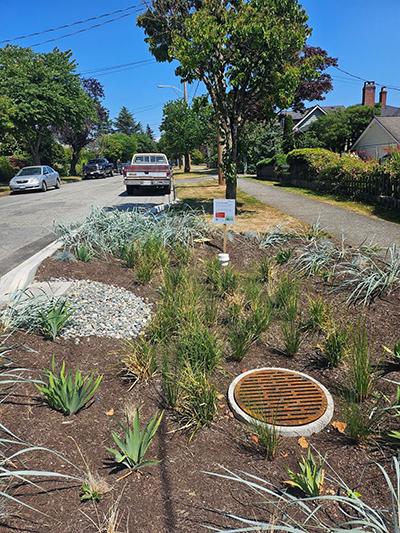
New West is currently focusing its sewer and water goals on the west end of the city. That is to say, it is installing storm sewers, watermains, rain gardens and flow monitoring stations in the 16th, 18th and 20th Street catchments.
RAM Engineering Ltd. of Vancouver is providing consulting services to New West’s engineering department.
Much of the work involves separating outdated combined sewers and replacing watermains.
Combined sewers are older underground pipe systems that carry both sanitary wastewater and stormwater in a single pipe, says RAM project manager Sara Mokhtari.
“During heavy rainfall, these systems can exceed their capacity, resulting in combined sewer overflows that discharge untreated wastewater into local waterways to prevent backups,” says Mokhtari. “The overflows can negatively impact water quality and aquatic ecosystems.”
Sewer separation is part of New West’s long-term strategy to eliminate combined sewer overflows and improve environmental protection.
Sewer separation replaces one combined sewer with two separate systems – one for sanitary wastewater and one for stormwater.
Separation reduces combined sewer overflows, improves water quality and increases infrastructure capacity and resilience during heavy rainfall.
The New West project also involves replacing aging watermains and installing new rain gardens.
“The watermain replacements are located throughout the west end project area,” says Mokhtari. “Most are within the same road corridors as the sewer separation work.”
Co-ordinating sewer and water upgrades in a single project minimizes road disruptions, reduces costs and limits the impact of the work to residents.
“One of the project’s most distinctive features is the integration of green infrastructure, in the form of 24 rain gardens, which naturally capture and filter stormwater before it enters the drainage system,” says Mokhtari. “Combining underground infrastructure renewal with nature-based stormwater management is a forward-looking approach that provides long-term environmental benefits.”
Mokhtari says the project is “a great example of how municipalities can combine essential infrastructure renewal with climate resilience and environmental stewardship.”
Construction began in April 2024, with work progressing through multiple catchments.
“The project is being delivered in phases,” says Mokhtari. “The phased approach helps minimize disruption while allowing the city to complete several major infrastructure improvements within the same program. It is expected to be substantially completed ahead of schedule by the end of 2026.”
The project has not been without its challenges.
“Working in an established residential neighbourhood like the west end requires careful planning in order to maintain access for residents, schools, businesses and emergency services during construction,” says Mokhtari.
“Regular communication through construction notices, open houses, project updates and proactive stakeholder engagement helped address concerns and build public trust. Strong collaboration between the city, consultants and contractors was key to successfully managing these challenges.”
Tom says the west end project is currently the city’s largest sewer and water infrastructure project.
Other sewer and water projects currently or soon to be undertaken are
a closed-circuit television sewer inspection and sewer rehabilitation program and the replacement of a watermain under Carnarvon Street.
Upgrades of three sanitary pump stations will be undertaken and completed in 2026 and 2027.
“The city is also planning the next phase of its multi-year construction program, although future project locations have not yet been finalized,” says Tom.
The West End Sewer Separation, Watermain Rehabilitation, and Green Infrastructure Project was nominated for a 2026 Association of Consulting Engineering Companies British Columbia award for engineering excellence in the municipal and civil engineering category.