A north Chicago synagogue will get new life while its redevelopment will spark a neighborhood revival.
Emmanuel Congregation, a fixture in the Edgewater district for more than 70 years but with declining attendance, will get a new home more suitable for its current membership as well as a new building compared to its current one that is increasingly shopworn.
As Andrew Degenholtz, co-president of Emanuel’s executive committee, told a public meeting this spring, it “isn’t holding together well.”
Edgewater is a working- and middle-class neighborhood bordering Lake Michigan about six miles north of The Loop. It has an ethnically diverse population with lively business arteries, solid middle-class homes – even an historic district – and its waterfront is characterized by highrise residential towers.
It is the waterfront where the new two-acre development is taking place.
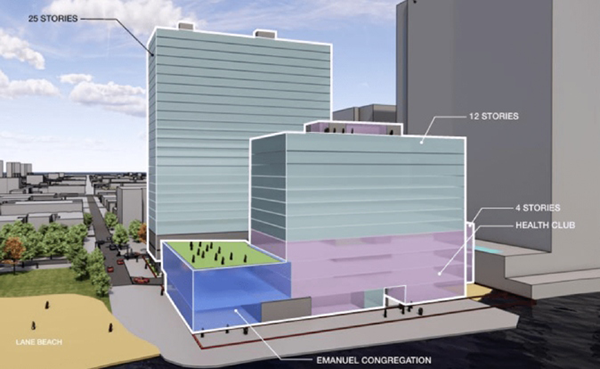
Emmanuel is working with Chicago developer Fern Hill to redevelop its property along with two others that will transform the site into highrise mixed-use residential along with a park-like setting with public access to the lake. Emmanuel is giving up its property in exchange for the new synagogue being integrated into the project.
The development seems right up Fern Hill’s alley. Its mission statement states it “seeks collaborative, community-driven opportunities that strengthen the neighborhoods in which we invest (and) improve the built environment to create experiences that reflect local identity and foster social connection, health and happiness.”
The synagogue announced the project last year and it has now gone through three iterations, the latest unveiled mid-July. This in large part is because of substantial input from the public, 48th Ward Alderwoman Leni Manaa-Hoppenworth, the civic lynchpin getting the project through city planning approval, told the Daily Commercial News.
The first proposal had a solid block building with a courtyard in the middle. The second had three highrises bordering the lake but with more public access. The third still has lakefront buildings but two highrises instead of three. Pedestrian access would be enhanced through an east-west walkway and building setbacks.
The development would also bolster an adjoining public park and beach with restrooms, more public safety and even an eco-bird-friendly park design.
“There’s guaranteed public access to the lakefront,” Manaa-Hoppenworth said.
The alderwoman said the community definitely “wants them (Emmanuel) to stay. And we’ve been working with them, the developer and the community to find a way to make this happen.” Besides public meetings there have been 850 letters and more than 1,000 online comment forms submitted.
Among the most important considerations is more affordable housing. This includes that the overall 605-unit apartment towers have 25 per cent family units.
Manaa-Hoppenworth said this is important because “rents are spiking and resident numbers have gone down. And we’re a ward where over 65 per cent of us are rentals.”
It’s also an area with high transit access and good retail.
As she says, “it’s a high opportunity community and yet we still don’t see the affordable housing that we need.”