London’s Bus Rapid Transit (BRT) network is still a couple of years away but is already attracting some development along its two main designated routes.
But developers have been slow to see the merits of building along the lines, perhaps a reflection of this being a smaller city in contrast to larger urban areas that have seen massive transit-oriented development (TOD) along subway and light rail.
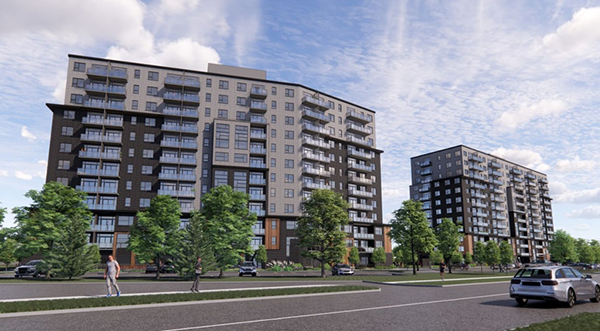
However, local developer Foundation Capital is proposing the largest project yet along the Wellington Gateway route, two almost 30 storey towers – a total of 1,004 units – just southeast of downtown in the so-called Old South.
These would be purposely designed with few vehicular parking spaces and an abundance of long-term bicycle parking.
“We are proposing these towers right along the BRT with minimal parking because we want the Canadians who are going to rent from us to save money, take the bus and have money left over to invest, not have it all go to the landlord. It’s also going to be environmentally friendly,” principal Jeff Wybo told local media.
The BRTs, the other one is called the East London Link and there’s a Downtown Loop connection, are zoned so that developments encourage transit use such as minimal parking.
In Foundation’s case, this will also save the developer money – $60,000 per space – which means apartments can be more affordable.
The development is to go before the city’s planning committee in September with construction beginning next summer.
Foundation officials didn’t reply to requests for comment to the Daily Commercial News.
But the City of London’s manager of community improvement and urban regeneration Mike Macaulay says there has not been a “rush of applicants” along BRT routes.
The main reason, a consultant’s study found, was that it’s simply “very expensive.”
Macaulay said the stumbling block is land costs.
“To get feasible development these days it requires land amalgamation,” especially in or near the core with a lot of older or historical properties.
“You get into those row properties with not very much frontage.”
For a 20-plus tower a developer would have to buy several properties having multiple owners. “We found that land amalgamation is one of the challenges, actually probably preventing a lot of development along these routes.”
Moreover, London is seeing rapid growth in its suburban northwest, southeast and southwest.
“Our development community they’re pretty satisfied, they’re pretty busy,” he said. “They’ve got the next 10 years of projects queued up – a lot of big towers out on the edge of London where land is cheap and they can get their big parcels and they can hit the density that they want.”
Macaulay said Foundation Capital’s proposal is an example of this.
“They’ve taken five parcels together,” he said, adding the location, not far from downtown, is amenable to walkable neighbourhoods and for people who likely wouldn’t have a vehicle.
And lack of parking would make sense from a developer’s cost perspective.
“That would be the tradeoff, anyone whose intending on purchasing or renting a unit here would probably not have a vehicle.”
Instead, Macaulay thinks TODs will more likely be a “steady drip” in the midsize Ontario city with a population of 625,000.
That’s not to say some TOD is not happening, but with substantial assistance.
This is through the city’s Community Improvement Plan (CIP), a forgivable loan of $15,000 per unit (up to $1.5 million per project) with money supplied from the London Housing Accelerator Fund totalling $13 million for some 700 units.
“It’s still very expensive but we’re trying to close the gap,” he said.
Macaulay said under the CIP there have been more than a dozen applicants for smaller and medium-sized buildings (six to 12 floors).
But the funding “is finite.”
He said city council would have to determine if it wants to add any new programs or increase funding.