A severe early winter storm in November 2021 destroyed both rail and road infrastructure at the Tank Hill Rail Underpass on Highway 1 near the village of Lytton, in southern British Columbia.
Damage caused by the storm severed two of B.C.’s main transportation corridors.
The provincial government immediately declared a provincial state of emergency, which remained in effect until Jan. 18, 2022.
The flooding came after a torrid summer in which Lytton hit an all-time Canadian record high temperature of 49.6°C, and severe wildfires that destroyed 90 per cent of the village.
The extreme heat weakened watershed soils and worsened the subsequent runoff and debris flow.
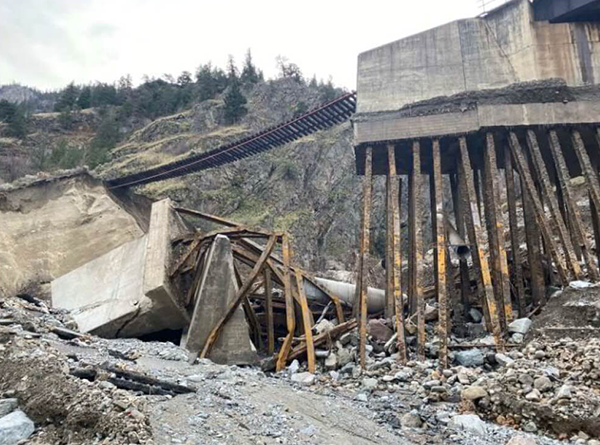
Although temporary works restored traffic within weeks, a permanent grade-separated solution was needed.
Completed in October 2025 (one month ahead of schedule), the Tank Hill project realigned a three-lane section of Highway 1 over the railway and creek channel with a 279-metre structural viaduct that has a 24-degree skew.
It restored two main transportation arteries in the Fraser Canyon, one of British Columbia’s most constrained and high-risk corridors.
The project was delivered by the Tank Hill Alliance, made up of the BC Ministry of Transportation and Transit (MOTT), Western Highway Infrastructure/Ledcor, McElhanney and Associated Engineering.
Brian Taylor, the alliance’s project manager, Baldev (Dave) Dulay, design manager, and Shane Cook, the co-ordinating professional engineer, explain the make-up of the group, how it worked and what it accomplished.
An alliance model is a collaborative project delivery approach whereby the owner, contractor and designers work together as one integrated team.
Rather than operating within separate contractual boundaries, the members of the group share risks, responsibilities, decision-making and project objectives, concentrating on what is best for the project and the communities it serves.
The model was well suited to Tank Hill because of the project’s urgency, complexity, challenging site conditions and the need for close co-ordination with the participants.
It allowed the team to respond quickly to challenges, make collaborative decisions and carry the project from planning and design through construction and completion.
The alliance model features integrated decision-making among all project partners; shared risks and rewards; and collective accountability for project outcomes.
Benefits of the model are faster and more collaborative problem-solving; improved constructability and safety during design; and greater ability to incorporate innovation and climate adaptation measures.
The model is relatively uncommon for highway construction in B.C.; MOTT typically uses more traditional design-bid-build and design-build approaches.
The project was innovative in the way in which established engineering approaches were applied to meet complex site conditions, safety requirements, railway-clearance constraints, climate-resilience objectives, and schedule demands.
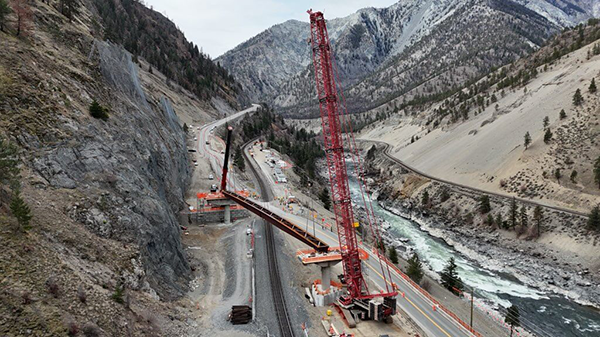
The materials and methods themselves were proven, but they were adapted thoughtfully to respond to the specific challenges of the Tank Hill site.
The project was innovative in a number of ways:
- A 279-metre structural viaduct was built to cross the Canadian Pacific Kansas City (CPKC) railway and a creek channel;
- custom variable-depth steel box girders that taper from approximately 2.2 metres to 1.2 metres, to maximize railway clearance and reduce the highway profile;
- approximately 290 metres of mechanically stabilized earth retaining walls reaching heights of up to 11 metres; and
- extensive rockfall protection systems, including anchored mesh, slope scaling and a catchment wall.
The project was not without some challenges.
Geotechnical uncertainty, slope stability, rockfall hazards, traffic management, railway co-ordination and climate resilience all posed hurdles.
In addition, the project was built in a very narrow corridor bounded by steep mountainsides, the Thompson River, a creek crossing, an active railway and an operating highway.
The alliance was able to keep roads and rail operating normally during the project by detailed staging and co-ordination with CPKC.
It evaluated 16 alignment alternatives before making its final selection; developed customized bridge and foundation designs to accommodate variable ground conditions; and implemented major rockfall mitigation and slope stabilization measures.
Tank Hill wasn’t simply about rebuilding a highway after the 2021 atmospheric river event.
It was about building back better — creating infrastructure that is safer, more climate-resilient and better connected to the communities it serves.
The Tank Hill Project – BC Highway Reinstatement Program won the 2026 Lieutenant Governor’s Award in the Bridges Category in the 2026 Association of Consulting Engineering Companies British Columbia awards for engineering excellence.