The massive computers inside today’s new hyperscale data centres generate a lot of heat. Keeping those machines cool requires extensive cooling systems which, for the most part, require a continuous supply of water. It’s an issue that has put data facility proposals under the political microscope wherever they go.
Water cooling for data centers is a hotly debated topic across certain areas in the American Southwest, Northern Virginia, areas of Georgia, and even in Alberta. Concerns have been raised that severe stress to municipal water infrastructure and in-ground supplies will result from the rapid expansion of these large data facilities. It’s a critical issue. As WSP says, “As demand for data infrastructure skyrockets, water emerges as a critical design constraint, one that’s too often overlooked until it’s too late.”
Furthermore, the power needed to pipe chilled water around land-based servers in order to prevent overheating can consume anywhere from 25 to 40 per cent of the data centre’s total electricity demand. That puts strain on local electrical grids or the facility’s self-powering generation.
There is a new idea now being floated, literally, about how to cool these data centres. Rather than having data centres located inland in areas where water supply might be a concern, locating them under the water or on the water’s surface is actively being discussed and developed.
It’s a concept whose time has come.
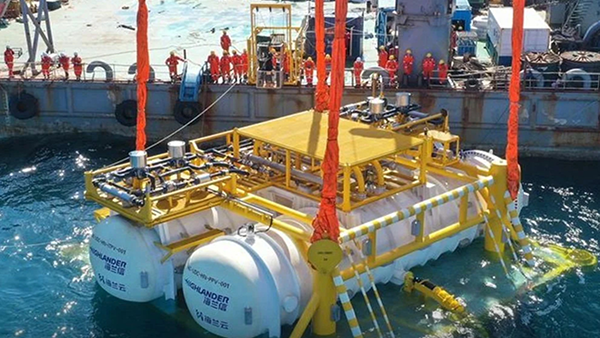
In China, a 24 MW data centre has begun commercial operation with its 2,000 AI servers, including GPU clusters from China Telecom and LinkWise, placed in sealed units in 35 metres of water six miles off the coast near Shanghai in order to passively use seawater for cooling. On land, power is generated by wind turbines.
“Compared to traditional land-based data centers, the project is designed to use over 95 per cent green electricity,” the Chinese government says, “reducing power consumption by 22.8 per cent, and water and land use by 100 per cent and over 90 per cent, respectively.”
Floating data centres on the surface of large bodies of seawater is another idea that is gaining traction.
In late July, Korea’s Samsung Heavy Industries Co., Ltd. (SHI), one of the world’s largest shipbuilders and maritime engineering firms, signed an engineering contract with Dallas-based Mousterian Corporation, Inc., a developer of water-adjacent data center infrastructure, for the dev elopement of a series of moored floating data centres (FDCs) in the United States.
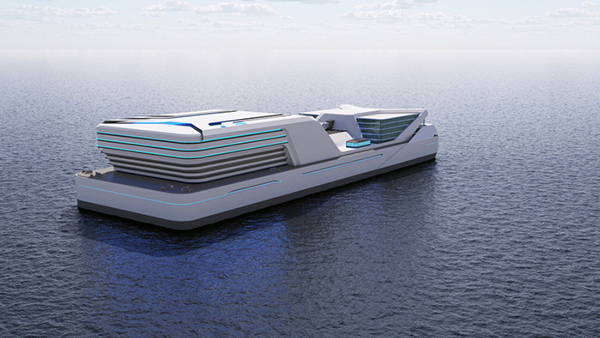
The companies will jointly perform the basic design, detailed engineering and production design for these purpose-built moored FDC units. Each FDC will deliver an IT capacity of 50 MW, with deployment planned for Texas and other key U.S. markets beginning as early as in 2028.
There is another important benefit for using open bodies of water for cooling. If facilities are sited adjacent to existing power generation assets, it can materially compress delivery timelines for hyperscale and AI computing by unlocking generation capacity often beyond the reach of conventional land-based sites.
“The data center design emphasizes sustainability and environmental sensitivity alongside speed of delivery,” the SHI and Mousterian said in a joint announcement. “Each facility employs bulk non-evaporative cooling that consumes no potable water and returns zero process discharge to the surrounding waterway; and supports facility-scale, high-density, liquid-cooled AI compute at a very low power usage effectiveness (PUE). Because the design eliminates the air-cooled chillers and fans that dominate conventional data centers, each facility also operates with a minimal noise profile — a meaningful reduction in noise pollution for surrounding communities.”
“Floating data centers are a natural extension of the engineering, fabrication, and project delivery capabilities we have built over five decades in offshore and maritime construction,” said Sung-an Choi, Vice Chairman and Chief Executive Officer of Samsung Heavy Industries. “Together with Mousterian, we intend to deliver floating data centers with the same rigor, quality, and schedule certainty that define our maritime track record.”
Prior to this agreement, SHI had signed another joint development agreement for floating data centres with U.S. artificial intelligence (AI) server specialist Super Micro Computer Inc., and followed that with a three-party business cooperation agreement with Greek ship owner Capital, and Britain’s maritime classification society Lloyd’s Register.
Floating data centres are being discussed by other major corporations as well.
Keppel Data Centres, a Singapore-based operator of data facilities in several countries, has been working with partners to explore the development of a near-shore FDC at the Loyang Offshore Supply Base near Changi Airport. The company says that a team of consultants and planners has conceptualised the design of FDCs, taking into account the terrain and deep waters at the location.
“Featuring a modular design, each floating data centre module can be scaled up quickly according to customers’ demand through faster fabrication and an elegant plug-and-play mechanism build in a controlled environment,” the company says. “This greatly improves build quality and improves the speed-to-market.”
There are other direct environmental benefits to FDCs. As Greg Trauthwein explains, floating facilities can be relocated, expanded, or redeployed as demand shifts, there is no need to clear forests, rezone land, or build massive new concrete structures and, in the case of smaller data centres, reused barge hulls can be put back into service.
However, the big advantage is the water. “You’ve got an essentially unlimited source of cooling water that you’re not consuming,” says Mike Complita, Principal and Vice President of Strategic Expansion at Seattle-based naval architecture and marine engineering firm EBDG. “That’s a huge advantage in a world where freshwater is becoming increasingly precious.”