At Penn State University, an hour’s drive northwest of Lewiston, Pa., the biggest plays aren’t being made on the gridiron at Beaver Stadium. They’re being rolled out off the field by construction workers involved in a three-year, $700-million renovation of the mammoth structure.
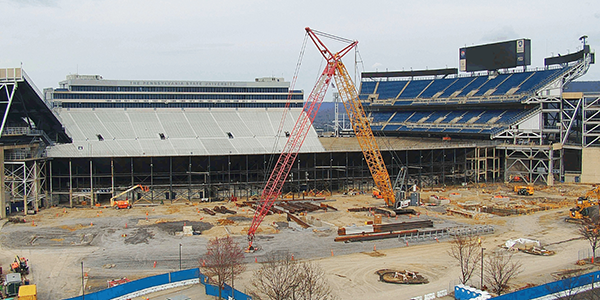
The first phase of the project, which began following the 2024 football season, has been completed. The press box area, upper bowl and several ground-level structures on the west side of the stadium have been removed and more than 9,000 temporary bleacher seats were installed.
The four-floor press box, which housed media and broadcasting facilities, along with the stadium’s original suites, was knocked down to make way for a completely new west side to the stadium.
On the day of the demolition, charges were set off in unison, sending the massive structure tumbling to the ground. The seating deck that sat below the press box was also removed. Crews have begun pouring concrete and building the foundation for a tower that will be built in time for the 2027 football season.
The tower will be home to two signature premium seating clubs – the Schuyler Family Club and the Marzano Club – that will include roughly 4,500 larger-sized seats and 70,000 square feet of lounge space. Seat prices will begin at $4,500. Fans will be required to make a gift of $10,000 to reserve club seating.
The project is tricky as the demolition and construction work are taking place over a three-year period while the stadium is still in operation. Work is being strategically phased and scheduled during football season, and barriers erected to ensure fans do not enter restricted areas.
The basic plan of action is to expand the construction footprint during the off-season and shrink it during the football season to accommodate game-day parking.
In the second phase of the renovation, which begins in 2026 after the football season, the lower bowl of the stadium, referred to as the superstructure, will be demolished and replaced.
The club levels that were torn down earlier will be completed, along with the upper part of the bowl. After that, work will begin on the lower bowl.
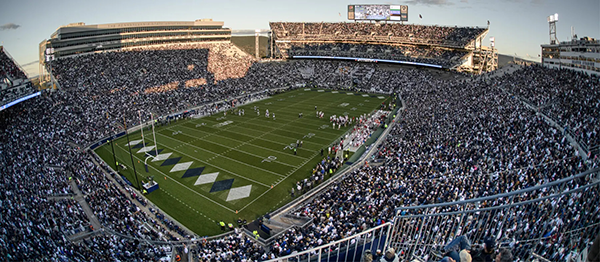
It is anticipated that Beaver Stadium will maintain a capacity for more than 100,000 spectators throughout the renovation project. The university does not expect there will be limitations on parking and tailgating on football game days during the stadium construction period.
The work will more than double the space of the previous concourses on the west side. The revitalization will increase vertical fan circulation as well with the addition of escalators, elevators and pedestrian ramps.
Stadium lighting will be replaced to enhance game day presentation. An upgraded north videoboard will be installed along with and ribbon boards on the west side intermediate and upper bowls.
Architectural renderings of the completed stadium show a massive venue with gradually sloping stands. There is no roof on the bowl so sightlines to the field are unimpeded.
In alignment with Penn State’s commitment to global sustainability, the renovations are aimed at achieving LEED certification.
Pat Kraft, vice-president of intercollegiate athletics at Penn State, says the university is thrilled to see the project progressing.
“The improvements we made on the east side following the 2023 season have enhanced fan experience and circulation throughout the building. Our next phase will modernize the west side of Beaver Stadium while maintaining its historic roots.
“As we continue to make these changes, we only further enhance our stadium, making it one of the most intimidating places to play in the country. This project is not just a project for football, it is one that will impact all 31 sports teams at Penn State, our campus community and the Centre Region for years to come.”
The university’s board of trustees approved investing in the stadium renovations in May 2024 so that the venue can be used year-round and drive more economic growth and development in the region.
During the revitalization project, there will be 800 to 1,000 unique tradespeople working each summer and 450 workers onsite daily at the peak of the project. The jobs are expected to generate $15 million in economic impact for the region. Penn State says the first phase of the project saw 75 per cent of the materials and labour procured from Pennsylvania.
The plan is to transform the iconic venue while preserving its historic roots and wrap up all the construction work in time for the 2027 football season.
The revitalization is being led by a tri-venture construction management team of Barton Malow, AECOM Hunt, and Alexander Construction, with Nations Group as a key consultant. The companies have a history of working together on multiple athletic facilities over the past 20-plus years.
Project architect is global design firm Populous which has extensive experience in designing sports and entertainment venues.