When it comes to Texas highways, if you build it, they will keep coming. That fits well with the state’s objective to continue its ever-upward economic path.
Even in the face of economic uncertainties and efforts to improve program efficiencies in several governmental departments, there always seems to be money available for investment in roads and highways.
In August, Texas Gov. Greg Abbott announced more than $146 billion in new spending for the Texas Department of Transportation (TxDOT) over the next decade, targeting new road construction and maintenance.
“This more than $146 billion investment in our roadways will help Texas meet the critical needs of our growing state as more people and businesses move here for the freedom and opportunity they can’t find anywhere else,” Abbott said in a press release. “We must strengthen our roadways and improve congestion and safety to keep our economy booming and keep Texans moving.”
Increased traffic congestion in auto-centric Texas is well documented. Across the entire state, research released in late 2024 by the Texas A&M Transportation Institute says traffic delays increased more than 20 per cent in 2023 over 2022, costing more than $13 billion in estimated congestion-related costs and nearly 150 million gallons of wasted fuel.
Two of the state’s top five traffic trouble spots are in Houston. The A&M study ranked Houston’s Katy Freeway as the most congested highway in Texas in 2023, although Dallas-Fort Worth and Houston each had highway segments in the top five. In fact, those three cities make up the first 28 spots overall for highway congestion.
Whether money spent on expanding highways is a worthwhile pursuit is questionable. Multiple studies suggest expanding highways in an effort to get ahead of increased traffic buildup appears to be a self-defeating exercise, in that it attracts more cars and perpetuates congestion. It’s called “induced traffic.”
In the case of Houston’s Katy Freeway, even after its expansion to 26 lanes back in 2011, Bloomberg reports traffic congestion became significantly worse within three years. Travel times had increased by 30 per cent during the morning commute and 55 per cent during the evening commute by 2014.
In fact, suburban cities like Pearland south of Houston are leveraging the I-35 expansion to promote economic growth plans that will ultimately feed more traffic onto the roadway.

“State Highway 35 is one of Pearland’s principal commercial corridors,” the Pearland Economic Development Corporation says. “One of the main strategies outlined in the Pearland 20/20 Community Strategic Plan is to optimize the development potential of Pearland’s principal commercial corridors.”
One such development is Edge Industrial Park, a new 36-acre multi-phase business park located where the I-35 runs through the center of Pearland. Nine buildings are planned, aimed at attracting manufacturing and distribution businesses looking for high-quality space in the Houston metro area.
Continued highway expansion can negatively impact the cost of living for residents as well as add to continued congestion.
In his recently-released analysis of 22 U.S. cities, Robert Noland of Rutgers University detailed the environmental impact of urban sprawl, citing Houston in particular.
“Houston is often cited as a city with a large population growth rate without housing costs being that high, but when you factor in the costs of owning cars and traveling long distances every day, that’s no longer the case,” he says.
When housing costs and transportation are combined, Noland’s study says Houston is the fourth most expensive city in the U.S. in which to live.
In the meantime, work on the I-35 continues. In Austin, Balfour Beatty was awarded $746 million last November to rebuild a 2.5 mile stretch of the I-35 through the south side of the city. This included upgraded access roads and a bridge and new intersection at Riverside Drive to support the future light rail line, key to expanding central Texas’ public transport network.
In Central Austin, work on the I-35 is presenting some interesting engineering and construction challenges and solutions.
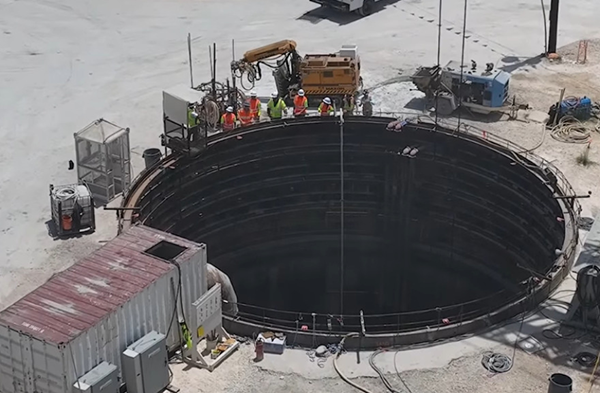
Across the I-35’s route through the city, machines are digging nine deep holes called drop shafts as part of one of the largest tunnel projects ever undertaken in Austin’s history. These tunnels are designed to prevent sections of the I-35 built below grade from becoming a fast-flowing river during rainstorms.
German-made machinery will begin boring the drainage tunnels in early 2026 and will simultaneously build the tunnel walls with panels of precast concrete at a speed of up to 50 feet a day. At the end of the 6.5-mile drainage tunnel, the TxDOT will build a pump station capable of moving 130,000 gallons of stormwater per minute into the Colorado River.
It is also proposed that parts of these sunken lanes will be covered with giant decks as a “cap-and-stitch” project, featuring public parks linking neighborhoods on either side.
However, funding of the cap-and-stitch project was put in doubt as a result of federal cuts under President Donald Trump’s “One Big Beautiful Bill” signed last July. That left city council member Chito Vela concerned. He told local media failing to go ahead would leave an open highway canyon even wider than the existing roadway that opened in 1962.
“We have to seize this moment,” Vela said. “When I look across the country, I don’t see anybody who has regretted capping their highway.”
Austin council approved $104 million for support columns over several portions of the I-35 although less than half the original size proposed.