At a Glance:
- Kalalou introduced a tiered loyalty program in 2025 modeled after Creative Co-Op‘s, offering discounts up to 20% based on annual retail spend.
- Creative Co-Op’s Advantage program grants retailers Silver, Gold, or Platinum status with discounts ranging from 10% to 20% on orders the following year.
- Mud Pie’s loyalty program includes extended terms, priority allocation, discounted freight, and product discounts, serving about 700 retailers.
Consumer loyalty programs — the points or perks we accrue from airlines, hotel chains, coffee houses and other businesses for favoring them over a competitor — have a counterpart in the B2B world. Though they are structured differently, wholesale loyalty programs in the home décor industry are proliferating and attracting retail attention.
B2C loyalty programs entice individual consumers to make smaller and more frequent purchases in exchange for points, discounts or freebies. They tend to be simple and standardized, and engage consumers through emotional connections and convenience, according to a November 2024 post on WPloyalty, a WordPress plugin that creates and manages loyalty programs.
B2B loyalty programs, on the other hand, are designed to promote long-term partnerships between wholesalers and their retail partners, who typically place high-value, bulk orders. These programs, which span longer business cycles, reward loyal customers with volume discounts, rebates or exclusive deals. They are based on trust and can be customized, WPloyalty noted.
“In B2B sectors there’s a higher focus on product knowledge and education, the quality of products or services being bought, and providing resources or solutions that support a business’s various needs and goals,” wrote Kimberly Lyons of Brandmovers, a tech company that structures loyalty programs for both B2C and B2B companies, in a 2022 blog post.
Wholesale businesses that prioritize customer loyalty see a 10-20 percent increase in annual revenue and have a 13% higher customer retention rate, according to Amplify, a consulting business focused on AI-powered digital services.
How home décor vendors foster loyalty
Several decorative accessories and gift vendors, like Creative Co-Op, Kalalou and Mud Pie, have rolled out retail loyalty programs that use the discount model — tiered programs that reward retailers who spend a certain amount of money with the wholesaler in a calendar year with a percentage off all orders placed the following year.
Kalalou introduced its loyalty program last year, after watching both existing and potential customers shop competitors with loyalty programs before placing orders at Kalalou, said Josh McKay, vice president of sales and marketing.
Buyers would ooh and ahh over Kalalou’s lineup but then promise to come back after first placing an order with Creative Co-Op, which has a well-established loyalty program. “When they come back, there’s not as much coin in the bag to spend,” said McKay.
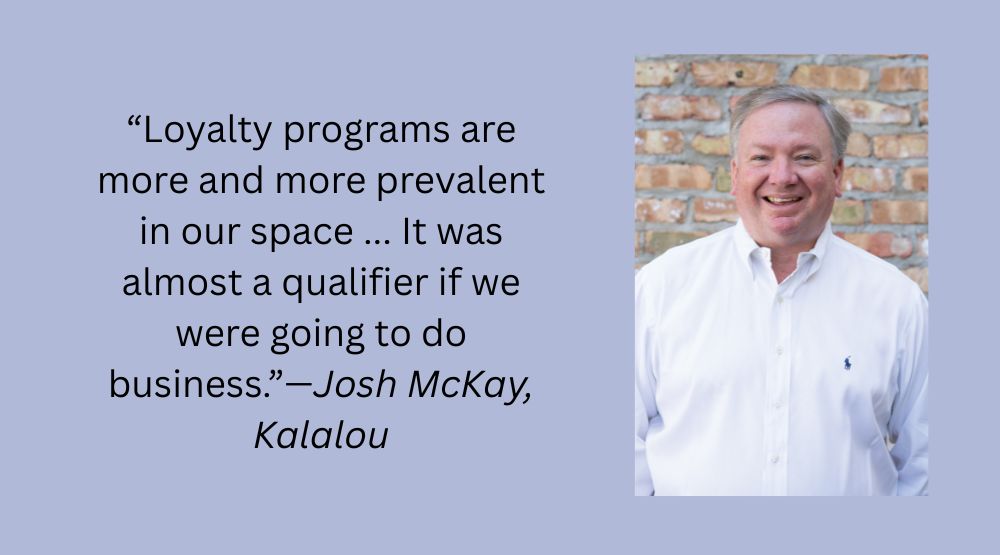
“Loyalty programs are more and more prevalent in our space,” he said. In the past, customers would come in and ask for a discount, McKay said. “Now, they ask whether we have a loyalty program. We found ourselves lacking in something customers put a premium on. … It was almost a qualifier if we were going to do business.”
He credited Creative Co-Op with running a good loyalty program. “When you do it well, you do it well. We saw time and again, it would pull people to their showroom to meet their qualifying mark.”
Creative Co-Op declined to go into details with Home Accents Today about the effectiveness of its program, citing its proprietary nature, but it did share the outline of how its Advantage program works.
Creative Co-Op bestows Silver status and a 10% discount on orders the following year to retailers who spend between $5,000 and $9,999 the prior calendar year; Gold status and a 15% discount for those who spend $10,000 to $19,999, and Platinum status and a 20% discount for those who spend $20,000 or more. Discounts are applied on the line-item level, “allowing for accurate retail pricing and margin evaluation.”

Kalalou modeled its program after Creative Co-Op’s, McKay said, but with lower minimums. Retailers who invoice $5,000 with Kalalou in a calendar year achieve gold status, granting them 10% off every order they place in the following year. “That’s enough to get anyone excited,” McKay said. Platinum members invoice $10,000 in a year for a 15% discount, and Diamond level partners spend $15,000 annually to get a 20% discount.
“This moves Kalalou up on the rotation in who they see first,” McKay said by phone late last month. “Having just completed Atlanta Market, it’s amazing how many customers that came in are loyalty members.”
Tony Weaver is one of them. The owner of New Vintage Modern in Greenville, S.C., has been a Kalalou customer for nearly 15 years, and started 2026 at the Diamond level.
“It’s an automatic program, based on purchase amount. I know how much I spend there, so it was easy for me to say let’s hurry up [and spend] early in the year so we can get our discounts,” said Weaver, who also does business with Creative Co-Op and maxes out his annual spend there, too.
“It does change our loyalty because it brings you back. Compared to other companies, I get 20% off. And they [Kalalou] haven’t changed their prices either. So, it’s a huge impact on my bottom line.
“That’s not customer loyalty, that’s brand loyalty to the customer.”
Other vendor benefits
Mud Pie’s loyalty benefits include a combination of extended dating terms, priority allocation, discounted freight and product discounts. It has offered this program for many years and roughly 700 retailers take advantage of it, said Katie Chapman, senior director of customer experience and B2B sales.
“Mud Pie’s loyalty program has strengthened the business by rewarding retailers with meaningful discounts while reinforcing Mud Pie as a dependable partner,” Chapman told Home Accents Today in an email. “The program gives customers confidence that they can rely on Mud Pie for consistent product, service and support, which in turn helps drive repeat business and long-term loyalty.”

A handful of other vendors in the furniture and lighting categories reportedly have similar incentive programs based on either the retail dollars spent in a given period, or the number of items purchased.
Lighting company Varaluz, for instance, offers a preferred partner tiered program for lighting showrooms willing to make store display commitments for orders ranging from $5,000 (Bronze) to $20,000 (Gold). Earnings and incentives, such as rebates for non-display purchases, increase with each tier, as do operational benefits, such as free shipping on non-display orders paid by credit card and virtual product and sales training with the Varaluz design team. Ready-to-use marketing and social media content are provided to all retailers in the preferred partner program.
Sagebrook Home just rolled out its Free Freight Pass at last month’s winter markets. Modeled on Amazon Prime, retailers purchase the pass for $999, and it provides free freight on all orders of $3,000 or more for all of 2026.
“The incentive is that the more you order the more value it has,” said Amy Affre, who oversees strategic partnerships for Sagebrook. The program has a money-back guarantee — if a customer’s orders don’t meet the full value of the pass this year, Sagebrook will refund the remainder of the value of the pass in the form of credit next January.
Affre declined to say how many people signed up for the pass last month, but she did say that it was more than the company expected. Furthermore, “we modeled with an average order of $3,200,” she said. “In the end, the average order was $9,500.”
Retailer reassess buying strategies
“I look for companies that offer these [loyalty] incentives,” said Katie Caldarera, owner of Estella’s Home, a store in Metairie, La., that sells furniture, wall art and decorative accessories as well as kitchen items, jewelry and gifts. “I will be more loyal to you because you are willing to give me a better bottom line, and I [in turn] am able to offer my customers a better bottom line. Especially when we have surcharges and tariffs, you have to work to have customers coming back to you.”
Beth Rich, owner of Mix It Up Home in Coeur d’Alene, Idaho, agreed. Earning a set discount every time she orders, for an entire year, changes the way she buys, she said. It allows her to replenish her shelves whenever she needs to, even if it’s small order for, say, a dozen tea towels. And it frees her from throwing extra items in her virtual cart just to meet a minimum for freight, she said.
“I’m not buying just to buy,” she said. “You should buy because you love it, because you need it, because your customers want it, but you shouldn’t buy just to buy.
“With the challenges of 2025, we worked really hard on inventory. Inventory is money. The better I manage my inventory, the better I manage my money.”
Weaver, of New Vintage Modern, agreed.
“I understand what I can sell an item for,” he said. “When looking at a price, I look at the price before the discount, not my price after the discount. [I ask myself], can I charge the full amount of the price before the discount? The discount is my savings, not the customer’s. When I can buy most of the product and sell at full retail price, and it’s a fair price, it’s so exciting because I am making an extra 20% on that purchase.”
Vendors who reward core customers and give them a reason to keep coming back are smart, said Rich. “Having a customer who is loyal to you can be your bread and butter,” she said.
“I would love if more companies would offer this type of thing. We will purchase and be loyal to those giving us that discount. It’s more customer-friendly and my customers benefit from it,” said Caldarera.