Toronto’s 19-kilometre Line 5 Eglinton and its 25 stations presented designers and builders with numerous challenges over the past 15 or so years.
Three of the most technically and architecturally demanding stations on the line were the Avenue, Forest Hill and Chaplin stations.
DIALOG, the architect of record for the three, faced various hurdles, each having much to do with site constraints. While the Avenue Station is among the deepest on the line, Chaplin is in a park setting and Forest Hill is integrated into the heart of a neighbourhood.
Avenue Station, unlike the other two, connects with the line’s bore tunnel.
As the architect neared finalizing construction documents, one of the demands was how to “marry up” information of the as-builts of the bore tunnel, rather than just work with a conceptual design, says Justin Tompson, principal associate, who worked closely with various engineering consultants and was responsible for drawing packages.
“How that (tunnel) interfaces with the station box is most critical, that’s the lifeline, the umbilical cord and the spinal cord of the entire line so we wanted to make sure it wasn’t interrupted.”
He says the station’s headwalls – the large concrete endwalls that define the station box – had to interface with the start of the tunnel on each side.
Co-ordinating the work with other disciplines, including structural, mechanical, electrical and other systems consultants was a key to success.
Each discipline had to progress at a similar pace to minimize disruptions, Tompson says. The key was setting milestones, the first being the supported excavation for the pits to place the station boxes.
It was followed by the “frozen design or fixed structure,” a milestone reached when the construction documents were only about 50 per cent completed.
Another benchmark was space proofing in which every room and size were confirmed, including everything from spaces for mechanical/electrical systems to walkways and stairs.
At each station, DIALOG employed a project architect and a documents production team of architects and technologists. One project manager from the firm oversaw all three stations.
Using Revit building information-modeling (BIM), the team produced “complex” 3D diagrams and working views (not on printed drawings for the constructor) to understand how all systems “weaved through the structure,” says Tompson.
During his time on the project, the architect did research on some of the earliest Paris subways built in the 1890s. While builders back then relied on simple tools and a lot more labour, he discovered many similarities with the building process of tunnel designs today.
But today’s subway engineering is not surprisingly more complex, with many safeguards such as tunnel ventilation systems.
“Everything is scaled up now…the fans are the size of a train car.”
As well, the sprinkler network along with communications and other systems are “very advanced,” he says.
“The trick is trying to find the spaces and the pathways for all of these systems to work without interfering with the passenger experience and the safety of the system.”
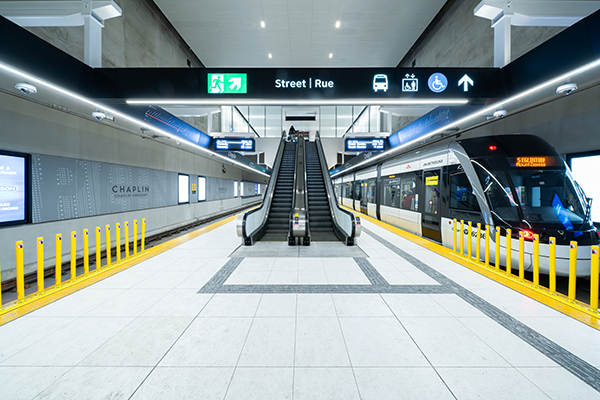
While providing as much natural light as possible was paramount for all three, the designer had to turn to other lighting sources because of the depth of the stations, including “artificial skylights,” which are large rectangular lights with diffusers strategically positioned to aid functional lighting for intuitive way-finding.
Light coloured materials were also specified while wayfinding tiles and feature wall coloured tiles identify vertical circulation, Tompson says.
Largely because each site is unique, the stations have their own “architectural identity” and Tompson is satisfied with the end results.
He says the finished stations “look pretty much exactly like we had envisioned in the (original) three-dimensional renders done about a decade ago. The design articulation, the concept…is consistent with the design vision, which is great to see.”
DIALOG worked within the Crosslinx consortium and alongside Arcadis, NORR, Daoust Lestage Lizotte Stecker, and gh3\*.
Arcadis led the system-wide architecture, interior design, urban design and landscape architecture, provided full detailed engineering services and construction support for several of the above and below ground stops.
Arcadis also managed the project’s design and engineering in joint venture with AtkinsRéalis.