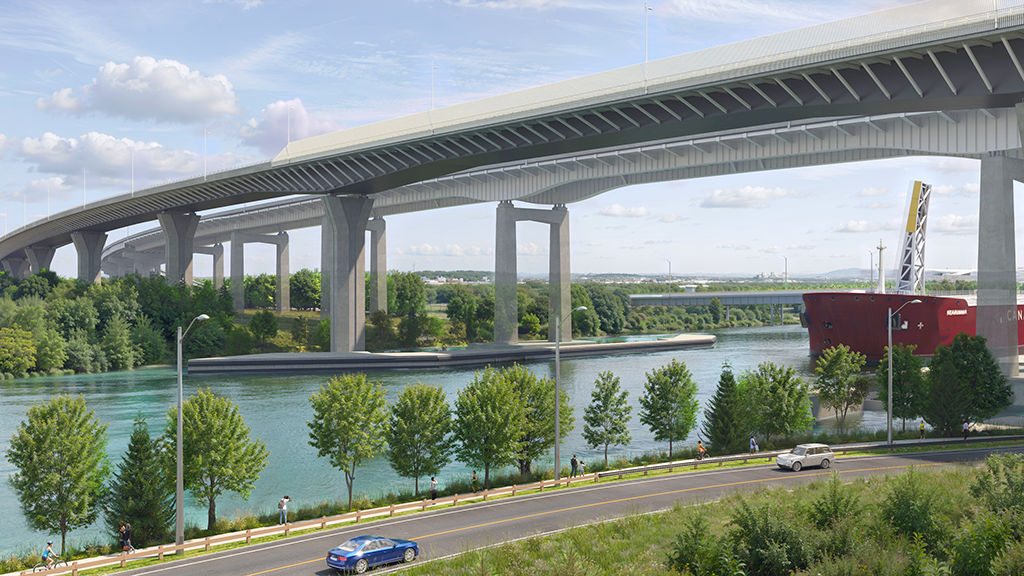
The design of a four-lane bridge over the Welland Canal is now 60 per cent complete and a timeline was recently unveiled at a virtual public information presentation.
“The QEW Garden City Skyway – Bridge Twinning project includes the design and construction of an approximately 2.2-kilometre-long ‘twin’ Garden City Skyway bridge across the Welland Canal between St. Catharines and Niagara-on-the-Lake,” said Ian McConachie on behalf of Infrastructure Ontario (IO).
The new twin bridge will be built alongside the existing Garden City Skyway, running parallel, slightly to the north, within the same corridor.
“Upon completion of the bridge, traffic from the existing bridge will be temporarily switched onto the newly constructed bridge to allow for rehabilitation of the existing Garden City Skyway bridge (under a separate contract),” said McConachie.
The project is a combined effort of the Ministry of Transportation, IO and Skyway Bridging Partners.
SBP is a consortium selected as the development phase partner for that stage of the project, combining selected construction and design firms to provide planning, design and, ultimately, construction.
The SBP team includes:
- Applicant lead: Flatiron Dragados Canada Inc., Construction Demathieu & Bard Inc., Green Infrastructure Partners Inc.
- Primary design team: Arcadis Professional Services (Canada) Inc., GHD Ltd.
- Construction team: Flatiron Dragados Canada Inc., Construction Demathieu & Bard Inc., Green Infrastructure Partners Inc.
The team was selected following an evaluation of proposals submitted in December 2024.
“The project entered into a development phase agreement on June 12, 2025. Infrastructure Ontario and the Ontario Ministry of Transportation selected Skyway Bridging Partners as the development partner for the QEW Garden City Skyway – Bridge Twinning Project. The development phase is expected to take 19 months,” added McConachie.
SBP’s work will include:
- Design of the new QEW bridge and new approaches to the new twin bridge, including on and off ramps.
- Impacted municipal road realignments/reconstructions, co-ordination with utility companies on required relocations.
- Developing an environmental plan to mitigate impacts on the community and natural environment.
- Preparing the site so it is ready for construction. This includes clearing vegetation, building access roads and completing investigation work, known as “enabling works.”
- Project-specific communications to stakeholders and the public.
In the public information presentation, it was explained the project will be built in phases, with the current timelines outlined, which are subject to change.
- 2026 Enabling works, underway now: Site clearing, ground testing, access road construction and utility relocation.
- 2027- 2028 Major construction begins: Local road changes starting as soon as spring 2027.
Construction is estimated to take multiple years, starting with bridge foundations and progressing to bridge girders, deck structure and roadworks. A schedule will be shared as the project progresses.
The bridge is a key transportation link for Niagara Region and a critical economic corridor between Canada and the U.S. More than 100,000 vehicles cross the corridor every day, supporting a commercial value more than $1.1 trillion in goods annually.
“The existing bridge, opened in 1963, is approaching the end of its service life and will require significant rehabilitation, including a full deck replacement, within (an) estimated five years. Building the new twin bridge first means traffic can keep moving while the original bridge is taken out of service for necessary works. This work will set the stage for future expansion of the QEW in the Niagara,” the presentation noted.
It also describes the benefits of the build, including improved mobility and connectivity, enhanced safety, reduced congestion and supporting regional employment and economic growth.
“The design and construction of the project will generate employment opportunities and produce significant benefits for commuters. It supports the long-term transportation needs throughout the corridor, and improves the movement of goods and people, making life easier for families and businesses throughout the region,” said McConachie.
It is reported the project cost is estimated between $1 billion and $2 billion. IO confirms the new bridge is expected to last 100 years and includes provisions to prioritize Ontario and Canadian subcontractors and materials – including steel.