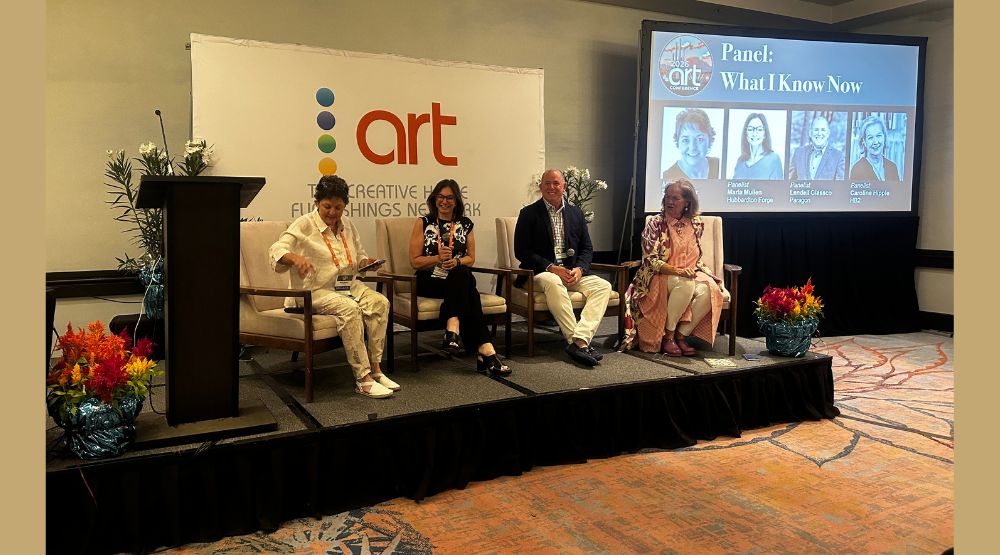
From left, Sheila Butler, Maria Mullen, Lendell Glassco and Caroline Hipple discuss “What I know now” at the 2026 ART Conference in Tucson.
Three long-term industry leaders — you could call them veterans, though they would probably cringe at the term — took the stage in Tucson, Ariz., to talk about “what I know now” during the ART Conference last week.
Asked to share wisdom acquired through many years of work, Caroline Hipple (HB2), Maria Mullen (Hubbardton Forge) and Lendell Glassco (Paragon), fielded questions about what they wish they knew sooner, their changing definition of success, and what they fiercely protect in their work and personal lives. They fielded questions from moderator Sheila Butler (Jola) along with exchanges from audience members and ultimately provided guideposts to people building a career in home furnishings.
From years of experience, they know that an individual’s career or a company’s success is rarely a constant, upward trajectory.
“There is an expectation that things will be linear, that we will be on this growth track,” said Glassco, who runs his family-owned wall décor company with his brother and sister. “But there are bumps in the road. It’s not linear at all. It’s a bunch of roller coaster rides.”
Referring to recent upheaval in the economy, geopolitics and the constantly changing tariffs on imports, he said that five- or 10-year plans “seem to be a thing of the past.”
Mullen agreed that there is no such thing as a straightforward and easily followed road to success. “I thought there was a path to follow,” said the lighting CEO. “Then you get curveballs. Sometimes the curveballs bring the next best thing. I wish I had known that; it would have saved me some anxiety.”
Paragon is a third-generation business, and Glassco noted that a vision for the future changes slightly with each generation and is influenced, in a good way, by people who join the family through marriage and who offer a different point of view.
Hipple, whose career spans both retail and manufacturing, recalled the guidance of her mentor, Stewart Brown of the now-defunct chain This End Up, who encouraged the women who worked for him to be bold and jump into opportunities without overly worrying about potential consequences. “It was the power of momentum — just do it,” Hipple said.
When asked about her experience as a woman leading a manufacturing company, Mullen recalled her early days at the Vermont-based business, where every lighting product is designed and forged in-house. Employees there held a little grudge against so-called “outsiders” (Mullen had spent years in lighting at other companies), she said, and they were a bit demoralized at the time because of leadership and other changes. She said she made it a point to speak to everyone in every department to learn what they did and to share her vision for the future. Leadership, she said, means “being consistent, showing up and doing the work, putting in the time.”
“I think they see I care about them,” she added.
This jump-started a conversation about employee well-being and an evolving definition of success.
“It’s about impact for me,” said Mullen. “It’s not about me, a title, or a paycheck.”
Glassco agreed. “In the early years, you’re building your career, your family, your nest egg,” he said. “Now, it’s about the business, the success of that business, and being part of the community. We want to see success in our people, [so they can] enjoy the best life they can.”
Hipple said her definition of success has not changed, but it has been clarified. And that is “finding what you’re meant to be good at.” It also means helping your team do the same, which brings joy, she said. “It’s not success; it’s alignment. That’s what success is for me. So much energy is released when you do that.”
Asked what they protect more fiercely today than in the past, Mullen said her time with family and friends (and the time to read for pleasure), and Glassco voiced his support for long-term employees and institutional knowledge.
Hipple said she treasures kindness.
“It sounds like a soft word, but if you’re truly kind, you are honest with the people around you,” she said. “The last competitive advantage is how you treat your people.”