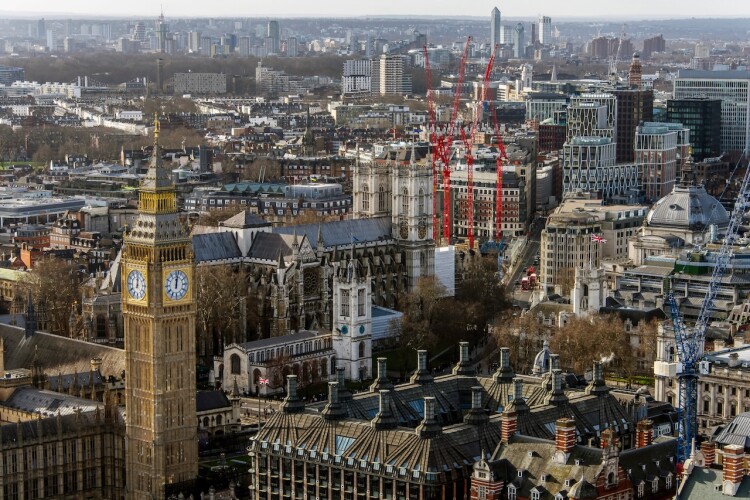
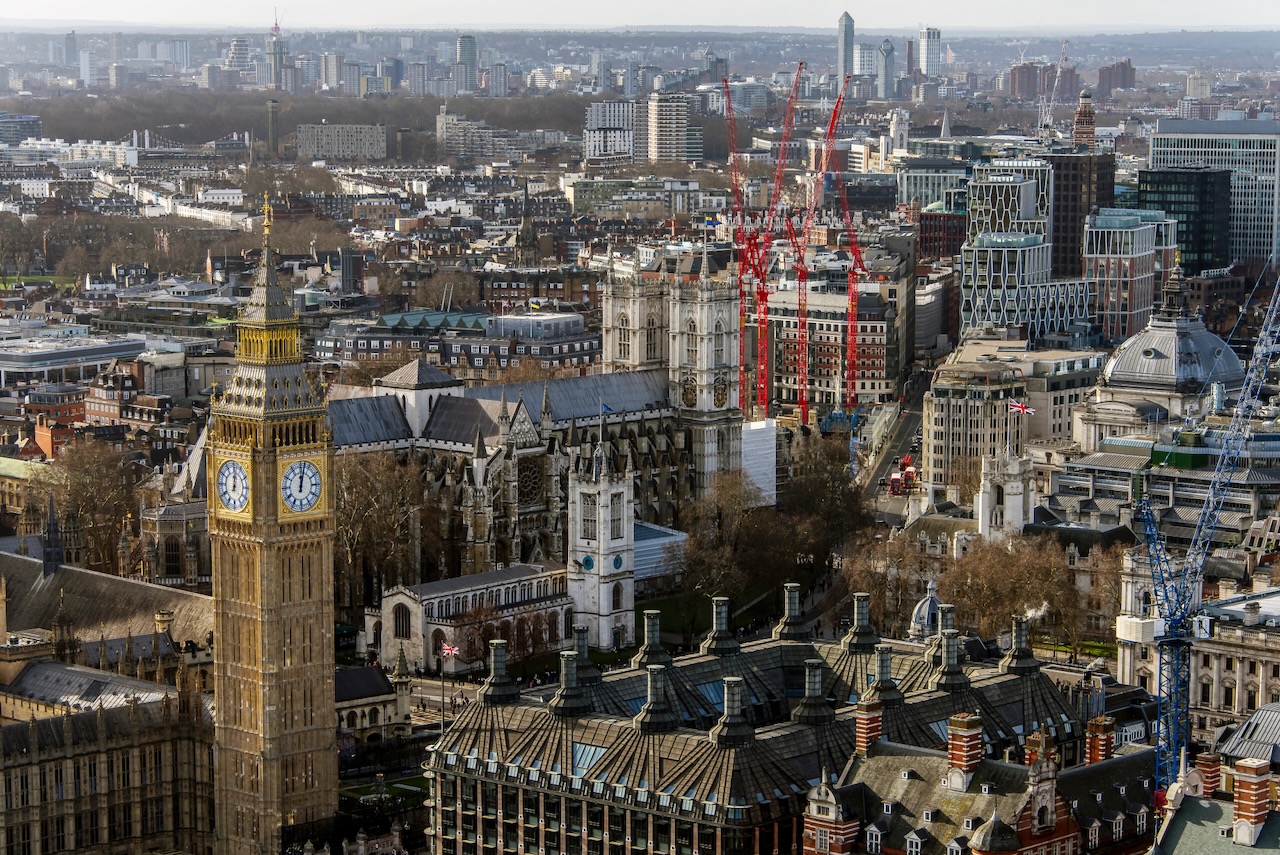
Large parts of the 1960s office block are being retained, reducing the carbon impact of new piling. But this meant that the cranes had to be installed at basement level, on foundations more than sixty years old.
The crane concept for 1 Victoria Street is divided into several construction phases and includes a total of nine Wolff cranes. The project began with demolition works carried out by Keltbray. To support operations on the confined and complex site, a Wolff 355 B luffing jib crane was deployed. The compact luffing jib crane was well suited to the restricted site conditions, while being able to handle heavy and awkward loads. The Wolff 355 B handled all major heavy lifts, including excavators, tracked loaders, dumpers, heavy skips, generators and structural steel.
Following demolition, the construction phase began for Mace Construct. Four additional Wolff tower cranes – one Wolff 166 B and three Wolff 355 Bs – were installed at B2 level to support the construction of the building core and early superstructure works. The cranes also supported the slipforming process used for the concrete core. In this method, the formwork continuously moves upwards while concrete is poured almost without interruption, placing high demands on timing, material flow and crane availability.
The installation sequence in the basement required meticulous coordination. As the demolition crane remained in service longer than anticipated, one of the Wolff 355 Bs was initially erected at a reduced height to prevent any potential clash. Once the first crane was dismantled, the other, designated TC2, was climbed to its full working height of 50 metres.
One of the project’s greatest engineering challenges was the installation of the cranes on the original foundations of the existing building. As these foundations are being reused without re-piling, each crane had to be positioned directly over the available foundation support points and the crane configuration adapted to the building structure. The location of both the cranes and their support points was therefore dictated by the existing structural layout. As a result, neither the free positioning of the cranes nor the conventional practice of anchoring them into purpose-built concrete foundations, as is typical on new-build projects, was possible.
To overcome this, Wolffkran deployed its cross-frame system. The system allows each of the four support legs to be individually adjusted to different lengths ranging from six to ten metres. In addition, the entire crane tower was rotated to align precisely with the available support points within the original foundation structure.
For TC2, the constraints were particularly demanding: four different leg lengths were required within a single cross-frame base to achieve the correct alignment with the available support points. As construction progresses, the basement slab will be cast around the crane bases, leaving only the tower openings accessible.
One of the most demanding aspects of the project still lies ahead: dismantling the cranes within the basement structure. The basement slabs are being cast extremely close to the crane towers, meaning the cross-frame and ballast will eventually become almost fully enclosed by the building structure. In addition, only very limited headroom and working space will be available below ground.
As dismantling using conventional mobile cranes will not be possible under these conditions, a combination of ceiling hoists, low-level forklifts and skating systems will be used to remove the central ballast blocks and cross-frame in a controlled and precise manner before transporting all crane components out of the building.
In the next major construction phase, scheduled for late 2026, the crane configuration will move to the roof of the building. Two 355 Bs and two 630 B luffing jib cranes will then take over lifting operations for the upper floors as well as the installation of the façade and building services.
Wolffkran says the project, due to complete in early 2028, ranks among the most technically demanding crane operations in central London due to its highly constrained urban environment and the unusual crane installation on existing foundations.

Got a story? Email [email protected]