MONTRÉAL – The Canada Green Building Council (CAGBC) recently unveiled the winners of the CAGBC Awards during its Building Lasting Change™ (BLC) conference in Montreal.
These awards recognize the country’s most “efficient, effective and impactful buildings as well as the individuals or teams contributing to the success of Canada’s green building sector,” a release reads.
This year’s recipients included deep carbon retrofits, leadership in market transformation, inspiring designs and new construction that focuses on sustainability.
“The projects and leaders receiving CAGBC Awards demonstrate how their commitment to sustainability drives innovation in the industry and strong performance outcomes which translate into clear business benefits,” said CAGBC president and CEO Thomas Mueller, in a statement. “What stands out is the level of practical implementation and how these approaches are replicated and adapted across markets, asset classes and climates.”
The following are this year’s recipients:
Lifetime achievement
André Cazelais was honoured for his impact across Quebec. He has been a “driving force for sustainable development, consistently championing progressive building practices and mentoring the next generation of green building professionals,” the release notes. “During his tenure with the City of Montréal, André led the adoption of LEED standards and helped implement a landmark sustainable development policy for municipal buildings.”
Green Building Awards
Zero Carbon Design
Winner: Rayside Labossière offices expansion
Location: Montreal, Que.
By eliminating fossil fuels and utilizing a carbon-sequestering mass timber structure, the Rayside Labossière expansion achieved Zero Carbon Building and LEED Platinum certifications. Passive design strategies including triple-glazed windows, green roofing, and shading vines reduced thermal loads, allowing the building to rely on a compact closed-loop geothermal system for heating and cooling. A 14.6 kW rooftop solar array supplies 17 per cent of the building’s power.
Deep Carbon Retrofit
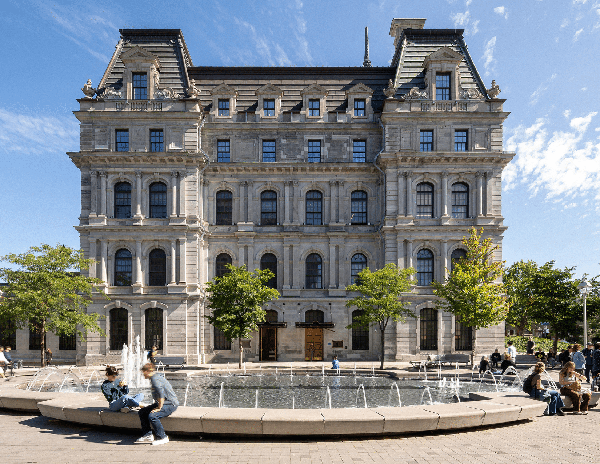
Winner: Hôtel de ville de Montréal
Location: Montreal, Que.
Built between 1872 and 1878, the Montreal City Hall underwent a major architectural restoration. Key aspects included tightening the building envelope, restoring 169 historical windows to achieve a 75 per cent increase in airtightness and replacing the legacy fossil-fuel steam heating with air-to-water and water-to-water electric heat pumps.
New Construction
Winner: təməsew̓txʷ Aquatic and Community Centre
Location: New Westminster, B.C.
The t’m’sew’txw Aquatic and Community Centre’s design honours Indigenous reconciliation by aligning with the natural topography and utilizing sustainably harvested local mass timber, the release describes. Achieving Zero Carbon Building – Design Standard and LEED v4 Gold certifications, this all-electric facility aims for a 92 per cent reduction in greenhouse gas emissions. It utilizes passive design strategies, a rooftop solar array and a gravity-fed filtration system to improve energy and water efficiency.
Inspiring Home
Winner: GEOpark – 485 Albert
Location: Kingston, Ont.
Completed in August 2025, G&O Park is a six-storey, 176-unit residential building designed to provide sustainable and affordable housing for families and students. Certified under the Zero Carbon Building – Design Standard, this project achieves its net-zero goals through an all-electric geo-exchange heat pump system, optimized ventilation and high-performance double-glazed windows. Embodied carbon was also significantly reduced by utilizing ultra-low-carbon concrete.
Leadership Awards
Green Building Champion
Winner: Ryan Zizzo, founder and CEO
Organization: Mantle Climate
Serving on CAGBC’s Zero Carbon Steering Committee from 2018-2023, Zizzo advocated for embodied carbon requirements across the Zero Carbon Building Standards. His research and expertise have guided federal, provincial and municipal approaches to circularity and low-carbon procurement, the release notes. As a volunteer, he contributes as part of the organizing committee for CAGBC’s Embodied Carbon Summit, the technical committed for embodied carbon for the 2030 National Building Code, CSA Group’s A512 Circular Construction Technical Committee and the Carbon Leadership Forum – Toronto.
Green Building Visionary
Winner: Royal Bank of Canada (Transformative Climate Action in Practice)
The Royal Bank of Canada (RBC) is advancing decarbonization in the commercial real estate sector strategies that focus on fossil fuel reduction, renewable energy expansion, and high-impact carbon investments. RBC has committed to fully electrifying its Canadian retail network’s HVAC systems by 2035. RBC also supports grid decarbonization by sourcing 100 per cent of its electricity from regional renewable projects. The bank actively collaborates with landlords, securing agreements to transition over 2.5 million square feet of leased office space to net-zero by 2040.
Emerging Green Leader
Winner: Callista Permana, sustainability analyst
Organization: EQ Building Performance
Permana has made it her mission to advocate for material consciousness through her work at EQ Building Performance. She conducts life cycle assessments for LEED, Zero Carbon Building Standards and Toronto Green Standards certifications and co-authored peer-reviewed research on low-carbon sheathing alternatives which was presented at the ninth International Building Physics Conference. In 2026 she was appointed co-lead of the Emerging Green Professionals.
Government Leadership
Winner: Business Development Bank (BDC) of Canada’s Green Building Leadership for SMEs
The BDC shows public-sector leadership through its targeted policies and financing programs that make sustainable building practices accessible to Canadian entrepreneurs. This includes integrating green criteria directly into financing for projects pursuing third-party certifications, such as LEED and the Zero Carbon Building Standards. BDC’s Climate Action Centre also offers advisory services, including energy audits, deep retrofit planning and free digital tracking tools.
Ed Lim Technical Volunteer
Winner: Adam Stoker, sustainable infrastructure engineer
Organization: City of Calgary
Stoker’s contributions help ensure Canada’s green building frameworks remain market ready. He brings over 20 years of experience to the field, currently serving as a Sustainable Infrastructure Engineer with the City of Calgary. In addition to many years volunteering on CAGBC technical committees, he serves as the chair of the U.S. Green Building Council’s Consensus Committee on Design + Construction. This committee oversaw the development of LEED v5 BD+C.