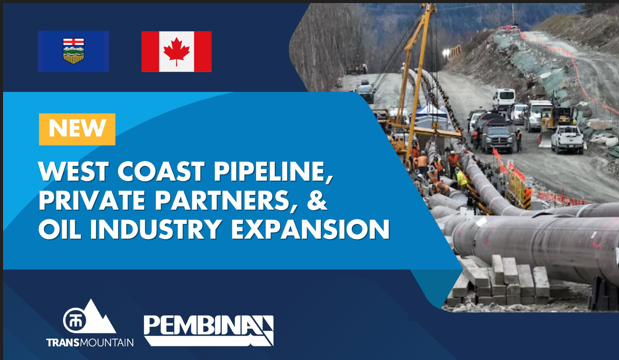
The $35.2 to $43.7 billion B.C.-Alberta West Coast Oil Pipeline (WCOP) proposal bringing Alberta oil from Bruderheim down the Trans Mountain pipeline corridor to Roberts Bank is fast dividing the construction industry from the environmentalists and leaving others searching for answers.
Construction associations applaud the federal government agreements with both B.C. and Alberta to develop the WCOP, urged a fast-track process but called for continued funding for skills training. The WCOP fast-track request before the Major Project Office (MPO) should be known by Oct. 1 to launch construction in the fall of 2027. Trans Mountain Corporation will be responsible for the WCOP project development, construction and operations.
But, environmental groups raised an outcry from the U.S. San Juan Islands to Ottawa condemning the WCOP build. The Trans Mountain pipeline build and expansion has seen protests from First Nations, environmentalists, climate activists and even the current B.C. NDP government which unsuccessfully launched court action. The Trans Mountain expansions saw dozens of protestors receive jail time for defying court orders
B.C. Premier David Eby has announced he will not take legal action while Alberta Premier Danielle Smith has stated her government will work with Indigenous groups. In Alberta, 23 Indigenous communities will be impacted by the WCOP with 85 Indigenous communities in B.C. identified for engagement, according to the project report submitted to the MPO.
The Musqueam and Tsawwassen First Nations (TFN) have publically commented they want more information on the 1,250-kilometre pipeline that impacts their lands.
TFN executive councilor Valerie Cross said: “We have not been consulted on this proposal. If this project proceeds, we expect to be meaningfully involved from the earliest stages of planning and decision-making.”
The Vancouver Fraser Port Authority, which operates Roberts Bank, said in a statement it has not been involved in the pipeline route discussions. The Bruderheim Receipt Terminal and the Roberts Bank Delivery Terminal would each have 15 tanks, with about 6.5 million barrels of oil storage capacity at each location. The Bruderheim Receipt Terminal will cover about 50 to 60 hectares, and the Roberts Bank Delivery Terminal and Marine Facility will cover about 260 hectares
“We are reviewing the proposal and will take the time to understand its potential conceptual implications and next steps with respect to the Government of Canada’s review process,” the port statement said, adding its focus “remains on delivering Roberts Bank Terminal 2 – a nation-building project that will build new industrial land and a container terminal facility set to add $100 billion in annual trade capacity annually.”
Calling it “good news,” ICBA CEO Chris Gardner said the WCOP steps toward U.S. market diversification. “It is an important focus on getting our energy resources to market and that includes oil from Alberta, LNG from northern B.C. and broader natural resources such as those from mining.”
Gardner said this also signals to the world that Canada is open to supplying energy and resources. In the past, he said, countries such as Japan, Poland and Germany all expressed interest in LNG.
“The new prime minister has shown that we want to talk to them,” he said.
Gardner said B.C. has the skills and labour capacity to carry out the WCOP project plus other major infrastructures outlined in an earlier signed Memorandum of Understanding, which will benefit from federal funding.
The challenge B.C. has faced in the past, he cautions, is delays in “getting the shovels in the ground” as projects need to move faster.
Chris Atchison, British Columbia Construction Association president, called the announcement “encouraging because it demonstrates governments working together on infrastructure that has the potential to strengthen Canada’s economy while creating jobs and opportunities here in B.C.”
Delivering nationally significant infrastructure requires long-term planning, investment certainty and co-ordinated decision-making, he said.
“That collaboration gives industry greater confidence to invest in people, equipment and the capacity needed to deliver major projects.”
The Alberta Construction Association (ACA) also welcomed the news.
“For several years, industry has advocated for greater certainty around major project development and export infrastructure,” said Warren Singh, ACA executive director, adding the project benefits “thousands of construction employers and workers who help build that infrastructure.”
He said the opportunity extends well beyond pipe installation.
“Major projects of this scale create demand for engineering, fabrication, earthworks, concrete, transportation, utilities, buildings, camps, environmental services and ongoing operations infrastructure,” he said.
He warned the workforce still remains the largest long-term constraint and reinforces the need for investment into workforce training, attraction and retention.
Singh urged project “clarity and early engagement” with industry.
“Early market sounding, realistic scheduling and transparent procurement practices help contractors plan labour, equipment and capital investments well in advance,” he said.
Paul de Jong, Progressive Contractors Association of Canada president, said his organization supports the MPO fast-tracking the project through a more streamlined and predictable regulatory process.
He urged the project to be built “cost-effectively, and competitively, with all capable Canadian contractors and skilled workers having a fair opportunity to participate.”
De Jong added: “When procurement is fair and competitive, projects are delivered more effectively, workers and apprentices gain more opportunities, and taxpayers receive stronger value.”
Labour has also chimed in.
“Investments like these are a historic opportunity to build a strong, inclusive workforce with measures like Project Labour Agreements and the involvement of groups like the BC Centre for Women in the Trades,” said BC Federation of Labour president Sussanne Skidmore.
Meanwhile the Green Party of Canada is calling it “a deal from hell” and another intrusion on sea life habit following the port authority go ahead with Terminal 2.
Green Party leader Elizabeth May said: “This project wins big with $10 billion in federal subsidies, all to grease the skids of a climate-killing pipeline.”
As well as May, Bloc Québécois MP Patrick Bonin, and NDP MP Leah Gazan have opposed the project as well as Emilia Belliveau (Environmental Defence), Anne-Céline Guyon (Nature Québec), Anna Johnston (West Coast Environmental Law) and Robb Barnes (Canadian Association of Physicians for the Environment).
The Friends of San Juan have expressed concern of increased track and potential spills.
The complete report submitted to the MPO can be found here.