This is the third and final article pertaining to the latest Construction Death Review (CDR) report, which examines 43 construction-related deaths in Ontario that occurred between 2015 and 2023 and one death that occurred in 1994. The first article gave a broad overview of the report and some of its recommendations. The second outlined the circumstances surrounding the deaths. This article has voices from advisory committee members and Dr. Dirk Huyer, Ontario’s chief coroner.
Michael Attfield – 22 – Electrocuted by a damaged solar panel
“Michael’s death has ripped the hearts of our small family apart. Living without him is challenging each and every day. It is hard to make it through some days without thinking of what he is missing during what should have been his best years of his life. Each day, I still wonder why, how, why him. That is the hardest thing I (Dad) struggle with…we miss him dearly.” – Michael’s father.
Robert Nash Aitchison – 28 – Killed after a bollard struck him
“Nash had tremendous potential that will never be fully realized. He has a nephew who will never have the chance to know his Uncle Nash. While he was not without his faults, he was kind, caring and ready to take on the world. We love him, think of him, and miss him every single day.” – Tracey Aitchison, his mother.
It’s not shall, it’s should.
For the victims and their families to be adequately honoured, Carmine Tiano, director of occupational services with the Provincial Building and Construction Trades Council of Ontario, says the industry needs to band together to implement the recommendations stemming from Ontario’s latest CDR report.
Specifically, the areas of complacency, worker inexperience and overall workplace culture must be addressed.
“Don’t run away from it. Deal with it. A genie is not going to pop out of a bottle and grant you three wishes,” he says. “For this to work, unless the workplace parties make the appropriate lobbying to the WSIB, to the Ministry (of Labour), this report will just become an exercise in looking at deaths. Out of sight, out of mind.”
Tiano was one of the several industry stakeholders who sat on the advisory committee examining themes, patterns and trends that emerged from the fatalities.
The review took roughly nine months and found 42 of the 44 deaths occurred because of interactions with the following five hazards:
- Heavy material or equipment hazard
- Crushing
- Walls, ceilings or trench collapse
- Electrical exposure
- Elemental exposure
The two other workers died many years after an incident from consequences incurred because of an injury.
In all, 14 recommendations were put forth with suggestions for the Ministry of Labour, the Infrastructure Health and Safety Association, Ontario Formwork Association, United Brotherhood of Carpenters and the Labourer’s International Union of North America (LIUNA).
Among them is for all of the above to conduct a review of the compatibility of commonly used formwork systems in Ontario. The review should be completed within 12 months from the date of this recommendation.
“What it means for us specifically, is being the largest construction union involved in formwork, that our training directors, who provide this training, are involved in any industry review to ensure that the best practices are there,” explains Sean McFarling, general counsel for LIUNA, Ontario Provincial District Council and Central and Eastern Canada Organizing Fund.
“We’re dealing with it at the ground level. We need to involve workers who are actually engaged in the process, so it’s not just a theoretical exercise, but it’s the people who do this on a day-to-day basis that are involved in any kind of recommendation that’s going to come forward. How can we prevent the types of fatalities in this industry over the past couple years? It’s having that real-world experience.”
Complacency is human nature
While one of the key findings of the report highlighted complacency as a major issue, creating change will not be easy, the experts noted.
“When people feel safe, they let their guard down. It (complacency) is a really hard thing to battle because you don’t even realize when you’re sliding into it,” explains Andrew Pariser, vice-president of the Residential Construction Council of Ontario.
“You have to make meaningful decisions to change your habits.”
Dr. Huyer echoes his comments, stating reminders, triggers can break the monotony.
“Part of the report is, see what the data shows. Analyze more deeply into those circumstances. It really is difficult to fully answer it,” he says. “How do we get people to think about things? Just a conversation alone will hopefully get people thinking about it.
“If you’re starting something new, just take a pause. Just think about where you’re going to go.”
Changing the workplace culture is also critical, states Tiano.
“In a couple of the deaths…the co-workers did indicate that there were some serious concerns in the manner in which the supervision had told them to do the job. The nature of the industry, even in unionized, doesn’t really allow a worker to exercise their rights for fear of blacklisting,” he adds.
He says rather than punitive damages, in cases of multiple offences, a “probationary”-type sentence could be imposed, with the courts following up to see the progress the company has made in instituting proper safety practices.
Third report currently underway
The general consensus is the CDR is more effective than the previous inquest process and is better for the victims’ families.
“Over the course of my 25-year career, I would say most inquests I did were in the seven-year range by the time we got to a decision,” says McFarling.
“Now we focus all of our energy on what are the things we can recommend to actually address this issue. Because we don’t see things in isolation anymore, it allows us to better see patterns.
“Having represented families before, I know how, with the passage of time, re-traumatizing a coroner’s inquest can be. I think not having the jury process reduces that.”
Dr. Huyer says after next year the caseload the coroner’s office had will have been dealt with and work is already underway on next year’s report with information being gathered and briefs being prepared. It will analyze 36 deaths.
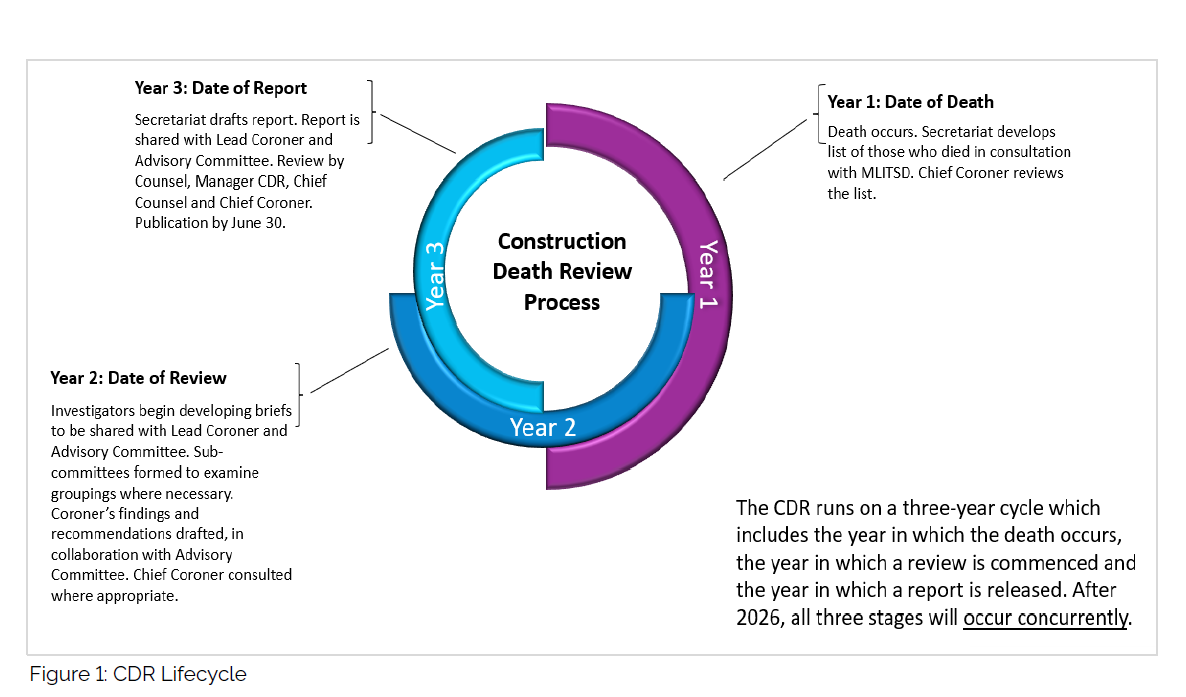
The CDR runs on a three-year cycle, which includes the year the death occurs, the year the review starts and when the report is released. After this year, all three stages will occur concurrently.
One of the main advantages of the CDR is the different voices at the table and potential to evoke broader systemic change.
“People die every year and it’s unacceptable,” says Pariser. “In a good year we lose around 10 people and in a bad year it’s over 20. We need to own up to that. We need to do something about it. The partnership between the coroner’s office and the construction industry is building.
“When we (the industry) all come together and pay attention to something, we generally do a really good job on it.”
“This is high risk work. This is an area of business and ever change,” adds Dr. Huyer.
“Let’s get you home, in a good way, after doing a good day’s work.”