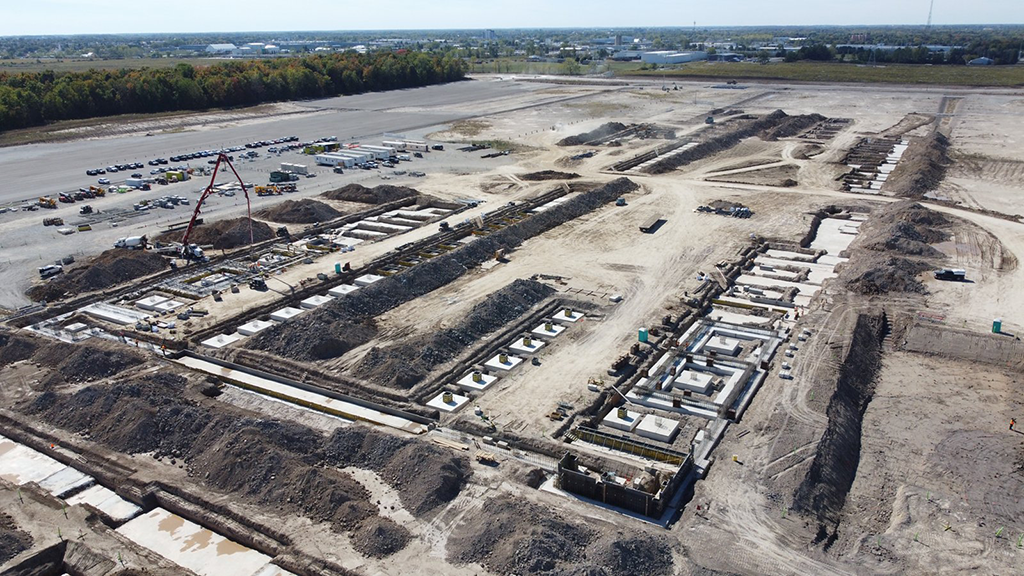
What was once a sprawling swath of farmland in the southeastern part of St. Thomas, Ont. is rapidly being transformed into one of the largest industrial construction projects in Canadian history.
The site will soon be home to a landmark $7-billion EV gigafactory being erected by PowerCo. It’ll be Canada’s largest EV battery plant, and the company’s first battery-cell factory outside Europe.
Today, the visible transformation of the site is becoming increasingly apparent. Foundation accelerated through late 2025 and the project is well into vertical construction. Crews are erecting massive steel columns, beams and trusses for the battery-cell production building and other structures.
Frank Blome, CEO of PowerCo SE, said in a statement the goal of the company is to build a global battery champion with a strong footprint in Europe and North America.
At 1.5-million-square-feet, the plant will be the size of 210 football fields just for the factory alone. The entire industrial park itself amounts to 1,500 acres, or an area of 850 football fields.
Hundreds of tradespeople are now onsite. When complete, the gigafactory will consist of six production blocks.
The volume of construction materials highlights the project’s extraordinary scale. Magil Construction Canada is leading foundation construction for three major buildings totalling 850,000 square feet. The foundation package alone includes more than 500,000 square feet of formwork, more than 32,000 cubic metres of concrete and 4,850 metric tonnes of reinforcing steel.
To put those numbers in perspective, the concrete volume is roughly equivalent to filling about 13 Olympic-sized swimming pools. The rebar package ranks among the largest publicly reported reinforcing-steel installations for an industrial project in southwestern Ontario.
Canadian contractor Steelcon Group of Companies is fabricating and erecting structural steel components, including columns, beams and roof trusses. More than 500 Steelcon employees are supporting fabrication and erection activities.
The work requires careful sequencing. Concrete crews establish the foundation systems and structural bases, after which steel erectors raise the building skeletons. Eventually, exterior cladding, roofing systems, mechanical and electrical infrastructure, utilities and sophisticated battery-manufacturing equipment will be installed before production can begin.
The gigafactory is the result of a landmark agreement announced in April 2023 between Volkswagen Group which is Europe’s largest automaker, PowerCo and the federal, provincial and municipal governments. PowerCo was founded by Volkswagen in 2022 with a vision to lead the charge in battery cell production on a global scale.
Land clearing and site preparation were completed in 2024, followed by the awarding of key construction contracts in 2025.
Once complete, the St. Thomas gigafactorySt. Thomas Battery Cell Manufacturing Plant – EV Battery PlantStatusUnder ConstructionValue$7BLocation800 Talbot St, St Thomas ONSectorPrivateTypeManufacturing · New ConstructionData as of July 24, 2026View Project Page → will bring PowerCo’s advanced Unified Cell battery technology to Canada.
The plant is expected to eventually produce up to 90 gigawatt-hours of battery cells annually – enough to power approximately one million electric vehicles each year.
Although major progress has been achieved, significant work remains.
Construction crews must complete the structural frameworks for multiple production buildings and supporting facilities across the site. Mechanical, electrical and process systems will then need to be installed, followed by commissioning and testing of battery-production equipment. Workforce recruitment and training must also continue as the facility prepares for operations.
Ultimately, the plant is expected to employ up to 3,000 workers directly, with as many as 30,000 indirect jobs supported through suppliers, logistics companies and other businesses across southwestern Ontario.
Hiring is already underway, with more than 200 employees on board by early 2026.
According to PowerCo, the project continues to advance as planned, with initial battery production targeted for 2027.
Like many projects of such magnitude, there have been challenges.
One of the most significant has been building through difficult winter conditions. Steel erection and structural work progressed during periods of challenging weather, requiring careful planning and co-ordination among contractors. Despite those conditions, crews successfully erected the first major steel structures and maintained construction momentum.
Another has been the complexity of the foundation package itself. Co-ordinating the placement of tens of thousands of cubic metres of concrete and thousands of tonnes of reinforcing steel across three major buildings has required extensive logistics planning, scheduling and quality control.
The project has also required the mobilization of a large skilled-trades workforce and the parallel development of supporting infrastructure to service the expansive site. Road improvements near Highway 3, utility upgrades and transportation enhancements are being undertaken to accommodate both construction activity and long-term operations at the plant.
The Volkswagen Group has plans to introduce more than 25 new EV models by 2030. Beyond producing batteries for Volkswagen’s next generation of electric vehicles, the project is expected to stimulate growth throughout the London-St. Thomas region and anchor a broader EV supply chain in southwestern Ontario, attracting suppliers of battery materials, components, logistics, and advanced manufacturing.