Montreal’s downtown arts centre, Place des Arts, an imposing multi-building complex that was one of several structures that defined the city’s massive urban reconstruction in the 1960s, is partly undergoing a facelift.
The complex is made up of two legacy buildings – Salle Wilfred-Pelletier, a convex colonnaded building that opened in 1963 bordering the site’s north side and the Theatre Building comprising three theatres on the east side, opening in time for the Expo 67 world fair. Both frame a giant outdoor esplanade where the public often gathers for public events or to walk, sit and enjoy the outdoors.
Moreover, the complex, designed by David, Barott and Boulva, is a grand example of the “expressive and unapologetic” use of concrete, Place des Arts said in a statement.
“It is now considered one of the most significant works of Brutalist architecture in Montréal’s architectural heritage, known for being one of the first buildings in Québec to feature an exterior concrete cladding.”
And it described those cladding’s ribbed panels as “exceptionally refined.”
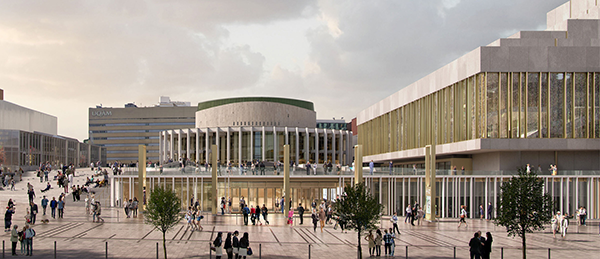
It is the Theatre Building that is undergoing the $134 million rehab that began in April to be completed by summer 2028. The arts centre is partnering with Quebec Crown corporation, Société québécoise des infrastructures.
Unlike Salle Wilfred Pelletier, this building is rectangular in shape but distinguished by a roof of stacked concrete slabs looking like a mountain. These are among the more than 650 exterior panels that are being removed and replaced.
Place des Arts said inspections initially carried out in 2018, followed by in-depth study and planning approvals, found “an advanced state of deterioration in these cladding panels, combined with corrosion of their anchoring system.”
The rehabilitation’s goals are public safety, long-term building preservation and to “renew the façade with durable materials” that are energy efficient.
But the rehabilitation will also see the building having greater access to the public esplanade with multi-door glazed entranceways as well as to neighbouring Sainte-Catherine Street on the south side. This to “create a stronger connection to the street and enhance integration with the Esplanade, creating a brighter and more versatile public space.”
The Sainte-Catherine entrance was built just 15 years ago, creating an architecturally dynamic street portal where there had been no entrance previously.
According to the city’s planning advisory committee, the new entrance “will be transformed by the removal of the triangular entrance building, making way for a linear glazed basilica.”
Place des Arts did not provide anyone for comment.
In a statement, president and CEO Marie-Josée Desrochers said, “Our goal is to complete the work by summer 2028 and restore full public access to our esplanade as well as to a Theatre Building renewed with a new façade.”
However, McGill University architecture professor Avi Friedman said the rehab in part “unfortunately (is) to repair errors that were made in the past.”
This was due to lack of public and street integration “to make the buildings fit into the urban context.”
Also, Place des Arts now adjoins a greater open-air entertainment space known as Quartier des Spectacles.
Said Friedman, “This is where you host your guests and so it has to be designed much better.”
He also said the new Sainte-Catherine entrance will dovetail with the street’s recent rehabilitation creating a greater pedestrian promenade.
“So, the idea of linking or connecting those buildings to the street easily is part of the master plan or the mindset.”
Heritage Montreal, a civic group that advocates for the city’s architectural and cultural heritage, made a few points.
In a statement it said the “architectural and urban context” should have been considered more.
As for the street entrance, it said it has “no particular attachment to it one way or the other” but questioned “demolition barely 15 years after it was built, following a design process that received considerable attention at the time.”
The group questioned if this was a “deeply rooted habit of valuing novelty at the expense of relevance longevity” and hoped Montreal “will not become…a city of ‘fast design.’”