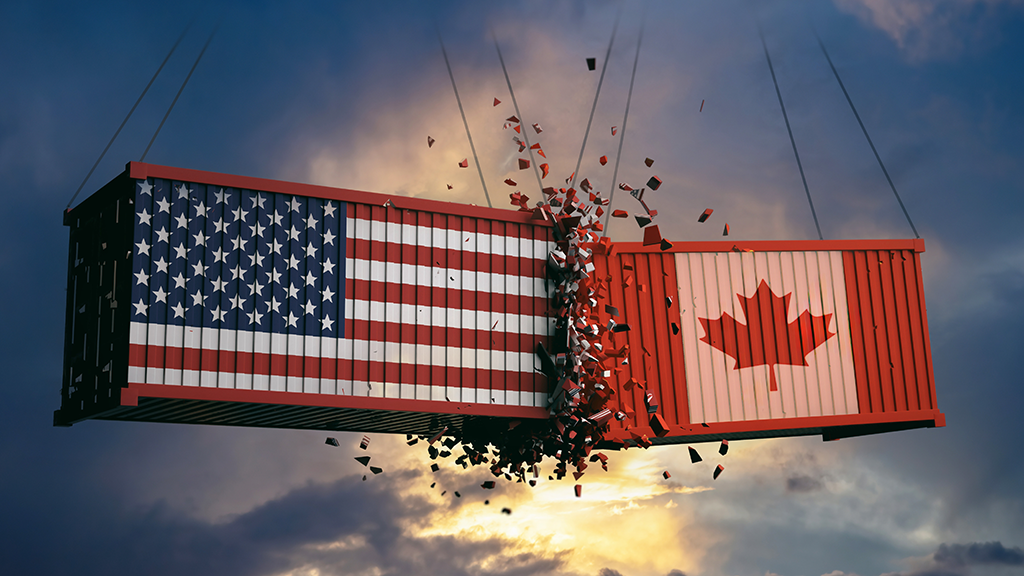
OTTAWA – The federal government is set to unveil details of Canada’s retaliatory tariffs against the United States on Tuesday.
Finance Minister François-Philippe Champagne, Industry Minister Mélanie Joly, Jobs Minister Patty Hajdu and Artificial Intelligence Minister Evan Solomon are also expected to share details of supports for workers affected by tariffs.
Solomon is also the minister responsible for the Federal Economic Development Agency for Southern Ontario.
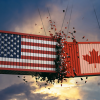
Communities on both sides of the Canada-U.S. border have been affected by the ongoing trade war.
Prime Minister Mark Carney said on Saturday that retaliation in the form of dollar-for-dollar tariffs would kick in on Sept. 8. He said Monday that discussions were ongoing about exactly how Canada will hit back.
The prime minister is not expected at the announcement, as his itinerary says he will not attend any public events Tuesday.
Carney suspended trade talks with the United States late Friday, accusing the U.S. of trying to introduce last-minute demands that would limit Canada’s ability to make trade deals with other countries and protect its culture and sovereignty.
The U.S. introduced a new round of 50 per cent tariffs on Canadian exports on Saturday, targeting goods worth $28 billion.
Canada will go back to the negotiating table on a trade deal once the United States changes its attitude and stops treating Canada as a subsidiary, Carney also said on Monday.
Carney held a news conference in Lévis, Que., where he announced an $11-billion contract to build six new icebreakers for the Canadian Coast Guard, emphasizing they would be built with Canadian steel.
“When the Americans go to the negotiation table first, with the right attitude toward our industries and a true partnership, of course we’ll come to the negotiating table,” Carney told reporters.
“An attitude at the negotiation table that Canada is a subsidiary of the United States, that Canadian industry is going to be disadvantaged relative to American industry, that we are going to set up terms so that over time Canadian industry is going to face constant headwinds, that’s not something we’re going to accept.
“And that’s before you get to constraints on our ability to do what the rest of the world wants, which is to sign trade deals with Canada. And that’s before the fundamental issues on culture.”
Before Carney spoke, U.S. President Donald Trump escalated the war, at least with words, this time posting a threat on social media to hike tariffs on all vehicles, auto parts and steel from Canada to 50 per cent on Jan. 1. He made a second post threatening Canadian energy flowing through the United States.
“Remember, much of the Electricity, Oil, and Gas that Canada gets is transported through the U.S.A. Someone should get these clowns to ‘fall in line’ or, the consequences for Canada will be far WORSE!” Trump posted.
Trump also reiterated previous accusations that Canada has been “ripping” the U.S. off for years, and repeated his insistence that the U.S. does not need anything from Canada.
“They feel entitled, and yet, WE DON’T NEED CANADA, THEY NEED US!” Trump posted.
Canada is the largest source of energy imported by the U.S., and supplies about 90 per cent of the potash it uses in agricultural fertilizers and as much as one-third of the uranium used by American nuclear power plants.
Trump also claimed Canada is reliant on the U.S. for 95 per cent of its exports, but Canadian data shows that in 2025, Canadian exports to the United States represented 72 per cent of all exports that year. That was down four percentage points from the year before.
In the first six months of 2026, that number fell further to 68 per cent, while non-U.S. exports rose as Canada moved to diversify its trade away from its largest trading partner south of the border.
Some of Trump’s second tirade was prompted by Ontario Premier Doug Ford, who earlier in the day told an Ontario radio talk show program that Trump could “kiss my ass” and said Ontario should leverage energy and critical minerals in trade negotiations.
The new threatened tariffs — which have not been enacted in any official order — would come well after the U.S. midterm elections in November in which Trump and the Republicans are at risk of losing control of both the House of Representatives and the Senate.
Flavio Volpe, president of the Automotive Parts Manufacturers’ Association of Canada, also said the new threat of tariffs on auto parts isn’t going to get very far.
“We’ve been over this. The ‘importer of record’ pays the tariffs,” he said in a post on X. “A threatened U.S. tariff on Canadian auto parts will be paid by U.S. auto assembly. Without those specific parts, auto assembly throughout the U.S. would halt. U.S. auto assembly will be on the phone to the (White House) today.”
The new tariffs that took effect Saturday affect dozens, if not hundreds, of small businesses, ranging from honey makers to hockey stick manufacturers to flower bulb growers.
On Aug. 18, just ahead of the first deadline for those tariffs to take effect, Trump said the two sides had come to a “deal” and he was pausing the tariffs pending getting that deal into writing. But by Friday, Carney suspended the talks and summoned his negotiators home, saying the U.S. had made unreasonable demands, and changed the terms of the agreement.
Opposition leaders in Canada pushed Carney to provide more information about the deal that fell apart.
Conservative Leader Pierre Poilievre asked Carney to reconvene Parliament to get details and Bloc Québécois Leader Yves-François Blanchet asked Carney to consult with other party leaders about it.
Poilievre, in a letter to Carney on Sunday, said it’s time for the prime minister to release the text of the deal because “Canadians must see it to judge what options are on the table.”
He also said Canadians need to know how much Carney’s trade and economic policies will cost them in higher groceries, gas and other prices.
Blanchet said Monday that Canada could retaliate by suspending the purchase of F-35 fighter jets from the U.S. and restoring a digital services tax on big tech companies that Carney agreed to cancel last year.
©2026 The Canadian Press