This month Cape Breton University (CBU) welcomed its second cohort of 30 students to its new $59.8 million medical school.
The striking three-storey building was designed by Perkins&Will’s Toronto office along with Sydney-based Trifos Design Consultants. Locally Joneljim Concrete Construction Ltd. headed up the contract work.
The building’s concept is an open glass feature with wood and beige accents to allow natural light while showcasing a signature staircase.
Functionally, the spaces create a collaborative teaching environment aided by high tech and multiple screens to access remote lectures given by Halifax’s Dalhousie University and its other satellite school in St. John, N.B. In fact, all three campuses will take turns disseminating lectures.
The long-sought school was built to assist Cape Breton having a shortage of doctors.
“The biggest focus in getting this school built was to try and have a focus on rural family medicine,” CBU building manager Colin Macdonald said.
At the Halifax campus, for example, students “typically want to stay where they graduated and none of them were taking their practices into rural areas.”
Construction began in December 2024 with design keeping pace as construction went along, Macdonald said.
In the design, most of the teaching modules, packed with “over the top” tech elements, are on the second floor, he said.
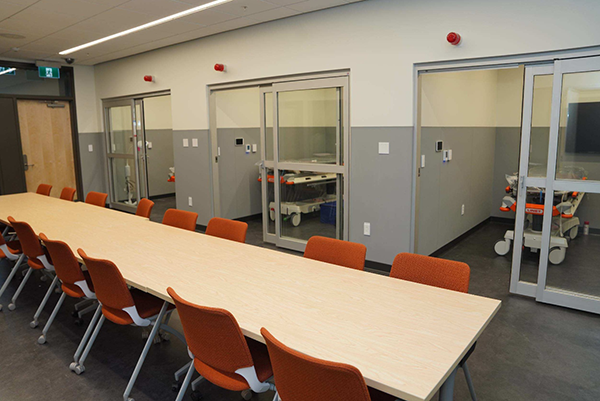
The simulated patient suites are located there, where “our students would have to go through all the steps that they would if they were a practicing doctor.”
Then there are the “high-fidelity” suites for specific clinical skills as opposed to diagnostic.
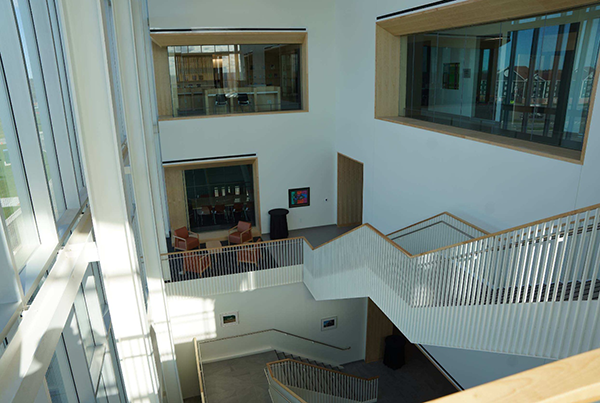
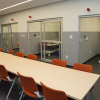
The design also allows breakout sessions after individual tutorials. And there is two-way glass for a master observational control room “so the supervisor physician can watch what students are doing and instruct how they can do it better,” he said.
Macdonald believes the building compares equally to any contemporary teaching facility in North America.
“The level of technology in this place is wild,” he said. “I think we’ve got more data cable running through the walls than we do steel studs.”
The tech is important as all three Dalhousie campuses can now share teaching – ideal for a satellite campus where experts are in short supply.
“It’s pretty difficult to get people in to doing medical teaching practicums as doctors,” he said. “So this reduces the teaching burden as well where you can have just one professor presenting to the three different campuses.”
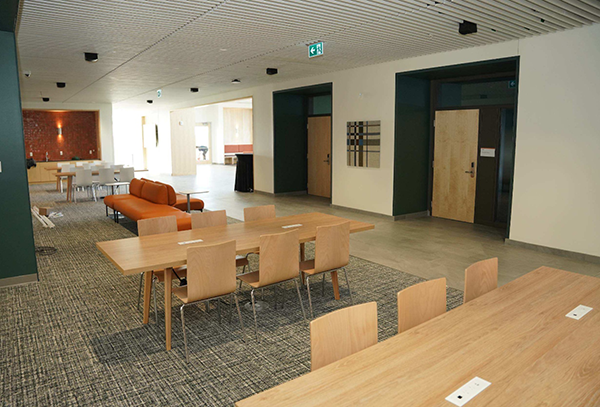
Other components on three floors include standard classrooms as well as collaborative discussion spaces and lounges. The accent is on an open atmosphere inviting engagement.
Finishes otherwise would be “pretty similar to a typical hospital room,” he said.
There were a few challenges in getting the school up and running.
“Once we got funding announced it was ‘OK – go go go, get this ready for the first cohort of students,’” Macdonald said.
But he doesn’t “think it was a realistic timeline” due to a skilled trades shortage mainly from a construction boom in Cape Breton.
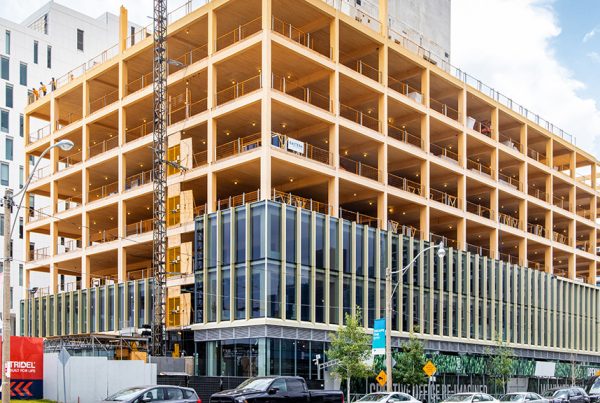
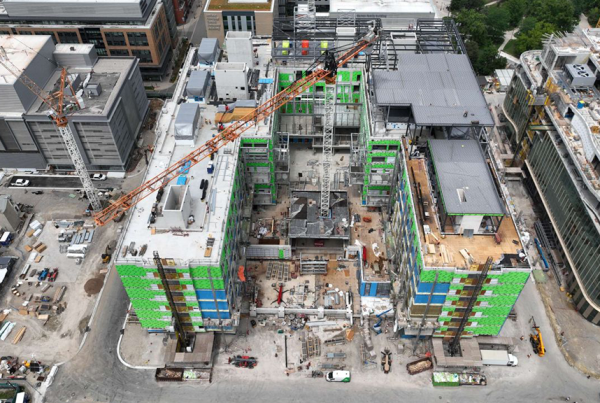
“I’ve never even seen tower cranes on the island before and we’ve got them scattered all over the place now,” he said.
The includes expansion of the Cape Breton Regional Hospital and the Nova Scotia Community College’s new waterfront campus in downtown Sydney.
“And there’s really a lot of housing development going up and other things,” Macdonald said. “It’s interesting to see in Cape Breton, the population went up for the first time since the ‘60s.”
Meanwhile, he said, there’s “still a limited amount of trade resources on the island. I’m hoping we get a lot more training but the union halls are empty right now. Everyone who can work is working.”