The Confederation Centre of the Arts (CCoA) in Charlottetown, P.E.I. is getting “a major life-cycle renewal,” including features to refresh its appearance without taking away from the 61-year-old building’s original architectural attributes.
When completed next year, the $67 million renovation to the centre, recognized as a National Historic Site of Canada, will contain a transformed library, a new theatre rehearsal space with mass timber components, a rooftop photo voltaic system and barrier-free access.
“The clients realized that they could turn from what was an introverted building to something that felt more welcoming,” says Alec Brown, principal at Abbott Brown Architects, the Halifax design firm leading the design.
“They want to upgrade the building to represent a new kind of transparency, openness and inclusivity.”
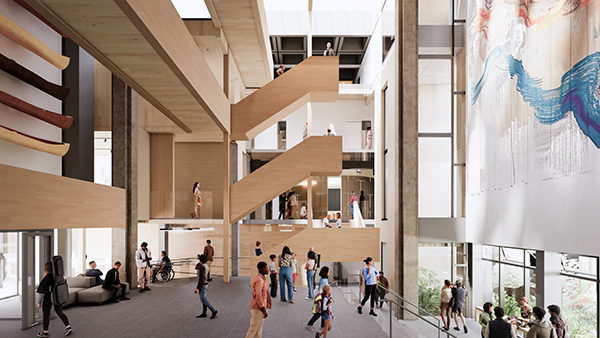
Built in the 1960s in the Brutalist architectural style, the largely windowless centre will add feature panels of glazing for improved natural lighting into the middle areas of the centre. Cross-laminated timber (CLT) and glulam details throughout will refresh the interior.
Retaining the “overall composition” of the centre has been critical to design success, Brown says, noting that “new interstitial zones of mass timber and glass” rising above the original three-level complex will be placed between original sandstone panels.
The “insert” additions on either side of the revamped entrance will be comprised of CLT for floor, wall and roof panels while glulam specified for beams, columns and even the elevator shaft, he says.
The new free-standing rehearsal hall built on one of the existing terraces will be clad in terra-cotta and glass and feature lightweight CLT floors and roof panels supported by glulam columns.
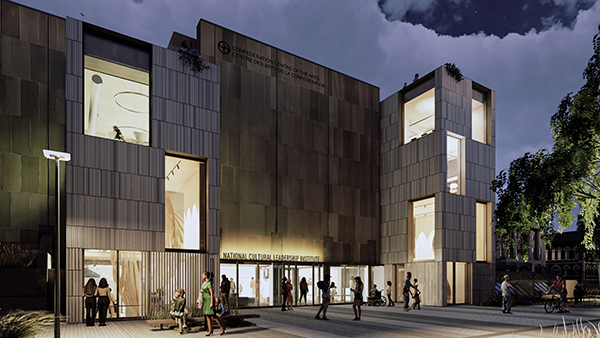
Chosen over conventional steel, mass timber meets the project’s goal of achieving a net-zero emissions certification, says Brown, adding the new rehearsal space doesn’t require additional foundation support over the terrace because of its light weight.
The use of mass timber “feels like a good counterpoint to the existing structure.”
One of the construction challenges on the project, set for completion in 2026, involves selective removal of Levels 2 and 3 of the library pavilion to introduce a light-filled atrium. Sixty-foot-long exposed glulam bridges and CLT structural elements will weave through the existing floors of the pavilion, introducing a barrier-free access route.
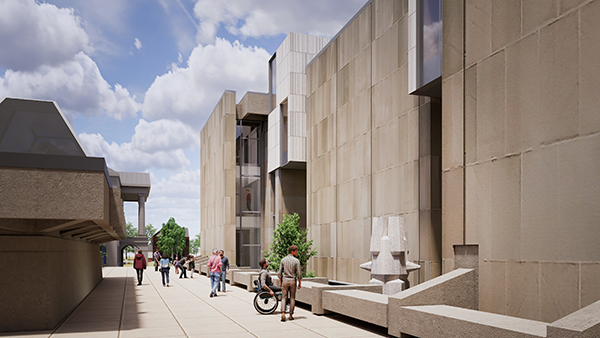
The art gallery will remain open and performances in the theatre will continue throughout the project so co-ordination of trades work by construction manager Brighton Construction Inc. is paramount to minimize disruptions, Brown says.
Based on the lack of detailed structural information in the original 1960s engineering drawings, the design team’s strategy has been a cautious one where additional loading has been under consideration.
Additional loading on the existing three-storey flat roofs, which are held up at the four corners by 36-foot spans, has been prohibited, the architect says.
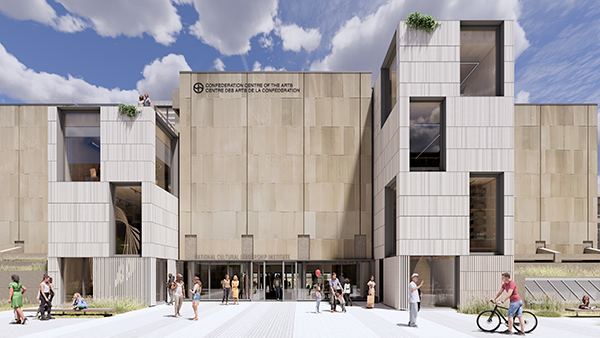
“The new additions (insertions) rise up a storey in between them (roofs) and reach down and touch them but are not supported on them.”
The additions feature glazing near their peaks to spread light deeper into the building.
One of the architectural firm’s “more important projects,” Brown says, the centre was the first building of a series of public infrastructure projects across Canada to commemorate confederation.
The new design won a 2024 Canadian Architect Award of Excellence (for unbuilt projects) for the preservation of the original design while incorporating sustainable materials and green elements for a passive certification.