
By Leigh Ann Schwarzkopf
It can be easy to dismiss licensing as a distraction, and unworthy of the resources required to engage with it, or to believe that licensing is only for big companies. In reality, nothing could be further from the truth.
Licensing has a proven track record of enhanced sales performance, profits, and perception for brand owners, manufacturers, and retailers in the home décor category and at every price point. When wielded correctly, licensing can also act as a catalyst to gain market share.
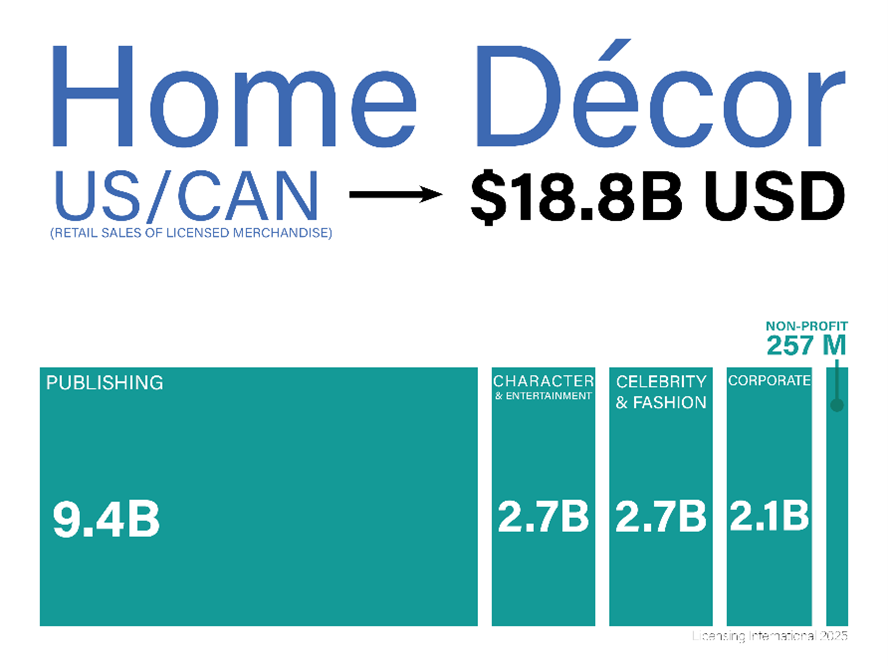
In the US/Canada region last year, for example, retail sales of licensed home décor items rang up to $19 billion. This is according to the latest 2025 Global Licensing Industry Study produced by Licensing International. $19 billion is a formidable number, on par with the profit earnings made by Visa or Walmart or Wells Fargo in 2024.
Global sales of licensed merchandise and services hit $369.6B in 2024. In the same year, the portion of licensed home décor products in the US/Canada region rose three percentage points, a $200 million gain from prior year.
Trending Licenses
According to the Licensing International annual study (now in its 10th year), overall incremental growth is the norm. What does ebb and flow is the genre of leading licensors, propelled by market preferences and trends.
Globally, character and entertainment intellectual properties lead the way. However, when it comes to home décor in the US/Canada, publishing titles – think shelter magazines – have long dominated. In 2024, the genre of corporate trademarks, especially beloved food brands, was so successful that it was in the top three categories, along with characters and entertainment.
In 2024, growth is burgeoning from multiple types of properties, including the growing non-profit realm. Several museums are using licensing to enter home décor categories such as tabletop, bed linens, textiles, and furniture. Nearly $279M globally and $257M in the US/Canada of non-profit licensed merchandise was sold in 2024. In addition, celebrity and fashion brands account for $3.8B globally and $2.6B in the US/Canada.
Analysts and syndicated data suggest the next wave of home-sprucing season is upon us. That’s because consumers are tiring of the looks and trends they enthusiastically welcomed into their home five years ago. Recent Circana research indicates consumers are seeking ways to refresh their homes. At the same time, trendologists and consumer data firms are noticing a spike of interest in licensed products.
How to Engage with Licensing
For the unfamiliar, to understand how licensing can benefit each type of stakeholder, start with the basics of who’s who.
The owner of a trademark or brand is known as the licensor. A licensor may wish to expand their brand into a category outside its expertise. One way to tackle an unfamiliar category is to seek a well-regarded manufacturing partner in the desired category. The manufacturer partner is known as a licensee.
According to the licensing agreement, the trademark owner (licensor) gives a manufacturer (licensee) permission to use the licensor’s trademark on product the licensee makes. The licensor receives a royalty, or a percentage of wholesale dollars, from the licensee.
If you identify with either of these titles (licensor or licensee), then licensing is already on your radar or in your tool kit – congratulations! Devote your energy to identifying the right product mix and determining how to best maximize the opportunity. You can leverage internal or external expertise to minimize risk.
If licensing is not already part of your strategy, it’s not too late to benefit from it.
Begin by conducting a market audit of your category and adjacent spaces. Learn what appeals to your stakeholders and customers. Talk to people in the industry within your network and find an expert that can help you figure out if licensing is for you, how to mitigate risk and how to leverage it to achieve your goals.
You can engage a licensing consultant to guide your journey and support you through everything from identifying the best properties for your business to negotiating contracts (full transparency: Project Partners Network has specialized in licensing support for over 20 years). A good consultant can be found through networking, at trade shows and through contact with the industry trade association, Licensing International.
Regardless of the method you select, remember that your goals for licensing can include buzz/relevance, as well as financial gain.
Benefits
In simple terms, licensing can benefit all parts of the retail continuum. A licensor gets increased brand awareness (for example, exposure in another store aisle) without spending the time and expense to build the infrastructure required to produce goods outside its bailiwick. A licensee gets access to “rent” an established brand or character that has a built-in fanbase.
Done correctly, the right licensing partnership helps two companies gain sales and customer reach faster and with less risk than working alone. Additionally, as we’ve all seen through so many wonderful collaborations across all categories and genres, people are looking for joy and fun throughout their days, and many licensed collaborations provide buzz and relevance while helping in that quest.
Of course, there are many ways to grow your business and strengthen your relationships with trading partners and shoppers. But do they all have $19B in sales potential, as licensing has already shown it can deliver? The numbers suggest that you can’t afford to exclude licensing from your next strategic plan.
Leigh Ann Schwarzkopf is principal of Project Partners Network.